WV data czar recognizes need to improve public communications over data center developments, HB 2014
May 19, 2026 | 5:55 pm ET
Description
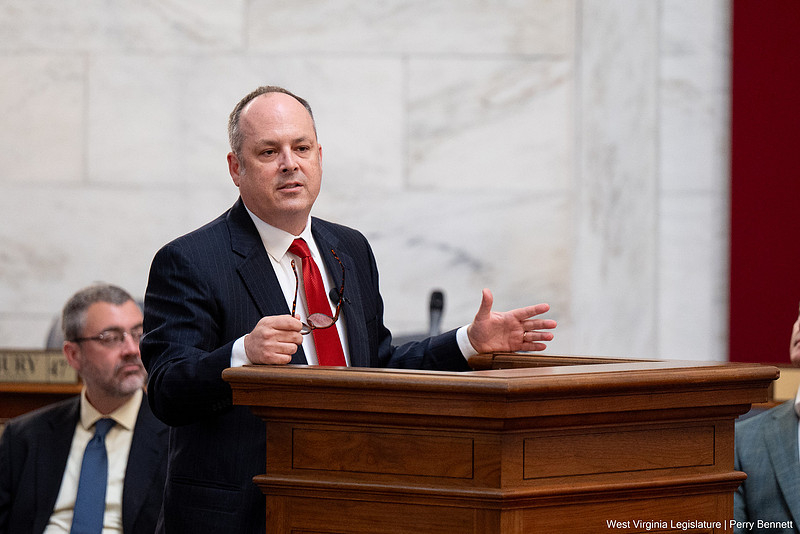
Chris Morris, head of the state’s Energy Economy Office, addresses lawmakers on the House Environment, Infrastructure and Technology and the Economic Development subcommittee in the House Chamber in Charleston, West Virginia, on Tuesday, May 19. (Photo by Perry Bennett/West Virginia Legislative Photography)
As data center developments continue to spark unrest in communities where they’re proposed, Chris Morris, the director of the state’s Data Economy Office, acknowledged Tuesday that communication regarding developments to community members could be improved.
Morris spent Tuesday morning speaking to members of the House Subcommittee on Environment, Infrastructure and Technology during informal House-only meetings held on Monday and Tuesday. Data center developments dominated several of the sessions over the two days, with Morris taking the podium Tuesday to explain the process behind certification and what information is considered by the Department of Commerce before a project is certified.
To date, only two data center projects in the state — one by Google in Putnam County, and one in Berkeley County, where real estate developer Penzance is developing a data center for a yet-to-be-announced end user — have been certified as “High Impact Data Centers” under House Bill 2014.
Several other projects — in Tucker, Mason and Mingo counties — are being pursued by developers, but have yet to garner state approval, Morris said.
In those counties and beyond, residents have spent the last year attempting to organize against the developments and push for more information regarding how they could impact their ways of life. They want local control returned to ensure developers operate as good neighbors, and they want assurances that the developments won’t harm the environment, tourism economies or public health.
To date, they’ve had little luck in their pursuits for more transparency and answers from either developers or the state Legislature.
Since being named as the state’s data center czar last year, Morris said he’s tried to meet with members of the public, as long as they’re respectful, to answer questions about proposed projects and hear concerns. For the most part, he said, those have been fruitful conversations.
But he also understands that mistakes have been made regarding communications that are complicating the state’s data center-oriented goals.
Del. Jim Butler, R-Mason, told Morris during Tuesday’s meeting that the state “really needs to do better with public relations” regarding the developments.
“For the past two years probably, I’ve been asking for public meetings for people in the neighborhood to find out what’s going on. (Developers) have had a really good reason as to why they (weren’t) ready to do that … (but) we still have not had public meetings,” Butler said. “There are questions we, as legislators, cannot answer … we need to maybe push (developers) a little bit.”
Morris said he agreed.
“The point is well taken. I’ll fall on the sword and tell you, when you’re running around and have 100 top priorities, one of the things that gets pushed aside is communications,” Morris said. “I can tell you right now, I recognize that is lacking.”
He believes the pushback over some concerns that have been shared by the public, he said in an interview following the meeting, “could have been avoided with better communication.” He specifically referenced Tucker and Mingo counties, where pushback has been strong but where developers have yet to apply for certification from the state while also avoiding conversations with locals who hold valid concerns.
He said that in Putnam and Berkeley counties, pushback still certainly exists but there has been better reception for the projects overall. He credits that with the increased communication between developers — who are more experienced in these sorts of projects compared to those attempting to build in Tucker and Mingo — and community leaders.
And in the background, Morris said, the state’s Data Economy Office has been attempting to “weed out” developers who are “not very legitimate” players and only bring in companies that will invest in communities and follow the law.
“We’ve certainly denied more than we’ve approved, and that does say something to me. We’re taking these (applications) seriously. We’re not going to just hand out designations,” Morris said. “We’ve had all kinds of people approach us, some very legitimate, some not very legitimate at all. And so I very much view it as my role and responsibility to weed out and make sure that we’re bringing in companies that are going to come in, invest in communities, and abide by the rules.”
Morris said the Data Economy Office and state Commerce have plans to show more of this work in action for both public education and relations.
This week, he said, their websites will be posting information on data centers generally and details — those that can be made public under existing rules — on projects that have been certified. In the future, he said, he wants a ready-made list of communities that have raised their hands in support of data centers, so companies aren’t dropping projects into places that don’t want them.
“We want to build an opportunity for local folks to say, ‘We’ve identified sites that make sense for us, from our perspective,’” Morris said.
In general, Morris said, the companies that are officially working through the state — Google and Penzance — have made good-faith efforts to connect with local communities about their projects and answer the questions they can. They’ve agreed to be voluntarily reviewed by local governments, even as the law doesn’t require that. He believes they’re committed to minimizing potential environmental hazards, like water waste and pollution.
To Morris, that’s a sign that these companies want to be invested not just in data centers, but the communities surrounding them.
“Those are the projects we want, and that’s what I personally want as a West Virginian,” Morris said. “I’ve lived in West Virginia my entire life. I will live here probably for the rest of my life. I take this responsibility very seriously and I want to do right by this state and our people in this work.”
And overall, he said, he knows that HB 2014 is not a perfect law. He said that while it’s still early in the implementation, there will likely need to be tweaks in coming years to ensure that communities and the state as a whole are getting a fair shake and considering all potential ramifications from it.
“Let’s not kid ourselves, we can always do things better. I don’t know what those things are, specifically, right now, but I think that certainly that’s something we can look at in the future,” Morris said. “Right now I’m just trying to set up a process that abides by the guidance provided through the law and the regulations, and then certainly if there’s ways to better that, that’s something that I would then work (on) and make recommendations for.”
- 9:08 pmThis story was updated to correct what lawmaker asked a question during Tuesday's House meeting.
Charleston, WV