Duggan drops independent bid for governor, remapping 2026 Michigan gubernatorial landscape
May 21, 2026 | 11:47 am ET
Description
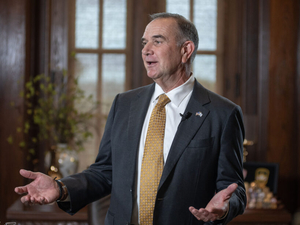
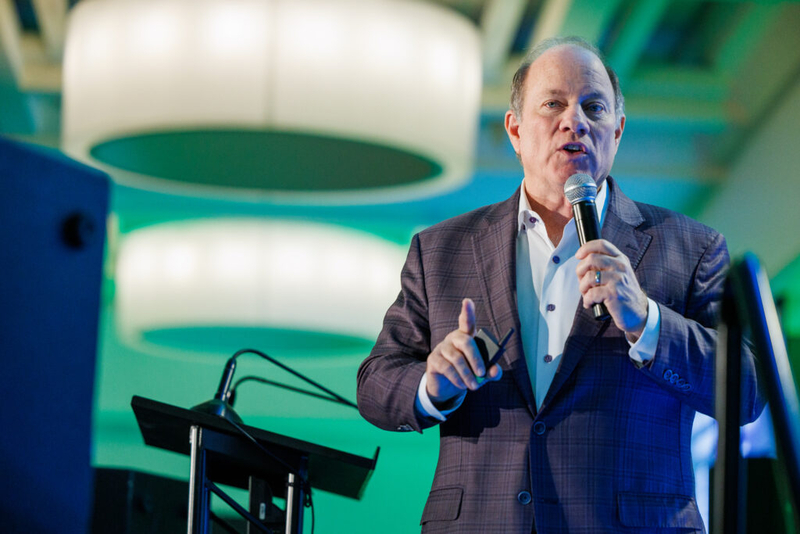
Detroit Mayor Mike Duggan speaks to the Lansing Economic Club during an event in East Lansing, Mich., on Feb. 6, 2025. (Photo by Andrew Roth/Michigan Advance)
Former Detroit Mayor Mike Duggan, betting on frustrations from both Republicans and Democrats over the two-party duopoly, cast aside his former Democratic Party credentials to embark on an intriguing albeit quixotic independent bid for governor in 2026.
Thursday, he abruptly ended that campaign.
Duggan’s press team announced that he would drop out of the race with an open letter from the former mayor to Michigan and his supporters.
“I am so disappointed to have to write you this letter,” Duggan wrote in a news release issued Thursday. “For the last 18 months I’ve worked every day to try to change Michigan’s toxic party politics. I’ve been supported by hundreds of volunteers who believe deeply that years of constant Democratic-Republican conflict in Lansing have led to our schools declining, our housing costs rising, and our young people moving out of Michigan in record numbers.”
Duggan wrote that he knew taking an independent route to the Romney Building, where the governor’s office is housed across the street from the Michigan Capitol, would certainly be a challenge.
“Even against those odds, the excitement for real change carried this campaign upward for more than a year,” Duggan wrote. “In every one of the 5-10 town halls a week I was holding across Michigan, we hosted Democrat, Republican, and Independent neighbors all mixed together in lively and positive discussions. It was a remarkable experience.”
Still, that effort wasn’t enough to break through, especially with the tide turning nationally toward Democratic Party momentum, and away from the Republican Party under President Donald Trump/
“Democrats (and many Independents) were unified in anger as Trump’s war in Iran dragged on and gas prices rose above $5 a gallon,” Duggan wrote. “On May 5, the Democratic State Senate candidate in Saginaw won 60% of the vote in a seat Republicans thought would be very competitive. Against the Democratic headwinds, we worked twice as hard.”
Duggan wrote that his team continued to “pile up huge numbers of union endorsements, once the unions learned that Michigan election law allowed voters to vote both straight ticket Democrat and also vote Duggan as an Independent.”
Again, those factors were not strong enough to justify continuing the race forward, Duggan wrote.
“But for the public in general, our internal polling showed the intense anger over gas prices and Iran was boosting Democrats in every office nationally,” the former mayor said. “The Chamber poll last week showing we’d fallen 11 points behind the Democratic candidate reflects that reality. Being down 11 points in May wouldn’t discourage me – I’ve been down worse than that in the past. But this time it’s compounded by our inability to build serious national fundraising support.”
Duggan noted that his Michigan donors “have been extraordinarily generous in supporting this campaign” and that 94% of his donors come from the Great Lakes state.
The experience running as an independent, however, showed Duggan that “governor’s campaigns are today funded overwhelmingly from well-established networks of national party money, which is why I’ve been all across America meeting with national groups to try to build a competitive fundraising network for Independents.”
That kind of national support did not materialize for his 2026 campaign.
“There is much interest, but we’ve finally concluded the national fundraising for these groups is too much in its infancy to be of great help to our race in 2026,” he said. “As generous as our Michigan donors have been, we will be strongly outspent by the national Republican and Democratic parties this fall.”
All of those dynamics pointed toward Duggan hitting a wall and having no path toward victory in November.
“If we were even in the polls and behind in fundraising, we have a path to winning,” Duggan wrote. “If we were behind in the polls and even in fundraising, we have a path. But we’re behind in both. It’s just not right to ask our volunteers, faith leaders, unions, elected officials and donors to continue in a campaign that, in my heart, I no longer feel good about our chances to win.”
Michigan Democrats weigh in on Duggan’s exit
Michigan Secretary of State Jocelyn Benson, whose gubernatorial campaign may benefit the most from Duggan’s departure, was gracious in her statement following his withdrawal from the race.
“I want to thank Mayor Mike Duggan for what he brought to this race and for his years of service to Detroit,” Benson said. “At a time when politics can feel divided and cynical, we need more civility, more listening, and more people willing to work together to move our state forward. I welcome Mayor Duggan’s ideas, his supporters, and everyone who believes Michigan’s future is bigger than division — and that it can be a place where anyone can afford to live, work, and thrive. We may not always agree on everything, but we share a commitment to building a stronger Michigan. And that work continues in this campaign.”
Michigan Democratic Party Chair Curtis Hertel, who was at odds with Duggan at every turn after he left the party to embark on his independent bid, wished Duggan well and thanked him for his political tenure in Detroit.
“We’re grateful to Mayor Mike Duggan for his service to the city of Detroit and our entire state. While we’ve had disagreements, the Mayor brought crucial ideas to this race and we appreciate his commitment to bringing people together,” Hertel said. “As we look ahead, we welcome Mayor Duggan’s supporters into our growing coalition as we work to elect a Democratic governor this November who will continue to move Michigan forward.”
It’s unclear if Duggan will be a part of that journey with his former Democratic brethren. On his way out the door, Duggan continued to rail against what he called the toxic politics of a two-party duopoly. Still, he was more hopeful than spiteful about the future of the message he brought to his campaign.
“I got into this race to try to change our politics, not to be a spoiler,” Duggan wrote. “I’m still hopeful our campaign will prove to have a real long-term impact. 23% support in the last poll means more than 1.6 million Michigan voters are today looking for a Governor candidate serious about reducing the toxic partisan politics. If the candidates on the ballot this year take that message to heart and truly reach out to those voters, we will have accomplished something important.”
State Sen. Dayna Polehanki (D-Livonia), who has endorsed Benson, told Michigan Advance that she found “it ironic that Mr. Duggan abandoned the Democratic party to run as an independent, in my opinion, because he didn’t think he could beat Jocelyn Benson, and turns out he was right, he can’t beat Jocelyn Benson.”
State Sen. Jeremy Moss (D-Bloomfield Township), also endorsing Benson, said she “is clearly the superior candidate in this race, has a known presence in all 83 counties, has a track record over the last eight years as Secretary of State.”
“I always thought no matter the dynamics, whether it was a two person race or a three person race, she was the best candidate, and she was on the path to winning, but Mike Duggan spent the last year and a half trashing only Democrats, and so it’s hard to make the case for Democrats to leave the party when he spent the last year and a half trashing them, trying to compel them to leave the party.” Moss said. “I think it was a challenging mistake that his campaign decided to make, and so I always thought he was going to kind of be capped at probably about 20%. The latest poll had him even below that, so I don’t know how he could have made a turnaround to have a big tent to win this race when he was really running … in a small lane.”
The dynamic now shifts in the governor race
Benson is the clear frontrunner on the Democratic side of the aisle, but Genesee County Sheriff Chris Swanson is still in the race and fighting hard. Benson and Swanson have not had to attack each other directly on the campaign trail, whereas Benson and Duggan were beginning to take each other head-on, as witnessed during a UAW-sponsored forum on Monday.
Without Duggan in the race, Benson and Swanson’s seemingly cordial races could turn on each other.
For their part, the Republicans in the race — U.S. Rep. John James of Shelby Township, former Attorney General Mike Cox, businessman Perry Johnson and state Senate Minority Leader Aric Nesbitt — have mostly been focused on each other and rarely had Duggan in their sights.
Pastor Ralph Rebandt was running for governor, but the Bureau of Elections on Wednesday issued a staff report to the Board of State Canvassers noting its decision to not recommend Rebandt be placed on the August ballot. The Bureau, after conducting a random sample of his nominating petition signatures, said that Rebandt appeared to have only 12,944 valid signatures. The threshold for ballot access is 15,000.

The prevailing wisdom has been that because Duggan was a former Democrat, he may have eventually pulled more from Benson or Swanson’s pool of voters than the Republican who might be victorious in the August primary.
However, recent polling from the Glengariff Group, commissioned by the Detroit Regional Chamber, which endorsed Duggan early on in the race, noted that Benson had all but consolidated Democratic support in the race. It also noted that Duggan was beginning to potentially hurt the Republican candidates more than the Democrats by eight points.
Duggan had boasted and was proud of the fact that while he was gaining some labor endorsements that typically swing toward Democrats, he also had a fair number of Republican donors whom he said believed in his campaign.
With his path to victory falling apart, and with him now backing out of the race, Michigan will never fully know if an independent Duggan in 2026 would have gone on to exceed expectations or from what party he might have pulled from in a real three-way electoral contest against a Republican and a Democratic candidate.
Moss predicted that it was going to be a good year for the Democrats, and that ultimately, Duggan’s team knew that, too.
“There’s a huge backlash to what Donald Trump is doing. What he’s doing is unpopular, if not dangerous, and so I feel like the winds are at the Democratic Party’s back right now, and so there just really wasn’t a lane to run in when Donald Trump endorses a Republican candidate, whether it’s his primary or after the person becomes the nominee,” Moss said. “I think Democrats are incredibly enthusiastic. Look at the margins of our newest senator and his win. Look at how many people have been out protesting in the streets in these historic No Kings rallies. In terms of attendance, there just wasn’t a lane for an independent.”
Lansing, MI