Gov. Mike Kehoe’s decision on ballot timing could shape Missouri’s 2026 elections
May 21, 2026 | 11:40 am ET
Description
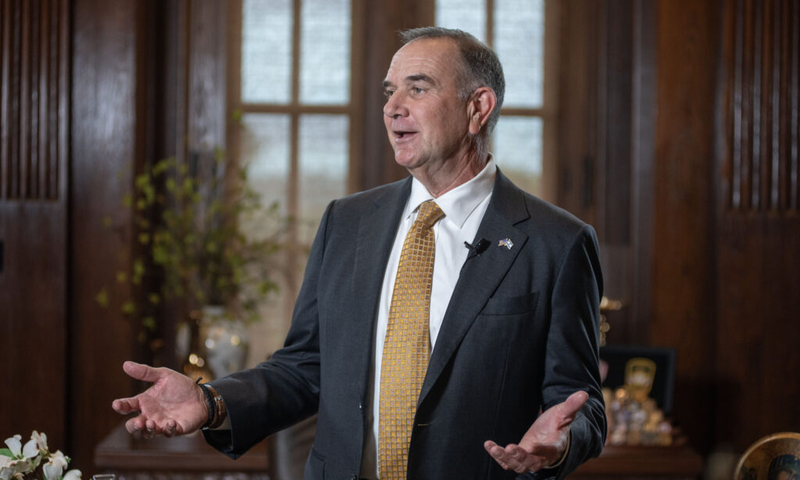
Gov. Mike Kehoe has been asked to decide by Friday which of five constitutional amendments will appear on the Aug. 4 primary ballot. He is shown speaking to reporters in April after signing three bills in his office (Annelise Hanshaw/Missouri Independent).
Gov. Mike Kehoe will soon choose when several proposed constitutional amendments will appear on the statewide ballot, a decision that could affect whether they pass and the turnout in this year’s elections.
Seven constitutional amendments are slated to go before Missouri voters this year, with two more possible ballot measures still awaiting decisions. Five could appear on the August ballot, while the others must wait until November, when ballot measures could compete with — or overshadow — the only statewide candidate race: state auditor.
Four of the measures eligible for August were sent to voters by lawmakers. Those proposals would make abortion illegal; give lawmakers power to expand sales taxes to replace the income tax; change the way majorities are calculated on constitutional amendments proposed by initiative petition; and require direct election of all county assessors.
Kehoe can also put the renewal of a sales tax for state parks and soil conservation on the August ballot.
Because Monday is a holiday and Tuesday is the legal deadline for certifying items for the Aug. 4 ballot, Secretary of State Denny Hoskins has asked Kehoe to make his decisions by Friday, Hoskins’ spokeswoman Anne Marie Moy said in an email Wednesday.
One Republican consultant, John Hancock, said he expects Kehoe to leave the most controversial questions for the November vote. While the primary electorate is more Republican than the general election and potentially more sympathetic to some of the measures, major ballot fights could impact the outcome of candidate races, he said.
Missouri voters could face as many as nine ballot measures in 2026
There will be hard-fought GOP primaries in the 5th and 6th congressional districts, as well as nine state Senate districts. Those primaries are in districts where Democrats traditionally fare poorly.
“August actually determines most of the elected officials in the state,” Hancock said.
Putting controversial questions on the ballot in November, however, will encourage Democrats to tie Republican opponents to unpopular measures on the ballot, said Mark Jones, a spokesman for the Missouri National Education Association.
“There will be a strong reaction of voters to tell politicians ‘no,’” he said.
There are 51 open seats in Missouri House races and 11 in state Senate races. Republicans won 111 of the 163 seats in the Missouri House in 2024 and hold a 24-10 majority in the state Senate, where half of the chamber is elected every two years.
A shift of three seats in the House and two in the state Senate would end the GOP supermajority that has been in place since the 2010 election.
Kehoe’s choice is whether he wants to draw more voters to the primary and create uncertainty or put measures off to November and risk losing seats to Democrats, said Peverill Squire, a retired professor of political science at University of Missouri professor.
“It puts the governor in a little bit of a tough spot,” Squire said. “It is not clear that any of these measures enjoy widespread support.”
Turnout swings
Presidential elections put a national focus on politics and always bring the largest number of people to the polls. More than 3 million people voted in 2020 in Missouri and 2.9 million voted in 2024.
This year in Missouri, the only statewide candidate race is for state auditor. Incumbent Republican Scott Fitzpatrick is expected to easily win renomination in August before facing a Democratic challenger in November.
The last time state auditor was the only statewide contest, in 2014, Democrats did not field a candidate and fewer than 1.3 million people voted in the race. A ballot measure on teacher tenure drew more than 1.4 million votes.
With such a wide spread in potential turnout, and legislative elections that will be fought out on a district-by-district level, a few hundred — or even a few dozen — extra votes could decide whether a swing district elects a Democrat or a Republican.
The combination of issues before voters this year is a distillation of the conservative agenda Republicans have pursued for more than a decade.
“What the Republicans are probably worried about is the extent to which some of these measures might mobilize Democratic voters,” Squire said.
How major ballot measures impact turnout is clear for primary elections, but not for general elections.
In most primary elections since 2000, the base Democratic turnout has been about 360,000 voters while Republicans generally can count on 600,000 or more votes in a statewide primary.
Those turnout numbers go up, data compiled by The Independent shows, when major ballot measures are on the August ballot. The trend is especially visible among voters taking Democratic primary ballots.
The highest Democratic primary turnout this century was in 2004, when almost 850,000 voters cast ballots in the primary for governor. Another 604,000 cast ballots in the Republican primary.
But that total was exceeded by the 1.5 million who voted on the ballot measure banning same-sex marriage.
Democrats also nearly doubled the expected turnout in 2018 and 2020, when right to work and Medicaid expansion were on the ballot, respectively. Those issues did not generate a noticeable increase in Republican ballots.
Getting more Democrats to the polls in August won’t mean the defeat of any Republicans in November. That is why, Squire said, Kehoe may be motivated to put the most controversial — and likely to be defeated — measures on an August ballot.
“There is nothing that is really going to motivate voters particularly,” he said. “And by November, we don’t know what the political world will look like.”
Whether what holds for August would be felt in November is, however, less clear. The data compiled by The Independent doesn’t point to a significant bump in November turnout that can be attributed to ballot measures in presidential or off-year elections.
In off-year elections, turnout is generally about 70% of presidential years. The highest off-year turnout elections combined major ballot measures with sharply contested candidate elections.
In 2018, 2.4 million people voted in the highest-turnout off-year election this century as Republican Josh Hawley defeated Democratic U.S. Sen. Claire McCaskill. The high-profile ballot measure that year was legalizing medical marijuana.
The highest-profile ballot measure that can only be on the November ballot is the referendum on the gerrymandered redistricting plan pushed through the General Assembly by Republicans last year. But Republicans are determined to keep it off the ballot, and the issue is likely to be settled, ultimately, in a courtroom.
The political calculation for Kehoe will be balancing any impact on Republican primaries with the potential for losing seats in November. Hancock said the balance favors waiting on some or all of the major ballot measures.
“I would be surprised if all three of the controversial ballot measures were placed on the same ballot,” he said.
In recent elections, Democrats have not shown much strength outside the state’s largest urban areas of St. Louis, Kansas City, Springfield and Columbia. That limits Democrats’ ability to flip legislative seats, Hancock said.
“The number of actual tight legislative races is pretty small, even in what could be a bad cycle for Republicans,” he said. “I don’t know whether that could be a factor in which ballot to place this stuff on.”
Kehoe must also decide which election gives the ballot measures he supports the best chance of passing.
Mark Jones, spokesman for the Missouri National Education Association, said the combination of issues before voters this year is a distillation of the conservative agenda Republicans have pursued for more than a decade.
The Missouri NEA is opposing the amendments to repeal the income tax and alter the majorities needed to pass a constitutional amendment proposed by initiative petition.
“What makes these ballot issues unique is they crystallize a decision about something people feel passionate about,” Jones said. “Those are things that grab people viscerally and overall there is a sense that politicians are not looking out for the best interest of the citizens of the state.”
With an auditor’s race unlikely to motivate much turnout, ballot measures “will mobilize a lot of voters who would otherwise be peripheral in midterm elections,” Squire said.
And evidence from around the country shows voters are in a contrary mood this year, he said.
On Saturday, voters in Louisiana rejected five constitutional amendments backed by that state’s Republican governor and supermajority Legislature.
Voter discontent could lead to unexpected upsets, he said. Democrats filed candidates in almost every state House race, including districts that have been safely Republican for decades.
“Given the political climate right now and what they have seen, that probably gives (Republicans) a little bit of pause on that score,” Squire said. “You could see some people you would assume were safe get knocked off.”
Jefferson City, MO