US education secretary touts SC programs as reason to put school control in states’ hands
Dec 16, 2025 | 5:04 pm ET
Description
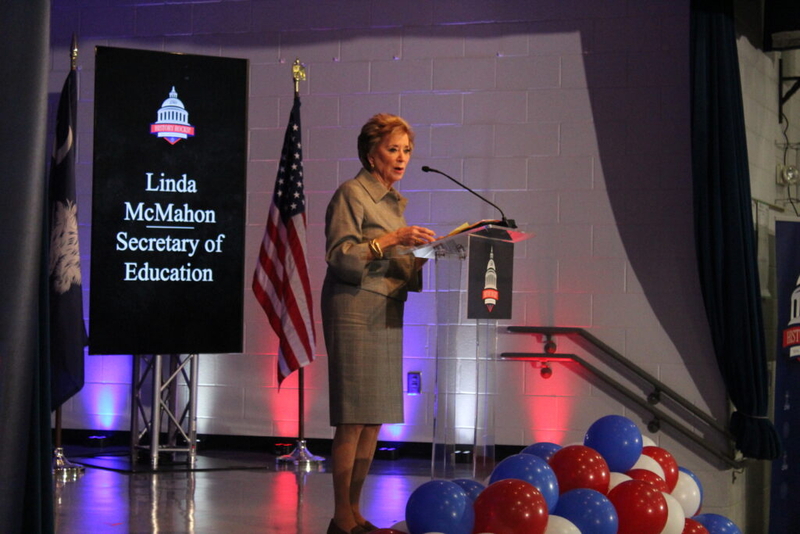
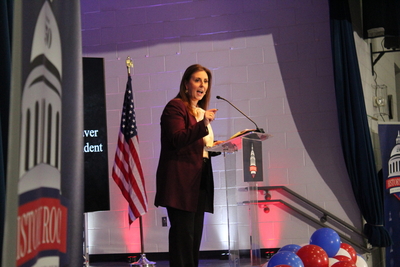
U.S. Secretary of Education Linda McMahon speaks to students about the nation's 250th birthday at West Pelzer Elementary School in West Pelzer, S.C., on Tuesday, Dec. 16, 2025. (Photo by Skylar Laird/SC Daily Gazette)
WEST PELZER — The U.S. secretary of education pointed to South Carolina education programs as a reason to give control of public schools to states while vowing not to cut certain federal funds during a visit Tuesday celebrating the state’s outsized role in the Revolutionary War.
Education Secretary Linda McMahon’s afternoon stop at West Pelzer Elementary School — in an Upstate town of about 1,000 people — was the fifth on a nationwide tour ahead of next year’s 250th birthday of the country’s founding with the Declaration of Independence. Previous stops included schools in Pennsylvania, Delaware, and New Jersey.
The tour, called History Rocks!, is sponsored by a coalition of about 40 organizations, most of them conservative. That includes Turning Point USA, the nonprofit founded by Charlie Kirk, who was assassinated on a Utah campus in September; and PragerU, a conservative nonprofit that creates videos teachers are allowed to show in South Carolina classrooms.
Joining McMahon on Tuesday was Mike Noriega, chief of outreach for the American Journey Experience, a Texas-based museum created by conservative media personality Glenn Beck. Students toured a traveling exhibit from the museum ahead of McMahon’s assembly, Noriega said.
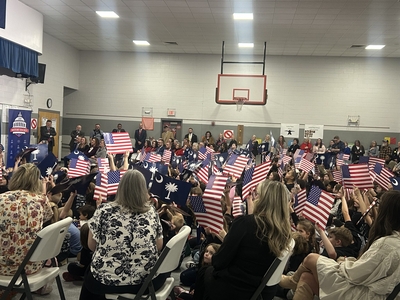
For the most part, politics took a backseat during the assembly, as elementary school students competed in a history trivia tournament and waved signs with the American flag printed on one side and the Palmetto flag on the other.
“This is the Trump administration. But the 250th birthday of our country is not political,” McMahon told reporters in response to a question about the event’s political ties.
Occasionally, however, politics surfaced in the celebration in ruby red Anderson County, which Trump won last year with 73% of the vote.
State Superintendent Ellen Weaver pointed to recent improvements in students’ performance on state-standardized tests as a reason for the federal government to give states total control over their schools.
This year, third- through eighth graders’ reading scores reached at least a 10-year high, with 60% statewide reading on grade level. However, more than half of those students still couldn’t do grade-level math by the end of last school year.
South Carolina fourth graders’ performance on the most recent National Assessment of Educational Progress aligned with national averages in math and reading. The results are considered the “nation’s report card,” since they’re the only tests taken by students in every state.
Along with state scores, Weaver touted that the number of teacher vacancies dropped for the second consecutive year — a first for this decade — as legislators continue to increase teachers’ minimum salaries.
She also pointed to the state’s policy prohibiting cellphones during school hours as a win.
“All of this represents our really fundamental belief that I know is very near and dear to the heart of our special guest today, (McMahon),” Weaver told a gymnasium full of elementary school students. “That’s the simple belief that the states can lead, and South Carolina is proving that every single day.”
McMahon agreed, she told reporters, pointing to the same successes Weaver mentioned.
The Trump administration has made moves toward putting control back in the hands of the state by dismantling the federal Department of Education, which supporters say will reduce bureaucracy and critics say will jeopardize essential education programs.
McMahon pledged that the federal government would continue to fund programs for children with disabilities, as covered by the Individuals with Disabilities Education Act first passed by Congress in 1975.
Last month, the Department of Education announced agreements to transfer some of its biggest grant programs to other federal agencies. That includes the Title I program that dates to 1965 and provides funding to schools with a high number of students living in poverty.
The U.S. Department of Education itself was created by Congress in 1979. A complete dismantling would likely require congressional action also. In Washington on Tuesday, U.S. Senate Democrats blasted the effort as weakening support for students and families.
The Trump administration contends the opposite: that breaking up the administrative bureaucracy will better serve students.
“Before there was a Department of Education, IDEA funding happened. Title I funding happened,” McMahon told reporters. “It continued to flow and happen without interruptions.”
Anderson School District One, which includes the school McMahon visited Tuesday, received nearly $1.9 million in Title I funding last school year. Statewide, schools collectively received $265.4 million through Title I.
At West Pelzer Elementary School, almost 80% of students live in poverty, according to state Department of Education data.
Weaver and McMahon pointed to the 360-student school as an example of success in the face of challenges.
Despite its high poverty rate, 77% of third- through fifth-graders showed on end-of-year state-standardized tests that they could read on grade level and 70% could do math on grade level. That’s far above the state average, according to agency data.
Group works to preserve, celebrate SC’s outsized role in Revolutionary War
The students had a chance to show off how much they’d learned Tuesday, answering questions about state and national history. Two at a time, a group of students competed to be the first to get the right answer as the school’s current and former state teachers of the year asked multiple-choice questions.
Among them: Which state had more Revolutionary battles than any other? Both students standing in front of microphones raised their hands to give the answer: South Carolina.
“South Carolina has been central to the American story,” McMahon told students.
McMahon opened her questions up to the room.
For example: What was Revolutionary War Gen. Francis Marion’s nickname?
“Swamp Fox,” the room of children shouted back in unison.
Another question got multiple answers: How old was the youngest signer of the Declaration of Independence?
The correct answer, she said, is 26, though the question itself could have confused even the adults. McMahon asked for the age of former Gov. John Rutledge, a Charleston lawyer who signed the U.S. Constitution. But the youngest signer of the Declaration of Independence was his youngest brother, Edward Rutledge.
“For America to stay great in the future, we must build upon our past,” McMahon said. “In order to do that, we must learn about our past. By the looks of this room, you are all ready to carry the torch and to lead America into the golden age.”
Editor’s note: This article has been updated to reflect which founding documents the Rutledge brothers signed.
Columbia