Curveball vote could snarl effort to reimpose campaign finance restrictions in Alaska
May 21, 2026 | 10:30 am ET
Description
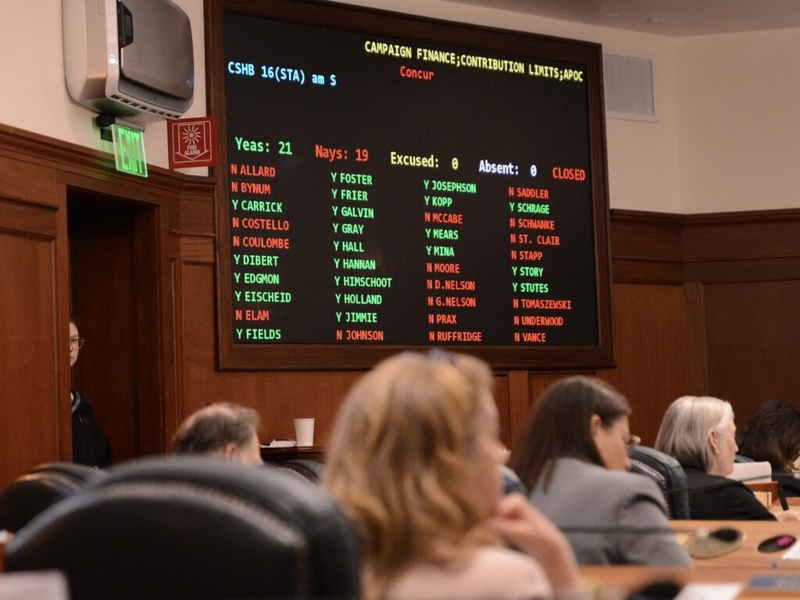
The voting board in the Alaska House of Representatives is seen on Wednesday, May 20, 2026, as legislators vote on House Bill 16. (James Brooks photo/Alaska Beacon)
The Alaska Legislature has approved new limits on the amount of money that can be donated to political candidates, but opponents of those limits are seeking to start those rules in the middle of the current election, something that could lead to a lawsuit that snarls the new rules altogether.
In a 21-19 vote on Wednesday, the Alaska House voted to advance House Bill 16, sending it to Gov. Mike Dunleavy. The Senate approved the bill on a 12-8 vote late Tuesday.
If Dunleavy vetoes the bill, a substantially similar measure will be presented to voters on the August primary election ballot. If he signs the bill or allows it to become law without his signature, the ballot measure likely would be removed from the August vote because Article XI, Section 4 of the Alaska Constitution says passage of a law “substantially similar” to an upcoming ballot measure will cancel the vote.
What do HB 16 or the ballot measure do?
Both the bill and the ballot measure install new individual limits on campaign donations: $2,000 per donor per candidate in each two-year election cycle. For the governor’s race, where a lieutenant governor candidate and governor candidate run together on a single ticket, the limit would be $4,000. The limit for donations from one person to a political party or group would be $5,000.
If a group wants to donate to a candidate, the limit is $4,000 per candidate, or $8,000 for the governor’s race.
Those limits would be adjusted for inflation every 10 years.
As written, HB 16 would take effect Jan. 1, after the 2026 elections.
But under Article II, Section 18 of the Alaska Constitution, a bill takes effect 90 days after the governor’s approval, unless two-thirds of legislators agree with a different date.
In this case, they didn’t. On Wednesday, the “effective date clause” vote failed by a 24-16 margin. That negates the Jan. 1 start date and means the bill would take effect in the middle of this year’s elections, depending on when it is sent to the governor for final action.
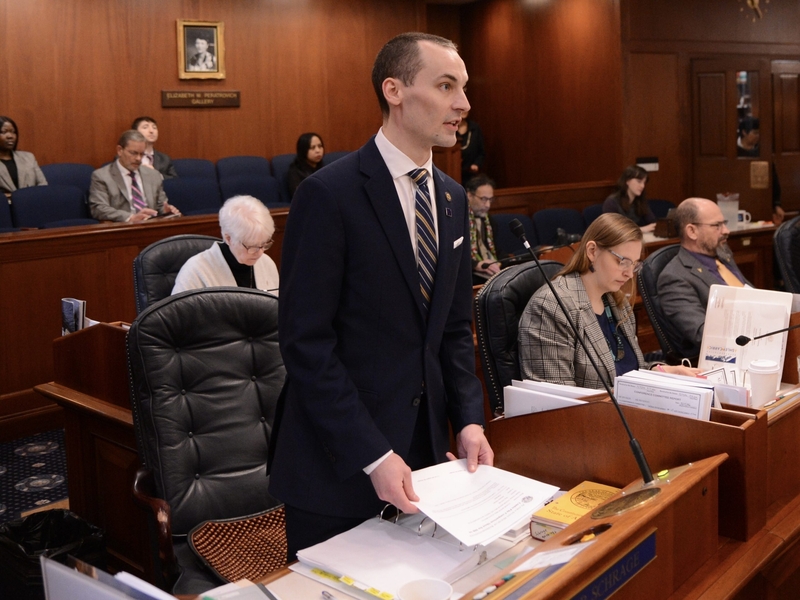
Rep. Calvin Schrage, I-Anchorage, sponsored HB 16 and helped organize the ballot measure campaign.
Speaking Tuesday night, he said he would have preferred that limits go in place before 2026 elections campaigns began. With that now impossible, he said he prefers waiting until 2027.
Implementing new limits in the middle of an election campaign is “impractical,” he said.
“The reality is … if we were to impose contribution limits mid-cycle, it would create all sorts of consequences for candidates where maybe they’ve already received donations that are above that limit. Certainly, in the gubernatorial campaigns, I would expect that. And then, do you have to refund those?” he asked.
Affected candidates or contributors could sue, he said on Wednesday.
All of the votes against the bill and against the effective date clause came from Republicans who are members of the House’s minority caucus.
Seven said they thought their “no” votes on the effective date clause were a mistake. Most bills have immediate effective dates, and voting no on the clause typically delays a bill.
“I think it was just a misunderstanding,” said Rep. Julie Coulombe, R-Anchorage, who voted no.
But Rep. Justin Ruffridge, R-Soldotna, voted against the effective date and said there was also a strategic reason for doing so.
“It gives the governor a reason to veto it,” he said, giving a thumbs-down for emphasis.
Legislators already believed the governor was likely to veto HB 16.
Speaking in 2022, Dunleavy implied that he’s generally opposed to campaign finance limits.
“You know me: I’m the guy that wants people to be able to drive four wheelers on the road. I’m a freedom guy,” he said. “My tendency is to just let people do what they want in campaign finance law, as long as it’s disclosed and it’s accurate.”
Rep. Jeremy Bynum, R-Ketchikan and a member of the House minority, said he thinks the governor will veto HB 16.
“I don’t think that bill will survive the process,” he said.
If that happens, Alaska voters will get a chance to decide the issue on August 18, primary election day.
Juneau