Democratic candidates for governor trade barbs over school choice debate
May 21, 2026 | 10:48 am ET
Description
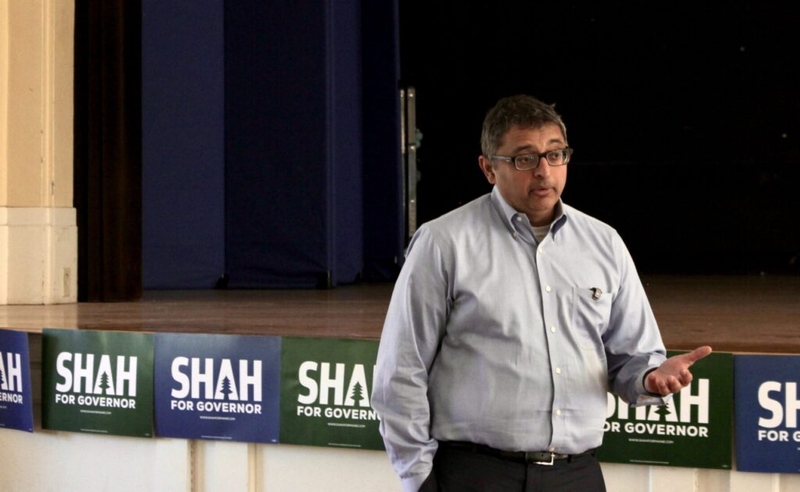
Democratic gubernatorial candidate Nirav Shah at a town hall in Kennebunk, Maine on May 16, 2026. (Photo by Eesha Pendharkar/Maine Morning Star)
The Maine Education Association is sticking to its endorsements for governor, despite their two top ranked gubernatorial candidates criticizing the third, Nirav Shah, for an outside ad supporting him that is partially funded by a school choice organization.
“Our first and second choices were Shenna Bellows and Troy Jackson, because of their adamant commitment to maintaining public funds in public schools,” said Maine Education Association President Jesse Hargrove.
Meanwhile, Shah “has expressed wanting to learn more information about charter schools and voucher systems, and he’s been direct and honest with that,” Hargrove added. “I think that his honesty is probably why [MEA] ranked him third, rather than first or second.”
Shah’s campaign clarified that he was asked during an interview with the teacher’s union about whether he supports expanding public charter schools. The candidate reportedly told members that he would support such schools to the extent that they would benefit public school students.
Shah has repeatedly polled at the top of the crowded Democratic field, as candidates make their final pitches ahead of the June 9 primary.
Earlier this week, a Washington, D.C.-based political action group, 314 Action, announced it was spending $650,000 on a new independent ad campaign backing Shah. Per Maine law, the advertisement notes its top three funders: 314 Action Victory Fund Maine, major Democratic backer Ashish Patel, and the organization Education Reform Now Advocacy, which advocates for school choice and vouchers.
In a joint statement Tuesday, Bellows and Jackson said Shah was being “bankrolled” by an organization that advocates for policies that would “divert public education funding away from Maine’s neighborhood public schools.”
Shah on public schools
Maine has some degree of school choice already, but does not have a voucher program.
At his town halls, Shah has talked about the need for the next governor to back public schools, and has not mentioned vouchers or private charter schools.
“One of my top values as governor will be to stand up for public education against the efforts by the Trump administration,” he said at a town hall in Kennebunk on Saturday.
“I think a lot of the cuts that they are making, and a lot of the language they use, it’s all aimed at trying to undermine public education as an institution, and for me, you know, I mean public education is the great equalizer.”
Major takeaways from the Democratic gubernatorial candidates’ final debate
Shah campaign manager Kayla vanWieringen said in a statement that he is “vehemently opposed to privatizing our education system or diverting a single public dollar to private schools.”
“Anyone twisting that into something it isn’t should ask why some would rather mislead voters than tell the truth about a candidate whose North Star is stronger public schools, better support for teachers, and opportunity for every Maine student,” she added.
But Shah’s opponents, including Jackson and Hannah Pingree, said they would not have let an ad run with Education Reform Now as a backer, even though candidates can’t legally coordinate or even know which entities are involved in independent expenditures in support of their campaign.
“I mean, if it had been me, there’s no goddamn way in the world I would have accepted their support. I’d be rejecting that [independent expenditure], I’d be coming out vehemently against it,” Jackson told Maine Morning Star on Tuesday at a campaign event with union workers.
“For me, this is like a 20-year fight about standing up for public education,” he added, “and it pisses me off that anyone walked into a room and told teachers that, ‘I’m all with you,’ and then would let an organization like that back them.”
School choice in Maine
Education Reform Now is closely affiliated with Democrats for Education Reform, whose chair, Jorge Elorza, has been making the case to Democratic governors to take advantage of President Donald Trump’s school choice program. Included in the president’s sweeping budget law passed last year, the initiative will provide a tax credit to families who make charitable donations to be spent on K-12 services, including private school tuition, tutoring and exam fees for public school students or other education expenses.
In response to questions about the groups’ support for Shah, Maine Morning Star was directed to a contact with Democrats for Education Reform, who did not respond to a request for comment.
For me, this is like a 20-year fight about standing up for public education, and it pisses me off that anyone walked into a room and told teachers that, ‘I'm all with you,’ and then would let an organization like that back them.
Bellows’ campaign, which denounced Education Reform Now, had been in touch with affiliate Democrats for Education Reform while it was developing the candidates’ education policy, according to communications reviewed by Maine Morning Star.
“Shenna met with DFER because she believes in transparency and honest dialogue, even with those she disagrees with,” said Amy Weinstock, Bellows’ campaign manager. “She has long been clear that she does not support vouchers or using tax dollars for private schools — which is exactly why they’re not supporting her. Unlike Nirav Shah, who is benefiting from hundreds of thousands of dollars in their ads, Shenna wouldn’t accept their support.”
VanWieringen also said throughout his campaign, Shah has met with “groups he agrees with and groups where there are meaningful differences.” She said Shah told MEA members he would be open to implementing the new tax credit if it could be structured in a way that utilizes potentially millions of federal dollars to help public school students in Maine. The governor has to craft the implementing legislation, so the state has control over where, when and how that funding can be spent.
“While Dr. Shah does not agree with every organization on every issue, he believes automatically rejecting ideas that could benefit public school students and strengthen public education simply because of who proposes them is not leadership — it’s ideology,” vanWieringen said. “Maine kids deserve leaders focused on results.”
The Maine teachers union did not condemn Education Reform Now directly but Hargove said if the next governor considers the Trump tax credit and vouchers, “we obviously want to have a seat at the table when these conversations are happening.”
“We look forward to having those policy conversations, where hopefully we can educate any policymaker to our concerns regarding these programs,” he added.
School choice in Maine is a complicated subject: the state does not have a voucher program, which provides tax dollars for families to use at private or charter schools, but allows some degree of school choice due to its system of regional school units.
For many rural towns that don’t have their own K-12 schools, the Maine Department of Education mandates they pay tuition for their residents to go to another town’s public school, or an approved private school. However, like every other public school decision, this is up to local control. Each school district can decide “whether or not your municipality has school choice,” the department says.
“A lot of times when we say school choice, it sounds really good, but one of the things that we’re aware of is that oftentimes it is the school who is choosing the students,” Hargrove said. “We believe that a community has a responsibility to be educating their kids and that we want to keep those community resources available to do that.”
Augusta, ME