At SC’s No Kings protest, more than 1,000 protesters urged to do more to make political change
Mar 28, 2026 | 5:43 pm ET
Description
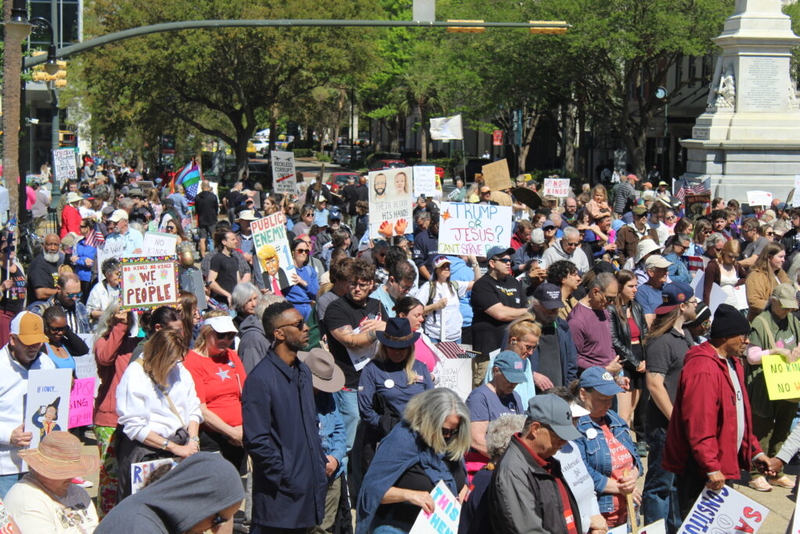
Protesters gather outside the South Carolina Statehouse in Columbia, S.C., on March 28, 2026, for the third nationwide No Kings rally. (Photo by Skylar Laird/SC Daily Gazette)
COLUMBIA — More than 1,000 people showed up to the Statehouse for the No Kings rally Saturday. They needed to do more than that if they wanted to see real change, activists and organizers said.
The rally, which ran most of the day Saturday, was the third major event held across the country generally protesting President Donald Trump. Similar protests took place across South Carolina and in every state in the country.
At the top of protesters’ minds Saturday were the war in Iran, the files released detailing the activities of Jeffrey Epstein, who died in jail while awaiting trial for sex trafficking charges, and voting rights, especially with the proposal of the SAVE Act, which would create photo ID requirements nationwide for voters. (South Carolina already has a photo ID law similar to the proposal rejected by the U.S. Senate on Thursday.)
Those added onto repeated grievances, including the rising cost of health care, racism and homophobia, and opposition to mass deportation of immigrants.
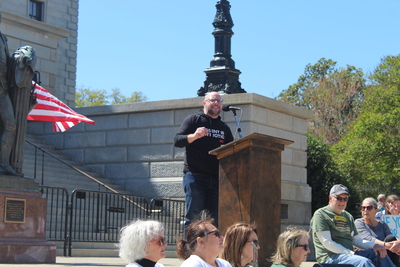
Although most of the protesters came to speak against Trump and other federal officials for nationwide issues, organizers and activists urged them to take a more local look at the problems.
“You don’t have to go to Washington, D.C., to protect democracy,” said Jace Woodrum, head of the state chapter of the American Civil Liberties Union. “You can do it right here.”
That might mean signing up to volunteer with a local organization, running for office or remembering and encouraging others to vote in upcoming elections, said Woodrum and other speakers.
“Don’t leave here today without making a commitment about what you’re going to do tomorrow,” Woodrum told the hundreds gathered on the Statehouse grounds.
Two dozen booths offered help in registering to vote, email lists of volunteer opportunities and information on candidates for upcoming elections. Among them were the South Carolina Progressive Network, the Young Democrats of the Central Midlands, the Alliance for Retired Americans and the Lexington County Democratic Party.
If the October No Kings event, when thousands marched down Main Street to the Governor’s Mansion, was meant to show that people were unhappy, Saturday was meant to focus on what they could do about it, said Sam Gibbons, who helped organize the event with national group 50501.
“I don’t just want to see you here,” Gibbons told the crowd. “I want to see you in the streets or with the ACLU or volunteering.”
Some candidates made appearances Saturday. More than two dozen Democratic and independent candidates for Congress, the state Legislature, local offices and statewide races made their case to a crowd of fluctuating size.
Candidates can file to run for office until noon Monday. A statewide primary election will take place June 9, ahead of the general election in November.
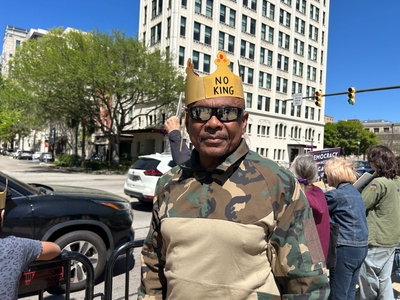
Simon Joseph, a retired Army sergeant, said he doesn’t have the time to volunteer for the causes he supports, but he believes the most important thing a person can do to make a change is vote and encourage people they know to vote.
“All I can do is just make sure that I vote in the next election,” the 65-year-old said.
He brought his two daughters, who are 11 and 13, from their home in Lexington to show them they can make a difference by showing up, he said. After spending six years in the Army, health care costs and the Iran war both weigh on Joseph, he said.
“Right now, it’s not the America I want to live in,” Joseph said.
Molly Westberry, Marcus Massoud and Marisa Rodriguez, all freshmen at the University of South Carolina, saw the event on social media and decided to show up to show their anger about the war in Iran, the Epstein files and a general culture of hatred.
The rally was the first protest any of the three had attended. As drivers honked their horns at protesters on the way past, they hoped the scale of the event would show not everyone is happy with the current administration, Massoud said.
“It’s hard to ignore past a certain point,” Massoud, a business major, said of the crowd.
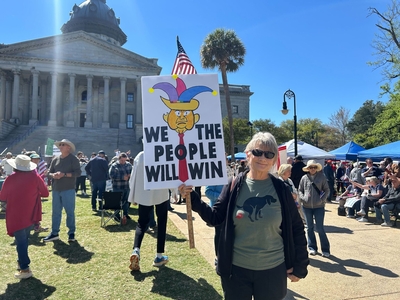
For Wendi McIntyre, the rally was more about building a sense of camaraderie. After attending the October march, McIntyre knew gathering in the streets wouldn’t necessarily create major change on its own.
“Politicians may change their stance a little bit, but seeing what’s happening, these really, to me, are about helping me to have hope and know that I’m not alone,” said the 67-year-old retiree from Pawleys Island.
In the Upstate
At Clemson University, about 50 students and a few older members of the community participated in the first No Kings protest on campus.
They marched near the main entrance in the shadow of Tillman Hall, a building that has sparked previous and unrelated protests at Clemson. The building is named after Ben Tillman, an avowed white supremacist as governor (1890-94) and U.S. senator (1895-1918), who helped found the college. Students and faculty often refer to the building as Old Main, a reference to its pre-1946 name, Main Building.
“Students are here because they’re concerned about a lot of things, about aggressive immigration enforcement, the war in Iran, and meanwhile the economy is still getting worse,” said Allison Curl, a biosystems engineering student at Clemson who organized the Clemson protest.
“The concerns vary among students,” she said. “Some graduate students are concerned about cuts in science research funding. Others are concerned about aggressive ICE enforcement or the war.”
Emma Harrington, a bioengineering graduate student at Clemson, said she attended the event to protest cuts to federal research funding.
Students had a number of other concerns, she said, including the number of prominent people named in the Epstein files who seem to be escaping accountability.
“The evidence is coming out that so many people in power, not just Trump, were involved with Epstein,” Harrington said. “Many were there on the island. The thing that really upsets me is that they’re not going to get investigated or punished.”
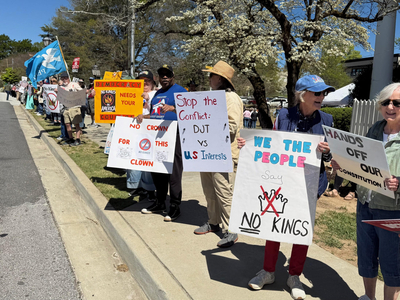
Meanwhile, the war in Iran also is much on the minds of students, Harrington said.
“The war is not only unnecessary,” she said. “It was poorly planned. They hit an elementary school on the very first day. We’re wasting the lives of our soldiers, and civilians over there are getting hurt as well.”
Shortly before the No Kings protest started in the small Anderson County town of Pendleton, organizer Erin Goss spoke about the wide range of issues on the minds of the hundreds of people who had already gathered on the town square, known as the Village Green.
“There are many things on people’s minds,” said Goss, an associate professor of English at Clemson University. Those include, she said, “the overstepping of ICE into our neighbors’ lives” and the war in Iran. But it’s Trump’s mass deportation efforts she most opposes, she said.
Goss also called the protest a celebration of a like-minded community.
“I think a lot of us for a long time thought that we were alone in the way we felt about the direction of the country,” Goss said. “So, a gathering like this is a reminder that we’re not alone and we’re working very hard to try to build a community that lasts when this regime is done.”
Paul Hyde contributed to this report from Clemson and Pendleton.


Columbia