Providence charter school singled out by moratorium sues McKee, General Assembly leaders
Jul 27, 2026 | 5:19 pm ET
Description
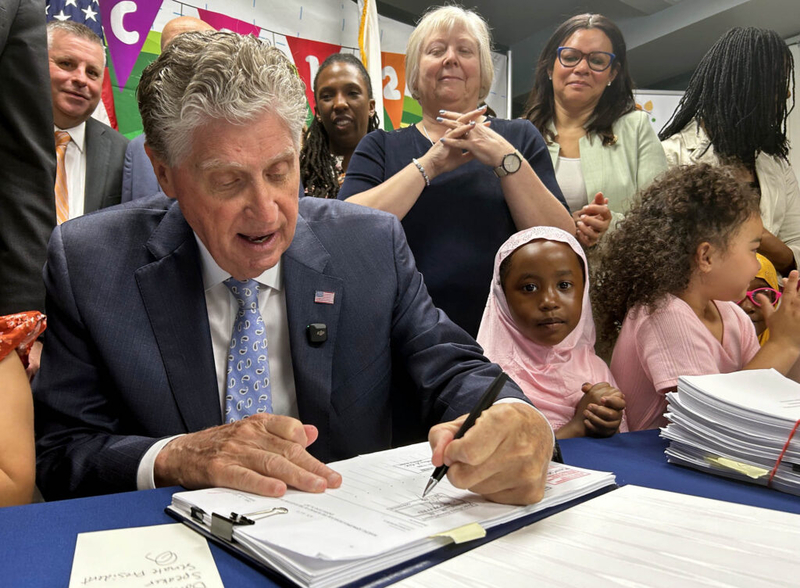
Left-handed Gov. Dan McKee signs the fiscal 2027 budget at Children's Friend in Providence on Friday, June 12, 2026. In center background looking on is Senate President Valarie Lawson. (Photo by Nancy Lavin/Rhode Island Current)
A dual-language public charter school blocked from opening in Providence next fall under a moratorium passed by the General Assembly and signed into law by Gov. Dan McKee filed a lawsuit in federal court Monday.
De La Comunidad Bilingual Public Charter School had moved partially, but not entirely, through the necessary approval pipeline when the state legislature OK’d a three-year moratorium on new charter school approvals, effectively preventing it from opening. McKee, who is seeking reelection, signed the teachers union-backed legislation into law on June 18 over the objections of charter school advocates.
“This law was aimed at one school: ours,” Carol Aguasvivas, board chair of De La Comunidad, said in a statement Monday. “Families chose us. Our community fought for us. And when lawmakers tried to shut the door before we even opened it, we had a responsibility to fight back.”
De La Comunidad planned to serve students from Providence, Pawtucket and Cranston, starting with around 140 students in its first year after opening in the fall of 2027and expanding over time.
The lawsuit, filed in U.S. District Court for the District of Rhode Island on Monday, names McKee, House Speaker Christopher Blazejewski, Senate President Valarie Lawson, and the state’s Council on Elementary and Secondary Education as defendants.
McKee signs charter school moratorium bills with five days to spare, ending uncertainty
Former Providence Mayor Angel Taveras, who is representing the charter school, wrote in the complaint that the charter school ban was a targeted effort. Taveras noted that the original draft of the charter bill was amended to preserve the expansion of another potentially affected charter school, The Greene School, but that the legislature did not “carve out an exception” for De La Comunidad and shot down further amendments.
“The General Assembly purports to want to address the fiscal impacts on school districts associated with students in the districts attending charter schools,” Taveras argued in the suit. “In truth, the Moratorium Bill was targeted to stop De La Comunidad and strip De La Comunidad of its right to obtain approval to operate.”
The complaint is asking the federal court to nullify the moratorium’s effect on De La Comunidad, alleging that the moratorium constitutes “an unconstitutional impairment of contract and a violation of substantive due process.” It also claims that the moratorium’s impact on De La Comunidad skirts both federal and state laws.
The school received preliminary approval to open from the Council on Elementary and Secondary Education on Jan. 5, with state education Commissioner Angélica Infante-Green having recommended passage.
Under Rhode Island Department of Education regulations, a preliminary approval does not guarantee a charter school will receive the charter it needs to open. Applicants still need to complete certain financial, governance, enrollment, staffing and facilities requirements.
The suit argues that De La Comunidad’s preliminary approval — even if downplayed by the General Assembly in its passage of the charter bill — created enforceable rights. The unopened school relied on the K-12 council’s tentative approval with the tacit understanding, the lawsuit argues, that a “school is given final approval to operate” once it satisfies the council’s outline conditions.
“[T]he activity approved was lawful and permitted at the time of approval, and the conditions in the preliminary charter were, on their face, an invitation to perform,” the lawsuit argues.
De La Comunidad had completed most of these conditions, according to the suit. The school incorporated, secured federal nonprofit status, developed financial and staffing plans, identified a possible building to operate from and obtained nearly $1.8 million in combined, conditional funding from a Charter School Program Grant, the New School Venture Fund, the Charter School Growth Fund, and the Rhode Island Education Collective.
Broader argument over school funding
The legal contest hinges largely on what rights, if any, the preliminary approval created.
The value of that tentative affirmation also played into the General Assembly’s passage of the bill, which was underscored by a wider debate about how Rhode Island pays for public charter schools versus traditional district schools.
The law blocks new charter approvals for the 2026-2027, 2027-2028 and 2028-2029 school years and also reduces the statewide charter cap from 35 to 28. The state needs this pause, legislative supporters argued, while Rhode Island reconsiders its school funding formula.
State and local per-pupil funding generally follows students when they transfer to charter schools, but districts can set aside part of that local contribution to allocate toward a district’s fixed costs — operational expenses that don’t budge easily, like building maintenance, utilities and staffing.
Defending the bill ahead of its successful passage on June 10, House Education Chair Joseph McNamara said Rhode Island could no longer afford to operate these “two school systems” in tandem.
But the broader argument about funding did not persuade all of McNamara’s colleagues during that floor debate, with some speaking up against the moratorium as specifically exclusionary of De La Comunidad.
Charter school moratorium passes RI House, awaits clearance from a favorable Senate
Rep. Leonela Felix, a Pawtucket Democrat, argued on the House floor on June 10 that the school would serve primarily students of color, and yet it would be the only school immediately impacted by the moratorium.
Felix tried to recommit the bill to committee, which would subject it to an additional round of legislative review, but her effort was countered by Majority Leader Katherine Kazarian, who objected and suggested moving on to the bill’s ultimately successful vote.
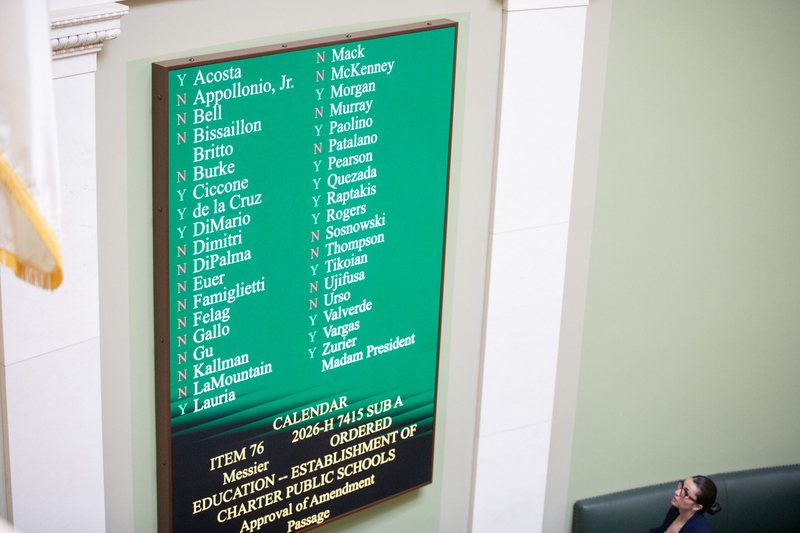
A day later, in the opposite chamber on the last night of the legislative session, Senate Minority Leader Jessica de la Cruz proposed an amendment to allow preliminarily approved schools to proceed with the opening process.
“Preliminary approval is just that, it is preliminary,” Sen. Melissa Murray, the bill’s sponsor, said that night, urging her colleagues to reject the minority leader’s amendment.
The amendment still failed despite drawing 15 votes of support — more than twice the six senators who opposed the moratorium itself.
McKee was ‘Against a Moratorium Before He Was for It’
Still, the Senate had approved an earlier amendment allowing The Greene School, an existing charter school in West Greenwich, to move forward with an expansion approved the same day De La Comunidad received preliminary approval.
That approvals allowed The Greene School to add 168 students, including 112 during the years covered by the moratorium. De La Comunidad would have added 140 students over the three years, and 96 more in the 2029-2030 school year.
The suit characterizes McKee as dealing the final blow against De La Comunidad, despite the fact that, as one heading in the lawsuit puts it, the governor was “Against a Moratorium Before He Was for It.” McKee had expressed support for charter schools in the past.
De la Comunidad leadership “met with Governor McKee to urge him to veto the Moratorium Bill,” the suit recounts, a meeting which McKee also referenced in public comments to reporters after he had signed the moratorium bill.
“During their meeting, Governor McKee confirmed that De La Comunidad had been specifically targeted by the advocates of the Moratorium Bill,” the complaint reads.
The complaint also focuses on opposition from Rhode Island’s two major teachers unions — the Rhode Island Federation of Teachers and Health Professionals (RIFTHP) and the National Education Association Rhode Island, of which Senate President Lawson is also president — as instrumental in pushing the moratorium to victory.
NEARI spokesperson Stephanie Mandeville said the organization needed time to review the lawsuit before deciding whether it would be able to comment. A representative for the Rhode Island Federation of Teachers and Health Professionals did not immediately respond to a request for comment.
McKee received an endorsement from the Rhode Island Federation of Teachers and Health Professionals on Friday.
McKee backed a charter school moratorium. Now a major teachers union has endorsed him.
McKee’s office is leaving comment on the matter up to the courts.
“Because this is now the subject of litigation, it will be addressed through the courts,” spokesperson Laura Hart said in an email, adding that McKee remained focused on educational access and pointed to school construction spending, academic gains, reduced chronic absenteeism and the addition of 21 after school learning centers planned statewide.
Spokespeople for Blazejewski and Lawson said the legislative leaders had not received the complaint and referred questions to the Attorney General’s Office, which would represent them in the matter.
The AG’s spokesperson, Tim Rondeau, said the office “had not yet been served with the lawsuit, but we will review once we receive it.”
Victor Morente, a spokesperson for the education department, confirmed that the agency is “aware of the lawsuit,” but would stick to its “longstanding practice” of not commenting on pending litigation.
The case has been assigned to Chief U.S. District Judge John J. McConnell Jr.

Providence, RI