GOP leaders say the NC budget offers ‘historic’ raises. A top education panel says it’s not enough.
Jul 27, 2026 | 6:00 pm ET
Description
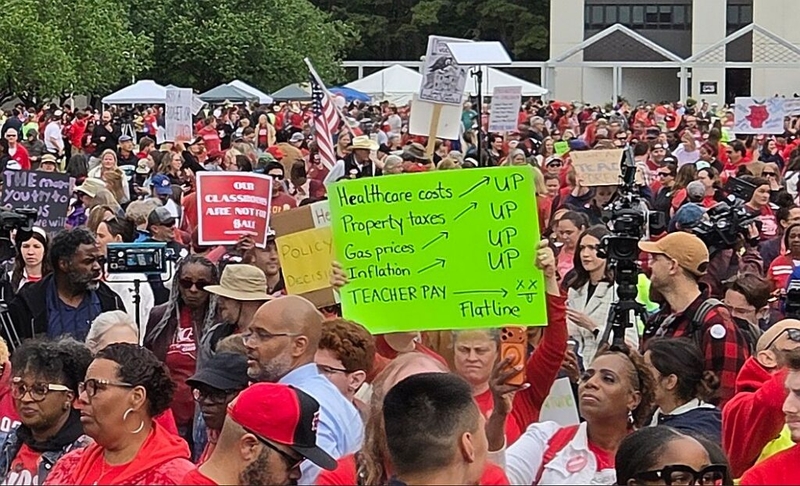
Thousands of N.C. teachers rallied on May 1, 2026 outside the legislature to say their pay has not kept up with rising inflation or healthcare costs. (Photo: Clayton Henkel/NC Newsline)
Just weeks after the North Carolina General Assembly passed a $34 billion state budget that included 8% average raises for teachers over two years, the state’s Blue Ribbon Commission on Public Education said it’s not enough.
The bipartisan panel, assembled in March by Democratic N.C. Gov. Josh Stein, Senate President Pro Tem Phil Berger, R-Rockingham, and House Speaker Destin Hall, R-Caldwell, has been working on recommendations to improve teacher training, student advancement, and administrative operations.
Bipartisan education panel unites NC Gov Stein, Republican leaders amid budget rift
At Monday’s meeting, the commission devoted much of its discussion to strengthening the state’s teacher pipeline and its compensation schedule.
“Very simply, we need to pay our teachers more,” said state Superintendent Mo Green during Monday’s commission meeting.
Hall said the new budget offers “historic raises” for teachers, though the largest percentage gains heavily favor early-career educators. Veteran teachers’ salaries have remained relatively stagnant over the past few budget cycles.
Green said teachers at all levels of experience need to be paid more for the state to become the top state for educators in the Southeast.
According to the N.C. Department of Public Instruction, more than 9,100 teachers decided to leave the state’s public schools in 2024-25. That represents a little more than 10% of the public school teachers employed statewide. Beginning teachers left at a much higher rate of 14.7%.
Lisa Godwin, a former North Carolina Teacher of the Year, told her fellow commission members the state should revisit retention bonuses for each year of service. Currently, teachers with 15 to 24 years’ experience don’t get an annual raise for nearly a decade.
“I’m one of those [whose salary] is frozen,” said Godwin, a beginning teacher coach and mentor coordinator for Pender County Schools.
Godwin said North Carolina did not face a perennial teacher shortage in the past.
“See what worked and what was good in the heyday of teaching and education. And let’s bring these things back,” Godwin said.
Brenda Berg, president & CEO of BEST NC, criticized the state budget for eliminating recurring funding for TeachNC, an online platform used to recruit teachers and teacher candidates.
“Teach NC recruited 3,700 candidates last year to educator preparation programs,” Berg said, “which was a 20% increase in EPP enrollment.”
Berg said the commission should recommend that the program be fully funded in the next budget.
Edgecombe Early College High School Principal Matt Bristow-Smith said the panel should consider recommending the indexing of teacher salaries to inflation to help them keep up with the cost of living.
“What we’ve effectively done is we have lowered the quality of living for teachers because the earning power of what teachers actually make is less than it was a decade ago,” said Bristow-Smith.
House Bill 1178, which proposed indexing teacher salaries starting in 2033-34, didn’t get a hearing in the short session.
Dr. Robert Taylor, superintendent of the Wake County Public School System, summed up what many on the commission were thinking.
“There just needs to be an acknowledgement that if we are going to address teacher compensation, that it’s going to cost us to fix the problem that has been built over the last several years,” said Taylor. “The longer we take to fix it, the harder the problem becomes to fix.”
The Blue Ribbon Commission on Public Education did not take a vote at Monday’s meeting. The bipartisan group, which is also discussing recommendations to strengthen literacy and modernize accountability, meets again August 31, 2026.
Raleigh, NC