Doug Jones calls for affordability measures, government reforms in policy speech
Jul 27, 2026 | 5:33 pm ET
Description
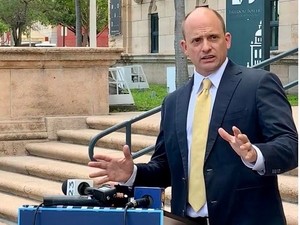
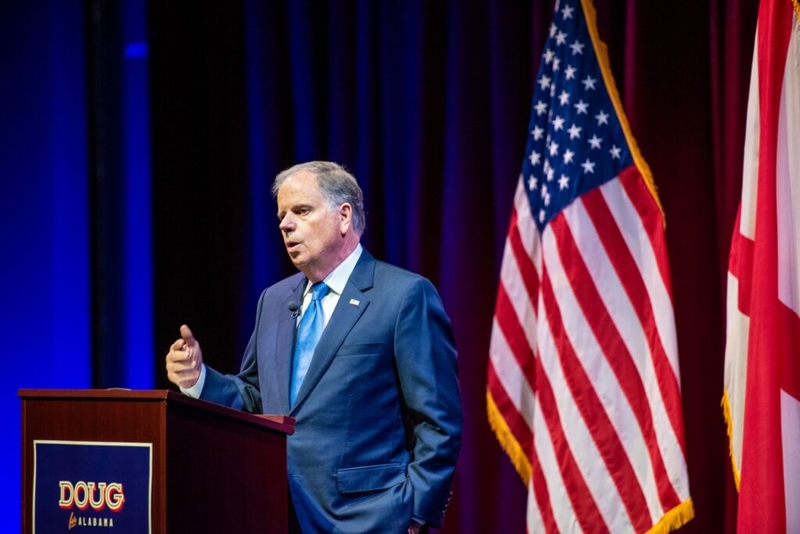
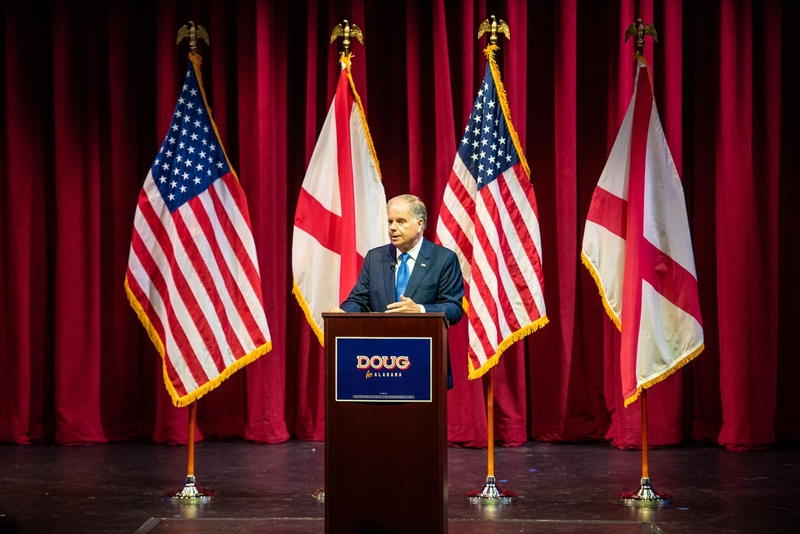
Democratic gubernatorial nominee and former U.S. Sen. Doug Jones delivers a policy speech on July 27, 2026 in Birmingham, Alabama. Jones Monday outlined an ambitious policy agenda touching on healthcare, affordability and governmental reform. (Andi Rice for Alabama Reflector)
BIRMINGHAM — Democratic gubernatorial nominee Doug Jones unveiled an ambitious policy agenda in a speech Monday, saying Alabamians deserve “three real opportunities” for health, government participation and economic prosperity.
In an hourlong speech delivered to at least 100 people, the former U.S. senator called for traditional Alabama Democratic policies like Medicaid expansion, a lottery vote and the abolition of the state grocery tax. But Jones also called for a one-year moratorium on data centers; a state ballot initiative process; more powers for local governments; constitutional protections for in-vitro fertilization and contraception and additional investments in housing and child care.
Jones said the state is being governed by “a small circle of people in Montgomery who learned that the surest way to hold power is to cut ordinary Alabamians out of the decisions that shape our life.”
“In this year, in 2026, we’re witnessing perhaps the greatest example of what is wrong with state government in Alabama and how big money works in our state. Not only that it gets in the way, but (it also) buys the willing support of Montgomery and any politician they need,” he said.
Alabama’s governor has limited power, and if Jones won election he would likely have to work with a Republican-controlled Legislature hostile to his proposals. Jones said after the speech he’d work to ensure his campaign promises much like he did when he was a U.S. Senator.
“You work with people. You talk to them, you listen to them, you don’t just dogmatically tell them this is the way it’s got to be,” he said. “You hear them out. That’s how you get things done.”
Jones’ proposals were a contrast with those of Republican gubernatorial nominee Tommy Tuberville, Alabama’s senior U.S. senator widely considered the favorite in the race, whose platform has largely focused on business development and culture war issues.
In a statement Monday, Jordan Doufexis, Tuberville’s campaign manager, accused Jones of standing “with the Obama-Biden agenda to bring open borders, socialized healthcare, radical gender policies, and reckless spending” and touted Tuberville’s record in Washington, citing his support of President Donald Trump’s job cuts and his work to bring Space Command to Huntsville, among other items.
“Alabama voters fired DC Doug once already,” the statement said. “Now he has come crawling back from Washington with the same failed liberal ideas, and they are going to reject him again.”
Jones denounced culture war rhetoric, saying that “every one of us — Republican, Democrat, and independent — is being sold the same lie so that a very few can keep the run of the place.”
“While they had us arguing over pronouns, they were cutting deals on our utility bills,” he said. “While they had us fighting about library books, they were quietly rewriting the tax code to fatten their own portfolios. It takes a lot of fear and a lot of closed doors to keep people from getting angry.”
Another major contrast was Jones’ support for a data center moratorium. Tuberville has been a vocal advocate for building data centers. AL.com reported earlier this month that Tuberville said people who are opposed to data centers and artificial intelligence are being influenced by China and called concerns about the environmental effects of data centers “bullcrap.”
Doug Jones kicks off Alabama gubernatorial campaign with vision of ‘crowded table’
Jones said a moratorium would allow the state to have “guardrails and policies in place to protect our people and our communities.”
“Those concerns are not bullcrap; they’re real, and they’re being heard in communities across the South,” he said.”
Jones also alluded to multiple candidacy challenges and a lawsuit challenging Tuberville’s eligibility to run for Alabama governor and allegations that the nominee lives in Florida.
“I guess maybe he also sees the concerns about housing costs as bullcrap, but it’s easy to do when you spend most of your time at a multi-million-dollar beach house in north Florida,” Jones said.
Earlier this month, a Montgomery judge dismissed a lawsuit over Tuberville’s residency, saying she lacked jurisdiction over the case. The plaintiffs later appealed the lawsuit to the Alabama Supreme Court. Briefs from plaintiffs in the case will go to the Supreme Court early next month.
Affordability, health care
Jones also said he plans to tackle affordability through eliminating the state’s grocery, tip and overtime taxes; decreasing housing costs through the new federal housing bill and increasing wages for workers across the state.
Jones also said he wants to expand Medicaid “one way or another.”
“The fact is, Alabama is a poor state. It’s an unhealthy state, and Medicaid expansion is not a handout, it’s a hand up,” he said. “Thirty-nine other states, red and blue, have already figured out that it’s a good thing. It’s time for the 40th state to catch up.”
Alabama is one of only 10 states who have not expanded Medicaid.
Staying in the theme of healthcare, Jones said he would work to protect contraception and in vitro fertilization (IVF) through a constitutional amendment along with fighting for other policies that would help women across the state. In 2024, the Alabama Legislature passed a law restarting IVF services in the state after the Alabama Supreme Court ruled that frozen embryos were children and parents could file civil suits if they were destroyed, leading several IVF clinics to stop operations.
Democrats argued at the time that because the Alabama Supreme Court relied on a 2018 state constitutional amendment on the “rights of unborn children” to make its IVF ruling, the only way to protect IVF was a constitutional amendment.
“Republican women, Democratic women, independent women, you watch politicians in Montgomery and Washington decide that they know better than you do about your own body, your own family and your own life,” Jones said. “I’m going to fight to protect access to contraception. I’m going to fight for paid family leave, for affordable childcare, for lower maternal mortality rates, and for wages that reflect the value of your work.”
Government reform
One of the last campaign proposals Jones made was to protect voting rights for Alabamians. Conversations surrounding voting rights re-emerged after an April SCOTUS ruling in Louisiana which ruled the state’s congressional map a racial gerrymander. The opinion had a ripple effect across the South where states including Alabama and Tennessee redrew congressional maps.
One way Jones wants to help protect voting rights is through implementing early voting in the state. Early voting bills have been brought by multiple Democratic members of the Legislature, but none of the bills have ever made it through either chamber for a vote.
“Voting rights are not a chapter in the history book anymore. We don’t get to close that vote. They’re a living promise that must be defended in every generation, and we are seeing it right now today,” he said.
Jones also called for an initiative process to allow citizens to put issues up for a vote, saying that “when Montgomery refuses to listen, the people have a way to act for themselves.” He also called for more power for local governments, “because the mayor of Clanton knows more about what Clanton needs on any Wednesday morning than a state bureaucracy learns in a year.”
Key points box written by Editor Brian Lyman.
Montgomery