Alaska Legislature opens third gasline special session with no fanfare and even less optimism
Jul 27, 2026 | 5:04 pm ET
Description
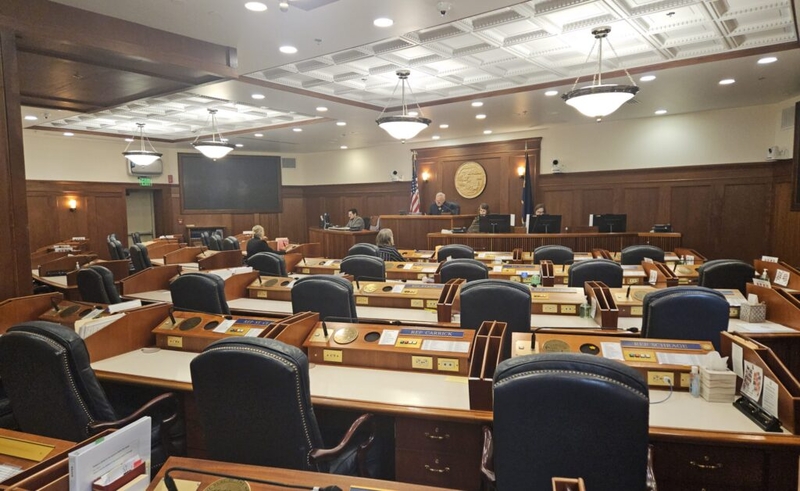
The Alaska House gavels in for the third special session in 2026 on the proposed AKLNG gasline project, with House Speaker Rep. Bryce Edgmon, I-Dillingham presiding and Reps. DeLena Johnson, R-Palmer, and Sara Hannan, D-Juneau in attendance on July 27, 2026. (Photo by Corinne Smith/Alaska Beacon)
The Alaska Legislature opened its third special session of 2026 with no bill, few lawmakers and little hope.
A handful of legislators gathered Monday in the state Capitol at Juneau to begin a 30-day session called by Gov. Mike Dunleavy after the failure of a compromise bill that would have provided a tax break to the developer of the proposed trans-Alaska natural gas pipeline.
Dunleavy and the state House opposed the addition of a corporate income tax on a handful of privately owned oil and gas companies that don’t currently pay one. That provision was intended to get support for the bill in the Senate.
But on Monday, the governor had no new alternative bill ready for legislators as the special session began.
In a statement on social media, Dunleavy said, “Before reintroducing the legislation, my administration is going to continue meeting with all parties to determine the best path forward to an agreement.”
Answering questions about those meetings, the governor’s office said it had nothing more to add.
‘I don’t believe the Legislature can do much now’
The pipeline’s lead developer, Glenfarne, has said that a reduction in the state’s petroleum property tax is necessary for it to obtain the financing needed to build the pipeline.
Passing a bill into law requires 21 votes in the House, 11 in the Senate, and the assent of the governor. In a special session called by the governor, lawmakers may only work on topics designated by the governor. In Dunleavy’s latest proclamation, he limited work to the proposed gas pipeline.
“It sounded like (the governor) is hopeful that there could be maybe some new developments, but that’s going to be his negotiation. I don’t believe the Legislature can do much now at this point,” said House Minority Leader DeLena Johnson, R-Palmer, at the Capitol on Monday.
With no legislation to consider, members of the House and Senate held pro forma “technical sessions” before adjourning until Friday, when a bill could be available.
Because no substantive action was expected on Monday, only two legislators traveled to Juneau on the first day of the special session. Speaker of the House Bryce Edgmon, I-Dillingham, and Johnson were joined by Rep. Sara Hannan, D-Juneau. In the Senate, Sen. Jesse Kiehl, D-Juneau, presided over an otherwise empty chamber.
The state House has 40 members, the state Senate has 20.
Down the hall from the House and Senate chambers, a group of cruise ship tourists watched a video about the history of the Capitol in a darkened committee room. At 10 a.m., there were more tourists than legislators.
Edgmon said that until the governor introduces a substantive bill, legislators will mostly stay away from the Capitol.
“The plan in the House is to have technical sessions, as you just saw, and to save time and certainly money (by) not bringing the Legislature back until we have something in front of us that’s worthy of bringing the entire body back … because it’s quite expensive to bring the Legislature back into session,” he said.
Typically, legislators have budgeted $1 million for a 30-day special session.
Fate of ‘pass-through’ tax is a key question
The current deadlock in negotiations is a “pass through entities tax” that would levy a form of the state’s corporate income tax on privately owned oil and gas companies, including Armstrong Oil and Gas, HEX, and Hilcorp.
Corporate income tax change remains key sticking point for Alaska gas pipeline bill
That tax was added to the bill in the Senate to garner the votes of senators who are skeptical of the underlying bill, which would replace the state’s petroleum property tax with a tax on gas pumped through the as-yet-unbuilt pipeline.
The result would be billions of dollars in deferred tax revenue over a 30-year period for the state and municipalities along the route. But some lawmakers worry that the switch could also result in lower oil and gas production taxes because of writeoffs available for companies who spend on oil and gas infrastructure.
The new tax would offset that possibility, but has drawn opposition from the governor and from legislators who worry about the effects of imposing a tax on companies that are actively drilling for oil and gas within the state.
Hilcorp is expected to drill 27 gas wells in Cook Inlet this year, at a time when the region is facing a shortage of natural gas. Some legislators say Hilcorp lobbying was a key factor in the defeat of the compromise bill earlier this month.
Edgmon said he spoke with Dunleavy on Sunday. With the state’s primary election on Aug. 18 and general elections in November, time is running out for any chance of action, Edgmon said.
“Every day that goes by gets that much more difficult to reconvene the Legislature and to get them refocused on a bill,” Edgmon said.
“And so I think the clock is ticking very loudly right now, and the governor realizes that.”
Dunleavy cannot run for another term in office, and January will see a new governor and a new Legislature. If a bill doesn’t pass before then, Johnson said, “general fatigue” about the idea of a gas pipeline is part of the reason why.
“I think it’s the years of times that we tried to take this up and we never moved it forward. And so there’s just this sense that somehow it can’t be done,” she said. “I mean, I know there’s a sense of having this roadblock out there, and I think that’s kind of pervasive.”
Juneau