New Mexico features in national discussion on childcare challenges
Jul 27, 2026 | 5:16 pm ET
Description
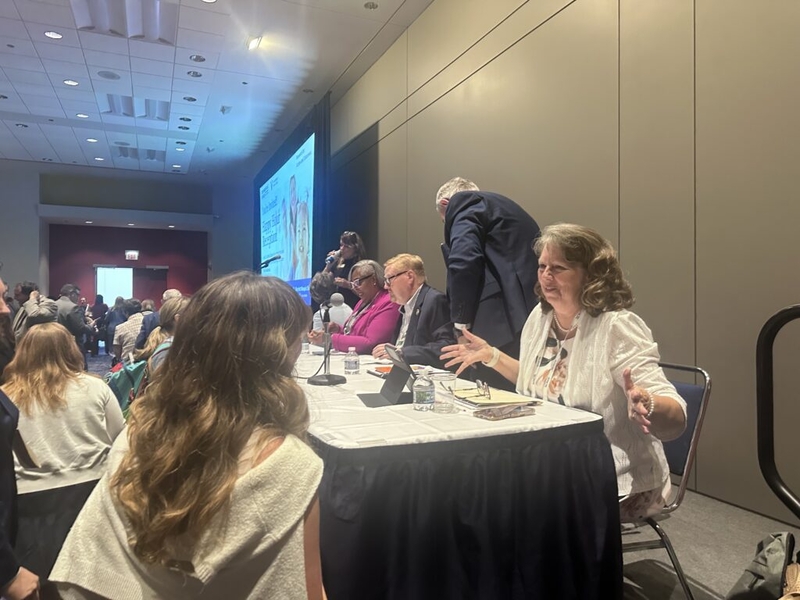
New Mexico Sen. Linda Trujillo (D-Santa Fe), right, speaks with attendees at the National Conference of State Legislatures in Chicago after presenting on national issues surrounding childcare. (Kevin Hardy/Stateline)
A bipartisan coalition of state lawmakers from around the nation on Monday identified lack of facilities and high costs as two leading challenges states are facing in addressing childcare needs.
The bipartisan group, which includes a New Mexico lawmaker, presented their findings at the National Conference of State Legislatures in Chicago, along with several proposed solutions.
The report found that nearly 30% of the nation has a childcare gap, meaning more children require care than daycare centers can accommodate. Economically, the report found that childcare averages a cost of $13,000 annually — and that infant care, in particular, can run as high as $27,000, roughly equivalent to the federal poverty rate for a family of three. And it found that the median annual wage for childcare professionals nationally is just $32,000.
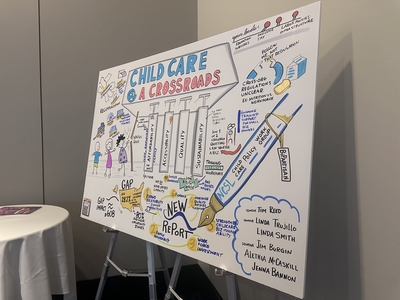
The panel proposed seven solutions: expand access and availability; address affordability; invest in the childcare workforce; modernize licensing and quality-rating systems; strengthen small childcare businesses; find for the future; and elevate state early childhood governance and leadership.
Monday’s discussion often turned to New Mexico, where Gov. Michelle Lujan Grisham in late 2025 announced the nation’s first universal childcare system. Earlier this year, the state Legislature passed a law that requires co-pays from some high-earning families during specific times of economic decline.
State Sen. Linda Trujillo (D-Santa Fe) told a room of conference attendees Monday that work to create the universal program had been underway for years, although many people in and out of New Mexico hadn’t heard of it until late last year.
“New Mexico didn’t just wake up one morning and say, ‘Hey, we’re going to provide universal childcare,’” she said.
In 2019, while a member of the state House of Representatives, Trujillo carried a bill to create the New Mexico Early Childhood Education and Care Department, which now oversees universal childcare. The next year, state leaders founded the Early Childhood Trust Fund with an investment of more than $300 million. The fund’s balance, which pays for universal childcare in large part, surpassed $11 billion earlier this year.
Jenna Bannon, associate director of the NCSL’s Children and Families Program, added that the very report conferencegoers discussed Monday was born in New Mexico. The bipartisan group of 13 state lawmakers first met in Albuquerque in mid-2025 to compare notes on their respective states’ challenges surrounding childcare access and affordability, she said.
The work, she said, was important because childcare has gone from being a family-based, private issue to a public, economic issue. Leaders in most every state are looking for direction on how to navigate the many issues childcare affects, particularly workforce development, she noted.
According to Bannon, the federal Bureau of Labor Statistics predicts about 160,000 job openings for childcare workers each year in the coming decade. If those workers can’t make livable wages, that can have an impact on households where both parents want to work outside of the home, she said.
“If childcare is the workforce behind the workforce, we have a problem on our hands.”
Trujillo said that problem is felt even in New Mexico, where every family is eligible for free childcare.
“Just because we say we have universal childcare doesn’t mean that we have universal access,” she said. “In Santa Fe, I have a working group of city councilors, county commissioners, community college and school board members because we have a shortage of 1,200 spaces for birth to 3-year-olds.”
Santa Fe, NM