LG&E and KU win approval to build gas-fired power for prospective data centers
Oct 30, 2025 | 5:51 pm ET
Description
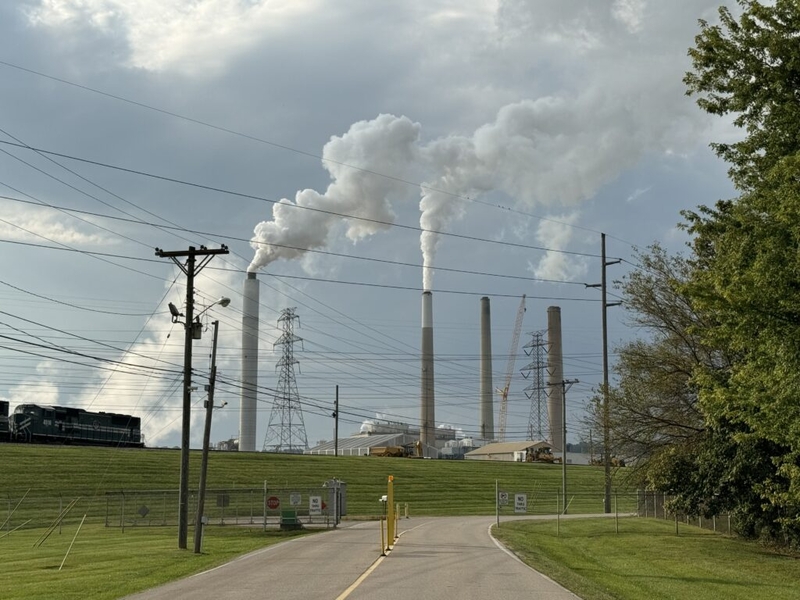
LG&E and KU's coal-fired Mill Creek Generating Station in September 2024. (Kentucky Lantern photo by Liam Niemeyer)
Kentucky’s utility regulator is granting permission to the state’s largest electric utility to build two new natural gas-fired power plants costing billions of dollars to meet a potential surge of power demand from prospective data centers seeking to locate in the state.
The Kentucky Public Service Commission in a Tuesday order wrote that Louisville Gas and Electric and Kentucky Utilities (LG&E and KU) demonstrated there is a market for power demand from data centers “in the immediately foreseeable future” large enough to make economic sense to allow for the construction of the gas-fired turbines.
The PSC — which is made up of three commissioners appointed by the governor and confirmed by the Kentucky Senate — also wrote in its 171-page order that while there is not “absolute certainty” that power demand from data centers will materialize, the electricity utility showed there is a “reasonable basis” that “economic development load is coming.”
Investor-owned LG&E and KU estimate the cost of the two combined-cycle gas-fired combustion turbines, each with a capacity of 645 megawatts, to total $2.798 billion in construction costs and related transmission work. One is to be sited the Mill Creek Generating Station in Jefferson County and the other will be at the E.W. Brown Generating Station in Mercer County. Utilities such as LG&E and KU are guaranteed a “return on equity,” or a set amount of profit approved by the PSC, on investments into power plants and other projects that are collected from ratepayers.
The utility, which serves more than 1 million customers with electricity and gas in the state, previously said the new power plants were needed to meet “unprecedented” projected electricity demand from prospective data centers looking to locate in the state. It’s a trend seen across the country due to a proliferation of power-intensive data centers supporting online services including artificial intelligence.
“These generation projects help ensure we continue to safely and reliably serve all customers and new economic development growth in the lowest reasonable cost manner,” said LG&E and KU president John Crockett in a statement.
The commission largely approved a settlement agreement proposed by several parties that intervened in the request to build the power plants, including the Republican Kentucky Attorney General Russell Coleman, the Kentucky Coal Association, Kentucky Industrial Utility Customers and the Southern Renewable Energy Association.
But not all aspects of the settlement were approved. The PSC did not grant a request to extend the life of a coal-fired power plant unit at the utility’s Mill Creek Generating Station beyond an approximate retirement date of 2027, writing it did not believe “it has the authority” under its current statutory framework. The GOP-controlled state legislature in recent years has passed laws specifying the conditions under which it can grant a utility’s request to retire a fossil fuel-fired power plant, generally making it significantly harder to retire such power generation.
The PSC also denied proposed mechanisms to recover costs associated with one of the new gas-fired power plants and an existing coal-fired power plant unit, writing that LG&E and KU could potentially propose those mechanisms again in the future.
Byron Gary, an attorney for the environmental legal group Kentucky Resources Council, represented a coalition of groups that did not agree to the proposed settlement agreement and were strongly concerned about ratepayers bearing the burden of costs of gas-fired power built for data center projects that may not ultimately be located in Kentucky.
A number of Kentuckians including some local elected officials testified to the PSC in August that the power plants could harm the climate, public health and burden ratepayers with costs.
“We’re disappointed that the commission has approved additional fossil infrastructure to feed speculative load growth,” Gary said. “But we did see some bright spots in their opinion, and we did value that in their attempt to balance some very difficult and very disparate competing interests.”
Gary specifically pointed to how the commission wrote about the difficulty LG&E and KU faces when determining which economic development projects, and their large power demand, will ultimately come to fruition. The commission wrote the utility had assigned various probabilities on the likelihood of various projects materializing. But the regulator found it “troubling” that the utility “did not provide evidence concerning how those probabilities were assigned.”
The commission urged LG&E and KU to put together a more transparent, evidence-based methodology to calculate the potential power load of prospective projects, including data centers, located in Kentucky.
“These same data centers that are calling and inquiring with LG&E, and therefore getting added to their economic development queue, were calling five, 10 other utilities. They’re shopping around,” Gary said. “We’re not sure yet which one of those five or 10 different utilities will be the one that ultimately serves any one of these data centers.”
The commission’s order also mentions testimony from Stacy Sherwood, a consultant with Energy Futures Group hired by the Sierra Club, that found residential electricity bills would increase significantly if the power plants are built but the data center power demand doesn’t materialize. Average Kentucky Utilities residential customers could see an increase of $23.05 per year, and Louisville Gas and Electric residential customers would see an increase of $138.07 per year, according to Sherwood.
Gary also said the commission was put in a difficult position by the utility’s request to build the power plants, presenting the gas-fired power as an “emergency situation” when the utility could have planned in advance with a wider range of options through demand-side management or adding more renewable energy. The wait times and costs for gas-fired turbines across the country have increased significantly with the surge in nationwide power demand, stretching up to seven years depending on the model of turbine. LG&E and KU agreed to pay $25 million to General Electric to reserve a “manufacturing slot” for one of its proposed gas-fired turbines.
The commission also opened up a separate case to monitor the construction and costs of one of the proposed gas-fired power plants LG&E and KU requested to build, serving as additional safeguards so that ratepayers “will not be harmed by the unnecessary construction” of the plant if power demand from data centers does not materialize.
The commission also cited written testimony from Lonnie Bellar, the executive vice president of engineering, construction and generation for the PPL Corporation, the parent company of LG&E and KU, in which he stated the utility wouldn’t build one of the two proposed gas-fired power plants if it would be “imprudent” to do so.
“The Commission expects LG&E/KU to follow through on their statement that if load growth does not materialize as reasonably anticipated, that LG&E/KU will not build CPCN-approved facilities when it was not least-cost to do so,” the regulator wrote in its order.
Frankfort