Embattled former Utah Supreme Court justice, judge discuss staying silent even amid controversy
Jul 02, 2026 | 5:48 pm ET
Description
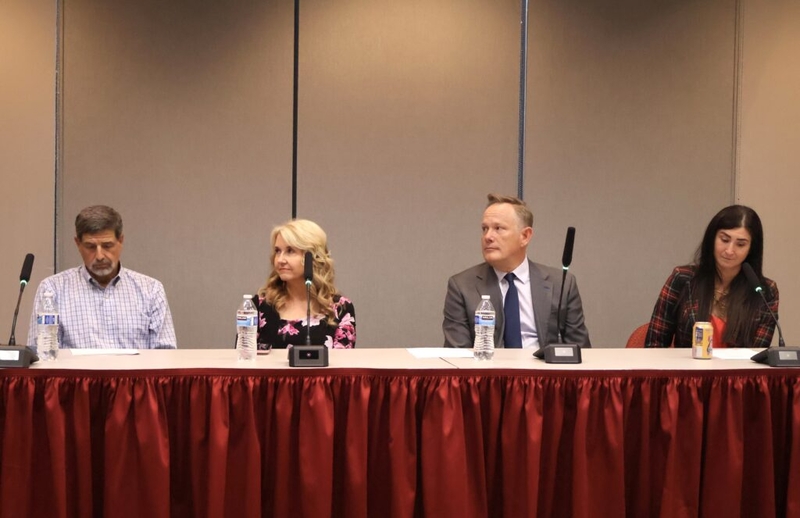
From left, retired 3rd District Judge Barry Lawrence, former Utah Supreme Court Justice Diana Hagen, 7th District Judge Don Torgerson, and 3rd District Judge Patricia Kuendig participate in a panel discussion at the Utah Law & Justice Center in Salt Lake City on June 29, 2026. (Photo courtesy of the Utah State Bar)
Current and former judges — including two who have recently caught the ire of Utah legislative leaders — participated in a panel discussion to offer “rare, behind-the-bench” perspectives on what it’s like serving in the judiciary, according to the Utah State Bar.
Former Utah Supreme Court Justice Diana Hagen — who resigned in May after Utah’s top Republican leaders called for an independent investigation into previously dismissed allegations that she had an affair — and 7th District Judge Don Torgerson — whom the Utah Legislature censured earlier this year for comments he made from the bench in a child pornography case — both participated in the panel Monday.
Retired 3rd District Judge Barry Lawrence and newly appointed 3rd District Judge Patricia Kuendig also participated.
The panel, held at the Utah Law & Justice Center in downtown Salt Lake City, was a Continuing Legal Education discussion to educate Utah lawyers and to help them meet mandatory continuing education requirements. In-person attendance to the panel wasn’t open to the media or the public — but the Utah State Bar posted a recording of it on YouTube on Wednesday. Nearly 400 attorneys attended in person and virtually, according to the bar.
Hagen and Torgerson were not directly asked about the controversies surrounding them, nor did they address them head on. Rather, the questions from Lawrence, who acted as a moderator, focused generally on what it’s like to serve in the judiciary and how judges insulate themselves from “public clamor” while making decisions, as they’re required to under judicial rules and the law.
The main focus of the panel discussion was to address common misconceptions about how judges make decisions while encouraging qualified and hard-working legal professionals to apply for Utah’s judicial positions, even if the job is tough and taxing.
Amid affair allegations, Utah Supreme Court Justice Diana Hagen resigns
The discussion came “at an important time for Utah’s judiciary,” according to a news release issued by the Utah State Bar, which noted that several judicial districts have seen “significant turnover in recent years, creating opportunities for experienced attorneys to pursue judicial service and helping ensure that Utah’s courts continue to be staffed by highly qualified, ethical and dedicated judges.”
Utah State Bar President Kim Cordova thanked the judges and Hagen “for their willingness to candidly share their experiences with fellow attorneys,” she said in a prepared statement. “Judicial service is one of the most important ways lawyers can serve the public, yet many attorneys never have the opportunity to hear firsthand what life on the bench is really like.”
Hagen’s recent resignation came after the Utah House, in response to a public records request from KSL, released a previously dismissed complaint alleging she had an extramarital affair with an attorney involved in the state’s high-profile redistricting case. The Judicial Conduct Commission had dismissed the complaint as lacking evidence and credibility, but Gov. Spencer Cox and Utah’s top Republican legislative leaders called for an independent investigation into the claims after the story was reported.
Hagen denied the allegations, but to avoid dragging her family into the independent investigation, she resigned.
Utah Supreme Court says affair allegations against justice were ‘inappropriately’ released
During a sentencing hearing last year for a child pornography case, Torgerson twice referenced the 22-year-old defendant’s “privilege,” KSL-TV reported. The judge also said he had “seen worse” depictions of child sexual abuse after watching two videos the defendant possessed showing children being raped and abused, though he added he didn’t mean to “minimize” what the defendant did.
One of Utah’s top Republican legislators, House Speaker Mike Schultz, R-Hooper, repeatedly criticized Torgenson’s comments as offensive and inappropriate. Earlier this year, Schultz was a driving force behind a House resolution “admonishing and censuring” Torgerson with the stated purpose of sending a message to voters not to retain him when he’s up for retention election in 2028.
The Senate did not sign on to the resolution, with at least one senator in Republican legislative leadership calling it “misguided” while pointing out that a prosecutor in the case who wanted a harsher penalty agreed to drop the felony counts that were dismissed.
Hagen, Torgerson on staying silent, even amid controversy
When Lawrence asked about how they handle the “challenges of being a judge” and the fact that “you give up some of your rights when you become a judge,” including engaging in politics to “maintain the integrity of the judiciary,” Torgerson said it can be a “tricky thing in the modern world with modern technology.”
“Because the least informed people are usually the loudest,” Torgerson said, “and they tend to have lots of people who glom onto their opinion of the world, and they’re typically uninformed about how the court process works.”
Utah House passes resolution ‘admonishing and censuring’ judge
Torgerson noted that judges are generally prohibited from commenting on pending and impending cases, adding that the “the court’s historical practice has typically been, you know, stay silent. Let your work speak for itself.”
“I think that’s wise, not just as a way to proceed as a judge, but also it helps us comport with those requirements, that we not comment when we shouldn’t be commenting,” he said, though he added, “it’s tough, because people comment, people say things. But it’s a cycle that you can’t win as a judge. We don’t have … access to the news media outlets in the way that other people might.”
He noted Utah’s judges are not elected — so they can’t campaign like judges do in other states. So he said Utah’s judiciary hasn’t engaged with the public as other states’ have.
“We’ve considered whether we should do more of that at the judiciary, whether that would be informative and helpful. Whether that happens or not in the future, I still would rather have the appointment process that we have in Utah over the elected judiciary that they have in other locations,” he said. “I think it’s a better process. And if the trade off is, you know, we tend to be more silent and we tend to not be able to fight back against criticism quite the way maybe other places could, I think that’s a worthy trade off.”
When Lawrence asked Hagen why it’s important to “remain above the fray” as much as possible, she said “because the courts really speak through their opinions.”
“Because we’re not a representative, elected branch of government, we’re not designed to respond to public criticism or public clamor about certain issues,” she said. “And we also need to speak with an official voice. If we are commenting on our decisions or the operations of the court and it conflicts with something we’ve put in our opinions, which is binding law, that’s going to be a problem as well.”
Hagen added that justices also “want to maintain the dignity of the court, as well.”
“We are not politicians, and we don’t want to be dragged into the fray in that same way,” she said. “We want to maintain the public’s trust and our integrity.”
Threats to judges, especially women
Lawrence pointed to another challenge facing judges that he said has grown dramatically amid the social media age — threats to state and federal judges, including online attacks.
“It’s a real problem,” Torgerson said, adding there were nearly 1,000 threats made against Utah judicial officers last year. “You know, it’s a concerning thing.”
Utah judiciary issues rare statement addressing threats against judge in redistricting case
Rural judges like himself have a “different experience than urban judges,” he said, “because we’re at soccer games and high school sports and those kind of things where we see people all the time who are appearing before us as litigants, and it’s kind of a tricky thing to navigate.”
Torgerson said he doesn’t “generally feel unsafe,” but he partly credited that to him being a man.
“A practical reality of this job is that women receive far more serious threats as judicial officers than men, and I think that’s a sad commentary on … the world we live in,” he said. “But for some reason, people believe that women as judicial officers deserve to get the kinds of threats that have nothing to do with their cases (but) have everything to do with the gender.”
Torgerson said he doesn’t receive “those kind of threats, (but) I get told that I’m dumb and, you know, stupid, and shouldn’t be on the bench, and those kinds of things, which I’m fine with,” he said.
Hagen agreed with Torgerson, but added that court security is “amazing,” and she felt the court system always took protective measures when it was necessary.
“As a judge, I felt like the court had my back and that I … was not afraid for my physical safety or that of my children,” she said. “Now that does not mean that there have not been invasions of privacy. That is difficult, and … it’s really difficult for the court to protect you against.”
Dealing with high-profile cases, ‘public clamor’
Hagen played a role in one of Utah’s highest-profile cases to come before the state Supreme Court: the League of Women of Voters of Utah anti-gerrymandering lawsuit.
That lawsuit, after being previously dismissed at the district level, was restored and remanded back to 3rd District Judge Dianna Gibson after the Utah Supreme Court in 2024 issued a unanimous opinion that Gibson had erred when she dismissed the claim that the Utah Legislature had overstepped when it repealed and replaced Proposition 4. The 2018 voter-approved ballot initiative created an independent redistricting commission and banned partisan gerrymandering.
After that ruling, Gibson called for a court-ordered redistricting process to remedy the Legislature’s 2021 congressional map — which she deemed unlawful as the result of an unconstitutional process — and the ensuing court process ultimately resulted in her picking a map drawn by plaintiffs instead of the one drawn by lawmakers because she determined the Legislature failed to produce a remedial map that adhered to Proposition 4’s neutral map-drawing standards.
Utah Supreme Court rejects Legislature’s redistricting appeal; court-ordered map still stands
To Republican lawmakers’ dismay, the court-ordered map created a Democratic-majority district concentrated around northern Salt Lake County. Attempts to overturn that map ahead of the 2026 elections failed, but they are likely to seek to replace it before the 2028 elections.
During Monday’s panel discussion, when Lawrence asked how the judges deal with “high-profile” cases, Hagen said people often don’t understand the appellate court system’s role in deciding contentious issues.
“People have the misconception that we are trying to decide the ultimate issue, like whether something should be legal or something should be against the constitution, and we’re usually deciding a very, very narrow issue,” she said. “We’re often arguing over very arcane procedural issues.”
She said the issues that decide their cases are usually “not as sexy as people might think. Even in the cases that draw a lot of attention, we’re often deciding a very narrow question of law.”
To a question about whether they’ve “ever been in a position where you felt compelled to decide a case in a certain way because of public perception, opinion, or political pressure,” Lawrence said “of course there are cases where you feel it and you’re aware of it, and our job is to ignore that.”
Utah Supreme Court hands big win to plaintiffs in anti-gerrymandering lawsuit
Torgerson referred to a judicial conduct rule that requires judges to uphold the law “fairly and impartially,” which he said is “for the most part, a fairly easy cannon to apply.”
“There are times, though, that I catch myself,” he said, “and I think … ‘Am I doing this thing because it’s the right outcome or am I doing this thing because it’s the outcome that’s the least painful for everybody?’ And I think we as judges have to make sometimes a conscious effort to remember to do things because it’s the right outcome, and I think every judge that I’ve ever met does that.”
Torgerson added that oftentimes judges must make decisions that “make somebody unhappy. That’s unfortunately the real obligation of the courtroom.”
“Regardless of how much public clamor there may be and regardless of what the people in the room may think we should be doing, (we must) apply the law in a fair and just way for everybody,” he said. “If you can imagine a scenario where someone in a position of authority or influence could come into the courtroom against someone who didn’t have that … and those parties felt like the person with authority and influence would win simply because of their position and status in the community, that would be a disheartening place to be.”
When asked about public pressure on cases, Hagen said the appellate courts simply “don’t have a lot of discretion” when they make decisions.
“You as lawyers understand that when we’re trying to decide if something’s constitutional or unconstitutional, we’re looking at whether it exceeds the Legislature’s or the executive branch’s ability to make a decision because of a particular provision of the constitution,” she said.
But Hagen said “I truly believe most of the general public thinks that what unconstitutional means is that it’s really unfair or a really bad policy idea. But we all know that we’re actually applying actual provisions and actual language.”
“When you zero in on the real job of deciding the case … for me at least it was fairly easy to not listen to public clamor,” she said. “Because really, that debate is about something else. That debate is about ‘shoulds,’ not what the law requires.”
Salt Lake City, UT