Ayotte vetoes nine bills, including book ban push and toll increases for out-of-state visitors
Jul 02, 2026 | 5:57 pm ET
Description
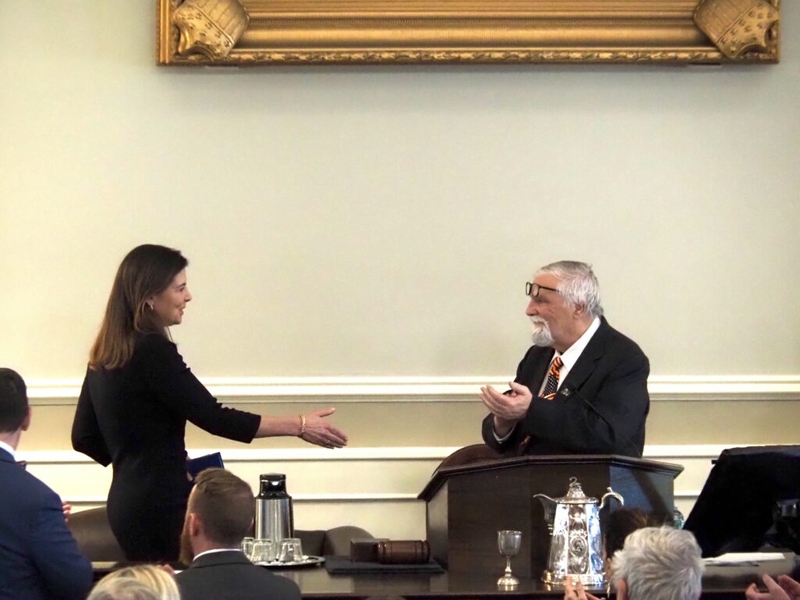
Gov. Kelly Ayotte greets fellow Republican and House Speaker Sherman Packard ahead of her State of the State address, Feb. 5, 2026. (Photo by Ethan DeWitt / New Hampshire Bulletin)
Nearly two years into her tenure, Gov. Kelly Ayotte has become comfortable with a veto pen.
The Republican governor vetoed nine bills Thursday, many of them lightning-rod political issues and priorities of lawmakers in her party. Months before the November general election, she took a red pen to conservative proposals to increase book removals in schools, protect conscientious objectors to abortion, and allow landlords to require a second security deposit for certain tenants.
The rejections, which came just before the July 4 holiday weekend, bring Ayotte’s 2026 veto tally to 24 so far. That’s double the number of bills she vetoed in 2025 and is likely not the final count. More bills are heading in her direction, including House Bill 1442, the “bathroom bill” that would allow businesses to separate bathrooms, locker rooms, sports teams, and other accommodations by biological sex. Ayotte has vetoed similar legislation three times.
The action underscored an ongoing dynamic in Concord: a moderate governor sharing uneasy power with an emboldened Republican Legislature. In comparison, former Gov. Chris Sununu, who also endured friction with conservative lawmakers, vetoed 13 bills in 2024, his last year in office.
Here are some of the bills that Ayotte rejected this week.
Ayotte shuts down an abortion-related measure
On the campaign trail in 2024, Ayotte — then just a gubernatorial hopeful — promised she wouldn’t further restrict abortion in New Hampshire.
She reiterated that promise in her 2025 inaugural speech, addressing her own party: “If you send me legislation that further restricts access to abortion beyond our current law: I will veto it.”
The right flank of her party has tested the bounds of what that means.
Since 2021, abortion has been legal in New Hampshire within the first 24 weeks of pregnancy. Lawmakers haven’t passed any legislation changing that. They have however pushed bills impacting other aspects of the procedure.
House Bill 232 is one of those bills. It would enshrine into law an employee’s rights not to participate in abortion due to “sincerely held religious belief or moral conviction.” Healthcare facilities would be required under the bill to annually provide employees with written notice of their right to request reasonable accommodations, and give them the right to file complaints with the state over denied accommodations.
Ayotte vetoed the bill, arguing that the federal government already has strong enough protections.
“Federal law has long protected the religious beliefs or moral convictions of medical professionals and the right to decline to perform or assist an abortion,” she said in her veto message Thursday. “This federal right of conscience protects those in New Hampshire who work for abortion providers. Therefore, this bill is unnecessary and does not create any greater protections for New Hampshire medical professionals.”
In a statement Thursday, Kayla Montgomery, of Planned Parenthood of Northern New England, said: “On behalf of the Granite Staters who overwhelmingly opposed this anti-abortion bill, a solution in search of a problem, we thank Governor Ayotte for keeping her vow to veto anti-abortion legislation. Over the past two years, the Legislature considered 16 anti-abortion bills, and all have failed thanks to the commitment and determination of reproductive health and rights supporters, advocacy organizations, legislators, patients, and providers.”
The veto was a blow to the GOP’s more conservative members. State Rep. Katy Peternel, a Republican proponent of the bill, had argued on the House floor earlier this year that it wasn’t an abortion restriction, but rather it was simply meant to “protect health care professionals from being forced to participate in the ending of a human life.” She said the bill would allow “New Hampshire to attract providers who value motherhood and family.”
Toll increases struck down
Ayotte also vetoed a bill that would have doubled the tolls for out-of-state visitors to New Hampshire — a bid by lawmakers to help pay for infrastructure upgrades.
“I have clearly said that I do not support raising the tolls,” she wrote in her veto message.
Senate Bill 627 would increase the tolls for people who drive without a New Hampshire E-ZPass. That would apply to anyone paying in cash, anyone driving with a different state’s E-ZPass transponder, and anyone driving through a toll without any transponder.
The toll increases in the bill vary depending on the toll location. The non-New Hampshire rate at the Hooksett tolls on Interstate 93 would increase from $1 to $2, for example.
Ayotte said she voted for the bill “to focus on making New Hampshire more affordable for all and a destination for tourists in the region.”
Governor nixes study into universal charter schools
A proposal to look into converting all New Hampshire public schools to charter schools was also vetoed Thursday. Ayotte said that while she supports school choice, it was a step too far.
“While I fully support education freedom allowing every child to be in the learning environment best for them, including innovative public charter schools, I cannot envision a future that does not include public schools,” Ayotte wrote in her veto message.
Currently, individuals or organizations may apply to the State Board of Education to create a charter school. If approved, those schools can receive funding directly from the state, at a minimum of about $9,000 per student per year, and may also seek federal grants and private donations.
While there are some rules — they must be tuition-free and must submit to standardized testing, financial reporting, and state audits — charter schools also have more freedom than public schools on teacher certifications, school calendars, and curricula.
Sponsored by House Majority Leader Jason Osborne, an Auburn Republican, House Bill 1358 would create a commission that would explore making that model the default for all public schools.
According to the bill, the commission would include state representatives and senators; the Department of Education; a charter school representative; a public school representative; and a member of the state advisory committee on students with disabilities.
The commission would be tasked with looking at whether a charter school model would save taxpayers money, increase local control and autonomy, make state education funding more efficient, and boost student achievement, teacher recruitment, and community engagement.
‘Book ban’ bill vetoed again
Ayotte also vetoed a Republican-led bill to make it easier to remove books and other materials in public schools, the second time she has vetoed such legislation.
House Bill 434 would require school districts to establish formal policies for removing content from schools that is “obscene and harmful to minors.”
The bill would create a standardized removal process in which parents could challenge any book, magazine, film, video, web-based content, sound recording, or live performance offered to students.
The legislation defines material harmful to minors as any that appeals to a minor’s “prurient” interest in sex or depicts or describes sexual conduct in a manner “so explicit as to be patently offensive to contemporary adult standards … with respect to what is suitable material to minors.”
The definition exempts any material with “serious literary, artistic, political, or scientific value.”
Republican lawmakers have pushed for similar legislation for years, arguing it is necessary to remove content that is graphic to the point of being pornographic.
Among the books targeted — in New Hampshire and elsewhere — are “The Perks of Being a Wallflower,” a 1999 novel by Stephen Chbosky that describes sexual assault and masturbation; “Gender Queer,” a 2019 graphic novel by Maia Kobabe about LGBTQ+ self-realization that depicts oral sex and masturbation; “Jarhead,” a 2003 memoir by Anthony Swofford about the Gulf War that includes some sexual content; and “Tree Girl,” a 2004 novel by Ben Mikaelsen centered on the Guatemalan Civil War that describes war crimes, including massacres, torture, and rape.
Opponents of the content removal bill say the challenges typically land on books featuring marginalized characters such as people of color and LGBTQ+ people, and that removing them deprives students of the opportunity to explore diverse experiences. The opponents include the American Booksellers Association, the American Civil Liberties Union, LGBTQ+ advocacy groups, Black Lives Matter New Hampshire, and teachers’ unions.
Most school districts already have removal processes in place. The New Hampshire School Boards Association has distributed a “model” policy for such policies to school boards since 2004.
For instance, Section 3000 of the Milford School District’s policy allows a parent to submit a “request for reconsideration” of materials in the library or classroom to the school’s principal.
Under the Milford policy, the principal must form a reconsideration committee within 10 days, which has 45 days to look into the request and five days to make a decision. The parent can appeal a decision to the superintendent and then to the school board, but if the request is denied, that specific book cannot be challenged for three years, the policy states.
The process in HB 434 has some similarities to Milford’s policy: complaints must be brought by parents, and school boards have the final say.
But the policy in the bill would be stricter. To start, HB 434 imposes specific criteria on what counts as material harmful to minors. Milford’s policy has no set criteria; the committee has full discretion.
HB 434 would rule out the creation of a committee by the principal. Instead, all complaints would be initially handled by the superintendent, and the decision would be required within 25 days, a tighter turnaround.
And HB 434 does not allow for the three-year moratorium on future challenges, meaning a book could be challenged repeatedly.
State law, RSA 186:11, IX-c, already allows a parent to opt their child out of certain course material on an individual basis, without removing it for other students, as long as the parent makes an arrangement for a suitable alternative.
Supporters of the content removal bill say it is laborious for every parent to follow that process, and that some material is so obscene it should be removed school-wide.
But Ayotte pointed to the mechanism in her veto Friday, echoing an argument she made when vetoing the 2025 version of the bill.
“As a parent, I understand and appreciate the concerns parents have about their children being exposed to age-inappropriate or objectionable materials in schools,” Ayotte wrote. “At the same time, existing New Hampshire law already requires school districts to adopt a policy allowing an exception to specific course material based on a parent’s determination that the material is objectionable.”
Other bills vetoed
Ayotte announced five other vetoes Thursday: House Bill 1337, a bill to eliminate the state’s Council on Autism Spectrum Disorders that advises state agencies on autism-related matters; House Bill 1442, a bill eliminating the three-year deadline for convicts to request a retrial on the basis of new evidence of their innocence; House Bill 1610, a bill requiring school districts to obtain voter approval to retain unused budget funds; Senate Bill 535, a bill exempting residential animal breeders from state regulations for commercial kennels; and House Bill 1336, a bill allowing landlords to require an additional month’s deposit for tenants with low incomes or low credit scores.
Lawmakers can override any of these vetoes with a two-thirds majority vote in each chamber. The Legislature will meet sometime later this year to hold those votes.
Concord, NH