Arkansas ends fiscal year with $655 million budget surplus
Jul 02, 2026 | 5:49 pm ET
Description
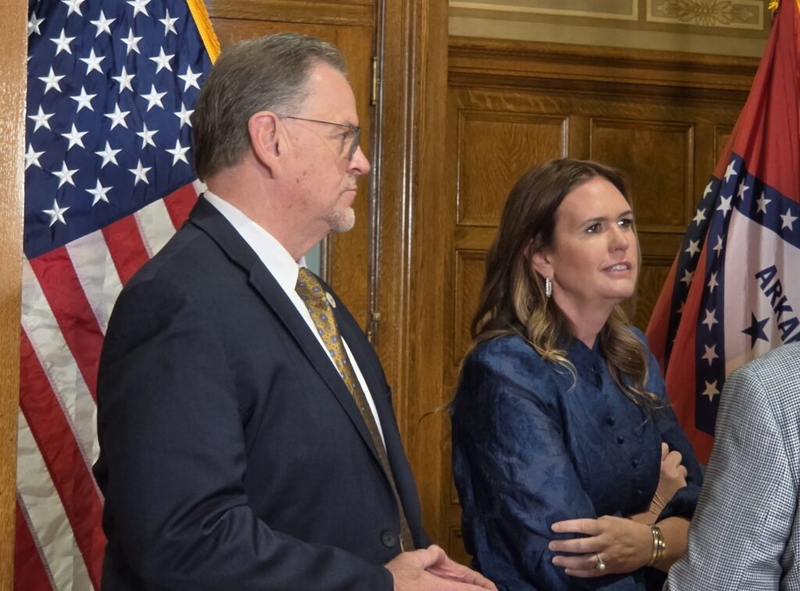
Arkansas House Speaker Brian Evans, a Cabot Republican, and Gov. Sarah Huckabee Sanders chat after a news conference at the Arkansas Capitol on July 1, 2026. (Photo by Tess Vrbin/Arkansas Advocate)
Arkansas ended the 2026 fiscal year Tuesday with a $655 million budget surplus, nearly $300 million more than the previous year, the state Department of Finance and Administration announced Thursday.
The surplus is the fifth-largest in state history, the largest being $1.628 billion four years ago. That surplus led lawmakers to cut income tax rates, which they have done four more times since then.
With the surplus for the budget year that ended Tuesday, the state’s reserves have grown to $4 billion, finance officials said.
Gov. Sarah Huckabee Sanders, who took office in 2023, said in the news release that the state’s surplus and revenue collections prove “conservative leadership works.”
“I look forward to continuing our close collaboration with the legislature to slow the growth of government, expand our economy, and responsibly phase out our state income tax,” Sanders said.
She reiterated her support for eliminating the income tax at a Wednesday news conference announcing an online database of government cost-saving efforts, the Arkansas Forward Dashboard.
The state collected nearly $8.7 billion for the fiscal year, a $327 million increase from the previous year. Individual income taxes brought in more than $3.8 billion and state sales and use taxes brought in more than $3.6 billion, according to the finance department’s news release.
About $7.15 billion is available after the state’s required payments such as tax refunds.
The surplus funds have been placed in the General Revenue Allotment Reserve Fund, which totals more than $1.2 billion, according to the finance department’s news release. The state also has $1 billion set aside in reserves and an additional $1.8 billion saved for emergencies.
These reserves “are at record levels,” and the “especially strong” tax collection totals indicate that “Arkansans are doing well,” Finance and Administration Secretary Jim Hudson said in the news release.
S&P and Moody’s both praised Arkansas’ budgeting practices and reserve levels when issuing their second-highest credit ratings to the state’s general obligation bonds, according to a Tuesday news release from the state finance department.
Senate President Pro Tempore Bart Hester, a Cave Springs Republican, echoed Sanders’ intent on Thursday to continue to cut income taxes next year.
Arkansas’ top income tax rate dropped from 7% to 4.9% under Sanders’ Republican predecessor Asa Hutchinson, who served from 2015 to 2023. The four tax cuts implemented during Sanders’ term have lowered the top rate to 3.7%.
Legislative Democrats have consistently opposed cutting taxes, saying it brings in less funding for social services when Arkansas has the nation’s highest food insecurity rate and when federal Medicaid cuts will kick in later this year.
Democratic and some Republican lawmakers have questioned the growing cost of the state’s school voucher program, one of Sanders’ highest policy priorities.
Senate Minority Leader Greg Leding, a Fayetteville Democrat, repeated his concerns Thursday that the state should not continue to “ignore some urgent problems for the sake of being able to accomplish this political goal” of achieving budget surpluses.
“No family ever sits down at their kitchen table to do their budget with the goal of being able to give money back to their employer,” Leding said. “So if you’re budgeting with the intent of cutting taxes, of course you’re going to have a surplus.”
Leding also noted that a surplus is never guaranteed year after year and that tax cuts are an ongoing expense.
In June, Sanders directed cabinet secretaries to “do more with less” and “work collaboratively to cut costs” in their departments in preparation for continued tax cuts.
Little Rock