New survey suggests Portland unsheltered population far larger than previous counts
Jul 02, 2026 | 5:05 pm ET
Description
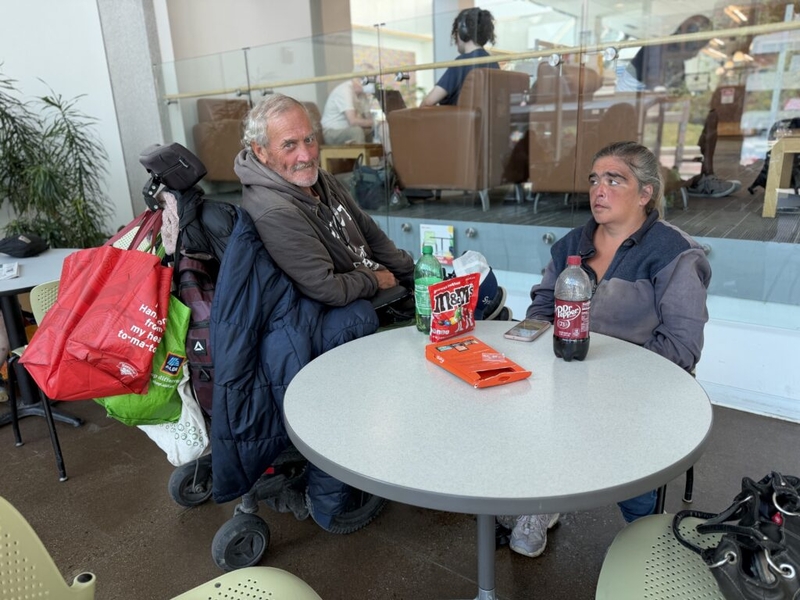
Robert Demmons and his wife Dawn Bruns use the cooling center at the Portland Public library. (Photo by Eesha Pendharkar/Maine Morning Star)
Robert Demmons has been unsheltered for six years, and his wife, Dawn Bruns, for three. On Thursday, so far the hottest day of the year, they sat inside the Portland Public Library, designated by the city as a cooling center as temperatures climbed into the 90s.
The hardest part of living on the street is the weather, Demmons said.
He relies on an electric wheelchair because of worsening arthritis, seeking shelter under awnings and in vestibules in the Old Port whenever he can. Sometimes he and Bruns find beds at Milestone Recovery, but they have been unable to secure stable housing for years.
“I don’t want to still be out here this winter, I’ll probably freeze to death,” he said. “If they give us a helping hand, help get us off the streets, we’d be a good part of society.”
Demmons’ experience reflects what Preble Street found to be the most common challenge of people experiencing chronic unsheltered homelessness: the daily struggle to meet basic needs. In the first survey of unsheltered homelessness conducted by the nonprofit, outreach workers identified 104 people living outdoors in Portland over nearly three weeks last November and interviewed 82 of them about their experiences.
The survey, released this week, was designed to capture a more complete picture of unsheltered homelessness than the federally mandated point-in-time count, which measures statewide homelessness on a single night each January. Preble Street found that more than 90% of respondents had experienced homelessness for at least a year.
By comparison, the 2025 Maine Point-in-Time count identified about 20 people experiencing unsheltered homelessness across all of Cumberland County and 281 statewide. Having a more accurate estimate makes it easier for nonprofits and municipalities to address the needs of unhoused people, according to Andrew Volkers, director of health services at Preble Street.
“We know that the longer somebody is outside, it can just compound things over time, and increase barriers, increase health concerns,” Volkers said. “Ultimately we don’t have enough affordable housing and permanent supportive housing options, which then leads to more people needing to utilize shelters, which then leads to less beds (available), which then leads to more people staying outside.”
The survey’s release came just before Maine experienced its first prolonged stretch of extreme summer heat. According to Preble Street, people living outdoors are facing increased risks of dehydration, heat-related illness and prolonged sun exposure, while limited access to shelter, food and bathrooms makes those conditions even more dangerous.
For Demmons and Bruns, the public library offered more than relief from the heat. It gave them access to bathrooms, a place to charge the phone they share, and an outlet for Demmons’ electric wheelchair.
The survey found that basic necessities remain difficult to access for many people sleeping outside. Eighty percent of respondents reported having limited or no access to bathrooms, while 72% had limited or no access to showers. Only 6% said they had consistent daily access to food.
Demmons said food is one of the easiest resources to find, thanks to the city-run distribution center on Cotton Street and a downtown Portland church. Bathrooms and places to charge his phone, tablet and wheelchair, however, are much harder to come by.
“If they catch us there, they shut power off, because they don’t care about us,” he said. “And there’s only certain places you’re allowed to go and use the bathroom without being hollered at.”
“I think they’re probably stereotyping us with the people that don’t pick up after themselves and leave their garbage around, and that’s sad,” he added
Augusta, ME