Polis fires clemency board members said to have breached confidentiality in Tina Peters case
Jul 02, 2026 | 6:26 pm ET
Description
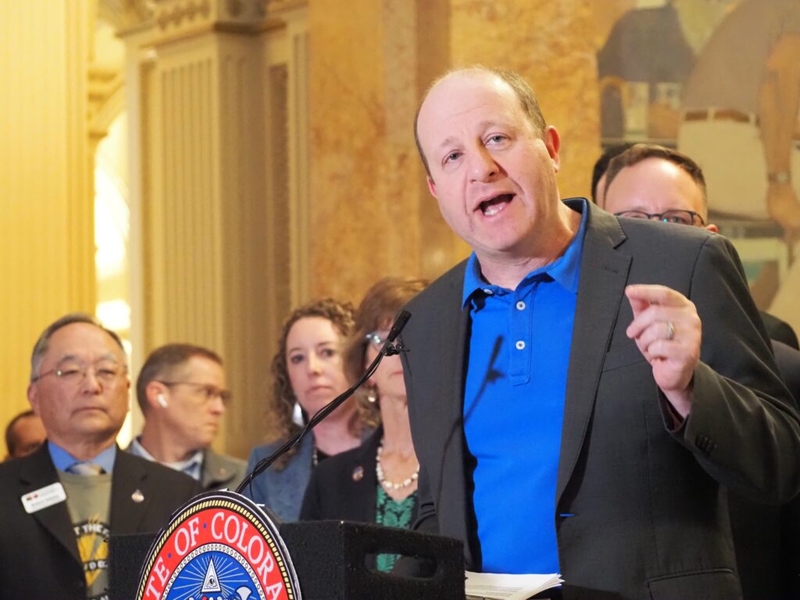
Gov. Jared Polis speaks during an Agriculture Day event at the Colorado Capitol on March 24, 2026. (Photo by Sara Wilson/Colorado Newsline)
Colorado Gov. Jared Polis fired two members of his clemency advisory board who spoke publicly about the board’s recommendation against releasing Tina Peters.
Peters, the former Mesa County clerk and election denier who was convicted and sentenced for her role in a breach of her office’s election system, was released from state prison on June 1 after Polis cut her sentence in half under pressure from the Trump administration.
Peters visited President Donald Trump at the White House earlier this week.
Polis granted Peters clemency in spite of two unanimous votes from his Executive Clemency Advisory Board denying her application. Board members Azra Taslimi and Hannah Seigel Proff wrote an op-ed in The Denver Post detailing the board’s votes and why they disagreed with Polis’ decision. They also spoke to the New York Times, which first reported the firings Wednesday.
Board votes and proceedings are confidential within the governor’s office, according to an executive order, and breach of that confidentiality by Taslimi and Proff resulted in their termination, according to a letter Polis sent to the former board members. No other votes of the board under Polis have been publicly disclosed.
“Maintaining the integrity of the clemency review process and preserving the confidentiality of Board deliberations are essential to the Board’s mission and the trust placed in its members,” Polis said in his letter to Taslimi, which Newsline reviewed. “As a result, your continued service on the Board is inconsistent with the requirements of the Executive Order.”
The standard that was applied to Tina Peters doesn’t exist anywhere in writing. It was invented for her, in response to pressure, and then dressed up as mercy.
Taslimi, a civil rights and employment attorney, served as an at-large member of the board. Proff, a juvenile defense attorney, served as a representative of juvenile justice and child welfare. Polis appointed two new members to the board Wednesday “occasioned by a vacancy.”
Colorado Gov. Polis cuts Tina Peters’ prison sentence in half
The people inside of a government process should be able to speak publicly about it when the outcome “raises serious questions of fairness and equal justice,” Taslimi said. That doesn’t undermine the process, but makes it better through accountability, she said.
“We were removed because we dared to bring transparency to the process,” Taslimi said in a statement. “It’s not that we disagreed with Polis’s decision. It’s that nobody on the outside could see what standard was being applied, because the standard that was applied to Tina Peters doesn’t exist anywhere in writing. It was invented for her, in response to pressure, and then dressed up as mercy.”
Polis spokesperson Eric Maruyama said public disclosure of board recommendations and individual votes “threatens the credibility of the board, colors future deliberations by the board and breaks clearly stated confidentiality policy” in the executive order. He said Taslimi and Proff were terminated not because they publicly disagreed with Polis’ decision, but because they disclosed how they and other members of the board voted.
“Strict confidentiality in the clemency process protects victims, applicants, witnesses, and the board members’ ability to have candid conversations about very difficult recommendations and topics,” Maruyama said in a statement. “Victims and applicants need to be secure in the confidence that any deliberations or votes by the board are confidential to avoid trauma and maintain privacy.”
Proff told Newsline Thursday that she is disappointed but not surprised that Polis removed her and Taslimi from the board.
“I really loved doing this work. It was an immense privilege to get to sit on the governor’s clemency board for 7.5 years,” Proff said.
They both knew the risk of speaking publicly about the process, Proff said, and she has no regrets. Proff said she and Taslimi felt compelled to speak about the board votes in part after seeing how Trump has undermined the federal clemency process.
“It felt like we had to speak out as soon as we saw anything similar to that happening at the Colorado level,” Proff said.
“I think that it is our role in a democracy to shed light on unjust processes. We have a federal clemency process that has … allowed allies and friends to go free, while others languish in prison,” Proff said. “And honestly, we spoke up to stand up for the Colorado process that … we worked so hard for and supported for so long.”
Polis is term-limited and will exit the governor’s office in January. The Colorado Department of Corrections’ web page on clemency says it is too late to apply for clemency from Polis, and anyone who wants to apply may do so under the next governor starting in January. Polis has said he will issue another round of clemency decisions before the end of his term.
Each governor has the ability to change the structure and members of their advisory boards, and the governor maintains full authority to override any of their recommendations. Former Gov. John Hickenlooper’s executive order setting up his clemency board also required confidentiality within the governor’s office, as did former Gov. Bill Ritter’s order.
Phil Weiser, Colorado’s attorney general, won the Democratic nomination for governor in the primary election Tuesday. He and Coloradans from across the political spectrum criticized Polis’ decision to release Peters. That includes Republican Mesa County District Attorney Dan Rubinstein, who prosecuted Peters; every single Democratic member of the state Legislature; several prominent conservative commentators on state politics; and the bipartisan Colorado County Clerks Association.
Trump targeted Colorado over the state’s incarceration of Peters, whom he illegitimately pardoned in December. The president threatened “harsh measures” if she wasn’t released, which included the veto of a unanimously passed bill to fund a southern Colorado water project, the denial of two disaster declaration requests, and the proposed dismantling of Boulder’s National Center for Atmospheric Research.
Denver, CO