Elections panel approves guidelines to ‘address the canvassing issue’
Jun 10, 2026 | 2:26 am ET
Description
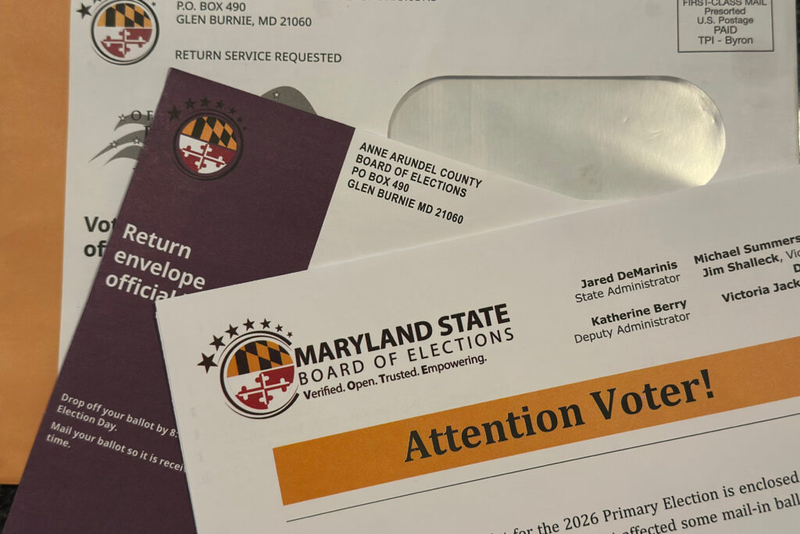
Maryland election officials approved easier-to-understand guidelines explaining how mail-in ballots will be handled following an error that resulted in 437.000 replacement ballots having to be sent to voters. (Photo Bryan P. Sears/Maryland Matters)
Maryland’s five-member state election board unanimously approved a set of public guidelines Tuesday laying out how thousands of mail-in ballots will be tabulated for the primary election.
The guidelines were needed to address the “canvassing issue” created when more than 437,000 mail-in ballots had to be replaced late last month. The rules made public Tuesday lay out instructions on how local election boards are to treat the original, potentially erroneous ballots and the replacements meant to correct the issue.
“If you vote the replacement ballot, the replacement ballot counts. If you vote in person and you voted the original ballot, you’ll vote a provisional ballot. Then that provisional ballot will count over your original ballot,” said Maryland Elections Administrator Jared DeMarinis after the meeting.
“If you vote neither the replacement or the provisional ballot, and all we get is the original ballot back, then it goes into three buckets.”
How that ballot is handled will depend on what bucket it lands in. That step is determined by a rubric that looks more complicated than it is.
Diane Butler, one of two Republicans on the board, praised staff for doing “a good job of breaking this down into regular voter speak.”
The so-called “canvassing issue” arose as election officials hurried to establish clear guidelines for how to count hundreds of thousands of mail-in ballots.
The guidance was needed after an error involving those mail-in ballots was discovered in May. The Minnesota company that prints Maryland’s ballots sent some voters the wrong ballots based on their party registration, with Republicans getting Democratic ballots and vice versa.
The printer, Taylor Print & Visual Impressions, and state election officials were unable to pinpoint exactly how many voters might have received the wrong ballot.
To fix the error, more than 437,000 replacements were sent to voters. But the fix raised questions about how to handle a variety of situations in which voters might send in the initial ballot or send in both the original and replacement ballot.
The state board essentially flagged the original ballots.
“We want you to vote the replacement ballot,” DeMarinis said.
If a voter mails one back instead of the replacement, it is quarantined.
Should that same voter then send in the replacement ballot, the replacement ballot counts and the original, flagged ballot remains quarantined.
If no other ballot comes in, the local boards will then examine the returned original ballot.
If the voter sent in a ballot that does not align with their voter registration and district, it will not be counted.
An original ballot that aligns with the voter’s registration and district would count if the replacement is not returned. The only exception — the third so-called bucket — is if that ballot includes nonpartisan races. In Maryland, that is limited to school board contests.
In those cases, only the votes for the nonpartisan race would count.
“No one can vote twice,” said DeMarinis. “There are protocols in place to prevent that.”
Annapolis, MD