Trump, Burgum out to undo Roosevelt’s legacy, conservation advocates say
Jun 30, 2026 | 3:38 pm ET
Description
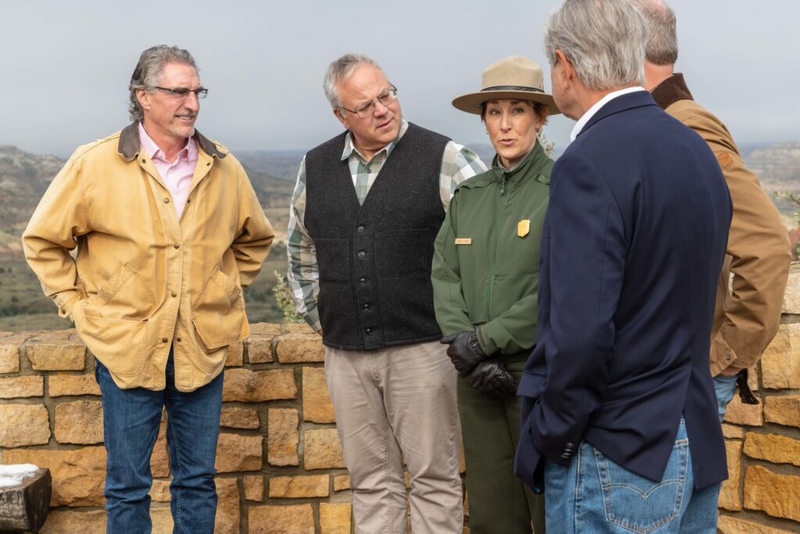
Then-Gov. Doug Burgum, from left, hosts Interior Secretary David Bernhardt for a tour of Theodore Roosevelt National Park in 2019, accompanied by Park Superintendent Wendy Ross and Sens. Kevin Cramer and John Hoeven. On Tuesday, conservation groups criticized Burgum's track record as Interior secretary. (Photo courtesy of Office of the Governor)
Conservation leaders on Tuesday accused the Trump administration and Interior Secretary Doug Burgum of undermining Theodore Roosevelt’s legacy of preserving American land.
Aaron Weiss, executive director of the Center for Western Priorities, said Roosevelt became president during what is known as America’s Gilded Age, “when industrialists ran roughshod over America’s public lands.”
“Teddy Roosevelt is the one who ended the Gilded Age, using his power to protect public lands and stop the exploitation of America’s natural resources,” Weiss said. “Donald Trump and Doug Burgum are using their power to do the opposite. They have taken every step imaginable to hand our public lands over to the industrialists who want to exploit America’s natural resources for private profit.”
Weiss and others spoke during a video conference led by the North Dakota-based Dakota Resource Council.
The comments come a day before Trump and Burgum visit North Dakota for the dedication of the Theodore Roosevelt Presidential Library at Medora, the gateway into Theodore Roosevelt National Park.
Valerie Naylor is the former superintendent of the park. She said national parks are understaffed and public lands are threatened by the administration’s goal of energy dominance.
Burgum staff were briefed on Badlands monument plan he called a ‘surprise’
Naylor said much attention has been paid to alleged attacks on the reflecting pool at the Washington Monument, but that there are 433 national parks and monuments “being attacked from the inside.”
She cited budget cuts, staff reductions and red tape that hinder the National Park Service from getting behind-the-scenes work done.
“That’s all coming directly from the Department of Interior,” Naylor said.
Scott Skokos, executive director of the Dakota Resource Council, said Burgum has shifted his position since he was North Dakota’s governor and supported conservation and renewable energy as part of an all-of-the-above energy strategy.
“When he got into the Trump administration, it was no renewables,” Skokos said. “So there was a fundamental change there in his thinking around energy.”
Burgum last week touted an Interior Department plan to streamline the process for determining the potential value of oil, gas and coal on public lands for development.
“The Trump administration is taking the handcuffs off American energy producers,” Burgum said in a news release.
Lawmakers demand info on Trump use of national park fees to pay for D.C. repairs
A statement from the Interior Department on Tuesday said Burgum is honoring Roosevelt’s legacy through “active stewardship.”
“Secretary Burgum, under President Trump’s leadership, believes conservation requires action, not abandonment,” the statement said. “Locking up public lands and refusing to manage them isn’t stewardship, it’s neglect. America’s forests, rangelands, and natural resources deserve the same practical, results-driven leadership that defined Roosevelt’s vision and helped build this nation.”
It said public land can be “put to work for the American people through sustainable timber, grazing, energy production, recreation, and wildfire prevention.”
Dave Brandt, a board member for North Dakota Wildlife Federation, said public lands are meant to be multiuse, and there can be energy development, but it should not go unchecked.
“Let’s do this responsibly, and not just try and make it so that a handful of people are making themselves extremely rich off the great resources of our public lands,” Brandt said.
Brandt also said Roosevelt “seemed to like colorful words.” He said Roosevelt would have called someone who viewed public lands and natural resources as being a source of profit “unscrupulous or maybe even morally bankrupt.”
Conservation groups, including North Dakota Wildlife Federation, Dakota Resource Council, and North Dakota Chapter of the Sierra Club, have formed the ND Public Lands Coalition.
The coalition plans to display mobile billboards in Medora and Fargo to protest selling public lands.
Bismarck, ND