Some cities opt out of Gov. Cox’s statewide fireworks ban, but most keep it in place
Jun 30, 2026 | 3:44 pm ET
Description
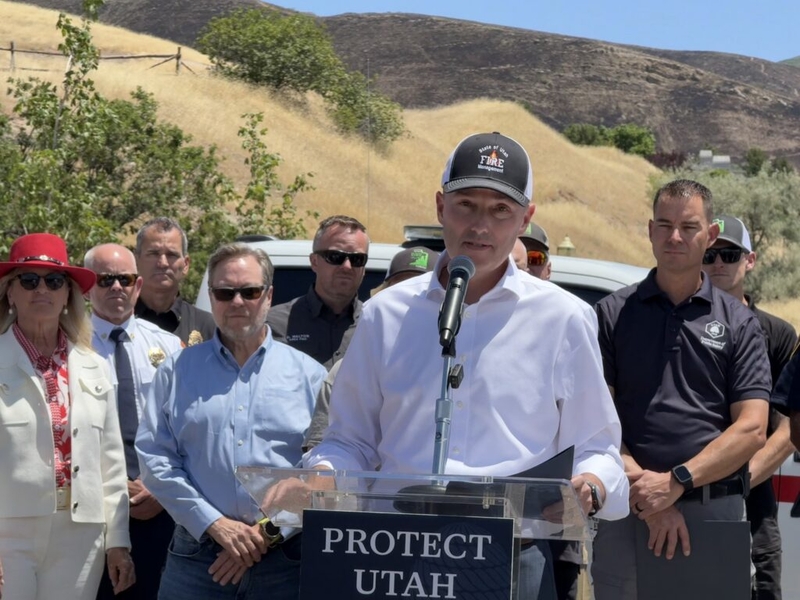
Utah Gov. Spencer Cox speaks during a news conference announcing a fireworks ban on June 25, 2026. (Alixel Cabrera/Utah News Dispatch)
Citing dire wildfire conditions across the state, Utah Gov. Spencer Cox last week sent a strong message of caution to Utahns when he issued an executive order enacting a statewide fireworks ban through July 5.
The order set a sweeping “default” ban that prohibited personal fireworks across the state, “but every mayor with every fire warden in the state can decide where fireworks are OK,” the governor said, encouraging cities to designate areas where their residents could light off fireworks safely in their communities.
The order temporarily suspended a law that blocks the state forester from banning fireworks within city boundaries. In Utah, local leaders have had the option to ban fireworks in certain areas, but the Utah Legislature has blocked them from enacting a blanket, citywide ban.
Professional firework shows, like those put on by communities, are still allowed under the order.
Utah Gov. Cox orders July 4 fireworks ban amid devastating wildfires
While most cities — including all in Salt Lake County — are letting the governor’s “default” ban stay in place, some are bucking the trend.
So even though the governor issued a statewide ban, what that actually looks like is a patchwork of different fire restrictions, depending on the city.
For a list of local fireworks restrictions or decisions to lift the governor’s blanket ban, visit the Utah fire marshal’s website. However, some of the local restrictions listed on that site were set before the governor’s ban, and as of Tuesday morning some cities hadn’t provided the fire marshal their decisions so the information there isn’t comprehensive.
“If your area isn’t listed, these local zones have not yet been finalized, or we have not received them, and you must contact your local fire authority directly to verify restrictions before any discharge,” fire marshal officials said in a post on the website.
Most city leaders across the state were posting their decisions on city and fire department Facebook pages to inform residents of whether they were deciding to keep the governor’s ban or designated authorized areas.
Some cities are lifting the governor’s ban
Cities setting their own fireworks guidance included Brigham City in Box Elder County. There, city leaders emphasized personal responsibility in a Facebook post Monday while saying “there will be no changes applied to Brigham City’s existing fireworks-restricting areas” that were enacted before the governor’s executive order.
“Everyone is personally responsible for their actions, and we encourage each person to make the best decision they can regarding firework use this year,” Brigham City Fire Chief Brandon Thueson said in a prepared statement about city leaders’ decision.
Brigham City leaders also noted that the fire department “will have extra personnel on hand” while fireworks are allowed, between the hours of 11 a.m. and 11 p.m. from July 2-5. Fireworks are also permitted until midnight on July 4th.
In Utah County, Spanish Fork officials also opted to not fully restrict personal fireworks within city limits, but kept its current ban on fireworks “anywhere near the mountainside or within 200 feet of any vacant field or lot.” A map on the city’s website shows where fireworks are or aren’t allowed.
“Residents should use common sense while lighting fireworks, staying clear of any weeds, fields, dry grasses, or other flammable area,” Spanish Fork city leaders said on the city’s website. “While the law requires a 200 (foot) buffer, residents should consider greater distances depending on their fireworks.”
Other Utah County cities also opted to allow some types of personal fireworks in some areas, including Springville, Payson and Mapleton, while others decided to keep the full ban, like American Fork and Lehi. Leaders in some cities like Saratoga Springs and Highland hadn’t yet issued a decision as of Tuesday morning.
“Even one spark can have devastating consequences for homes, businesses, open spaces, and the people who call American Fork home,” American Fork Mayor Brad Frost said in a statement. “We ask every resident and visitor to respect this decision and comply with the temporary restriction. By choosing caution and embracing safer ways to celebrate, we can protect the people and places that make American Fork such a great community.”
Some cities in Davis and Weber counties are also allowing personal fireworks in certain areas, including Clearfield, Clinton, South Weber, Sunset and West Point.
In a post on the Clinton City Fire Department’s Facebook page on Friday, Clinton Mayor Marie Dougherty and Fire Chief Jason Poulsen said that after evaluating fire risks they decided to “lift the ban for the majority of Clinton” because “most of the city does not qualify as extremely hazardous.”
The Clinton mayor and fire chief said city leaders prioritize safety, but Clinton has seen “very few incidents involving fireworks,” with “only two small grass fires and one garbage fire” in 2022, a year when the state was experiencing drought conditions. They also said Clinton “is suburban and does not border wildlands the way many other cities do.”
“The use of emergency executive power is very serious,” the Clinton mayor and fire chief said. “We have concluded we cannot in good conscience override the Legislature’s laws without a clear threat of extreme hazard. We recognize there will always be risk. Dry residential yards do not pose the same fire management risk as wildlands, but we strongly urge the community to exercise caution in our neighborhoods.”
In Tooele County, several rural cities had already issued a full ban on personal fireworks before the governor’s order. In the county’s suburban city of Tooele, leaders also decided Monday they would keep the full ban.
Some lawmakers say the governor took the ‘wrong approach’
While Cox said Republican legislative leaders have expressed support for his executive order, he acknowledged that some lawmakers “disagree with this.”
“I understand that, I know they don’t want any restrictions anywhere,” Cox said when he announced the ban. “I totally get that, but again, and I would not do this if it wasn’t the worst possible situation that we’ve ever seen.”
Some of those lawmakers that disagree with his approach include Rep. Michael Petersen, R-North Logan, Rep. Walt Brooks, R-St. George, and Rep. Matt MacPherson, R-West Valley City.
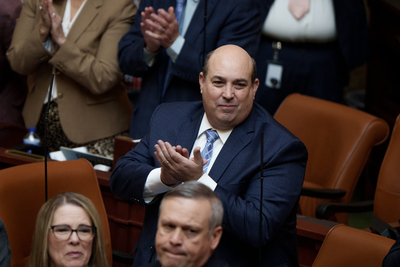
MacPherson, in a post on X, noted that he’s a professional firework display operator and owner of a firework manufacturer, wholesaler and retailer. He argued that the governor “has no authority to ban fireworks, and Utah has legalized fireworks, including aerials. If you follow the law, act responsibly, there is little danger of causing major fires within city limits.”
“Those that choose to use fireworks dangerously or illegally will not follow any regulations, laws, bans or common sense with fireworks anyways,” MacPherson said.
He told Utah News Dispatch in a text message Monday that he’s not against firework restrictions, but “I think the governor did it in the worst way possible and most likely to face legal challenges.”
Petersen and Brooks also told Utah News Dispatch on Monday they agree that in some areas fireworks restrictions make sense, but not in all cities.
A blanket ban is “the wrong approach,” Petersen said, adding that he wished the governor would have focused efforts on “an inform, an educate, a suggest approach” to cities rather than an executive order that he thinks went too far.
In Cache County, where Petersen lives as a North Logan resident, Smithfield appears to be the only city to authorize designated fireworks areas.
Though he said he understands the state’s wildfire risk this year may call for more drastic measures, “I don’t like taking the decision making away from the folks who get elected in their own city and counties.” While city leaders can still decide to opt out, he argued those city leaders are now put in a position to “go against” the governor if they want to opt out.
Cox says ‘there’s no end in sight’ to wildfire that could be Utah’s most destructive ever
“That’s sort of where they feel they are,” Petersen said. “They have to stand up and be brave and step out across the line for the governor. I wish they weren’t in that position.”
But some mayors don’t see it that way. For example, Dougherty, the Clinton mayor, told FOX 13 on Monday she sees allowing designated fireworks areas as adhering to Cox’s order, which allowed the option for local leaders.
“Clinton did not defy the governor’s order,” she told the station. “We followed it.”
Both Brooks and Petersen also noted that fireworks aren’t the culprit for the majority of human-caused wildfires (vehicles and equipment use tends to be), according to data from the National Interagency Fire Center. However, fireworks still do cause some blazes, just not as many.
Like Petersen, Brooks said the governor’s statewide default ban went too far.
“I hear from people in Salt Lake, like, ‘Everything’s so dry.’ Well, welcome to our world,” Brooks said from the Southern Utah desert community of St. George, where July heat is often scorching. “Every July, everything’s dead … every blade of grass that used to be green now is yellow. … We’ve always had fireworks because the downtown area is probably the safest place to light fireworks.”
Brooks said St. George’s paved areas “can still allow the freedom and expression of this wonderful 250th year anniversary of our country, and be able to have fireworks.” On the other hand, anywhere outside of St. George is a “kindling box,” he said, which is why St. George officials have in past years allowed fireworks within the city.
This year, St. George city leaders have kept its restricted areas, while allowing personal fireworks to be set off in 19 parks.
“We’ve kind of proven the point that you can still have restrictions, but an all-out ban is probably not the right approach,” Brooks said, though he also credited the governor for leaving “the window open” so city leaders who want to can make different decisions if they see fit.
Salt Lake City, UT