Nebraska AG Hilgers approves medical cannabis regulations; Governor Pillen to review next
Jun 30, 2026 | 4:09 pm ET

Description
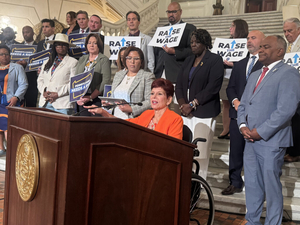
Nebraska Attorney General Mike Hilgers, center, leads a news conference against Legislative Bill 677 that sought to help implement medical cannabis regulations in the state. About a dozen law enforcement officials joined him in standing against the legislation as it awaited full legislative debate. May 7, 2025. (Zach Wendling/Nebraska Examiner)
LINCOLN — Nebraska Attorney General Mike Hilgers on Tuesday signed off on the constitutionality of regulations from the state Medical Cannabis Commission, a key step toward final approval.
Hilgers, who has opposed the creation of the regulatory commission and questioned the legality of its existence, said in a Tuesday letter that his review “does not imply my support for or opposition to the regulations as a policy matter.”
“As to constitutionality, I conclude that the medical cannabis regulations do not clearly violate the state or federal Constitutions on their face,” Hilgers said.

The regulations now go to Nebraska Gov. Jim Pillen, who will need to act by July 11 to prevent any lapse for current temporary regulations. The emergency set — the same as the more formal guidelines that Pillen will now review — expires July 15. Should Pillen sign, the more formal set of rules would take effect five days after signing.
Laura Strimple, a spokesperson for Pillen, told the Nebraska Examiner: “The governor will be reviewing and taking action on these regulations in the coming days.”
Regulations specifics
Among requirements in the regulations are:
- Establishing a “Recommending Health Care Practitioner” directory and requiring patients who want to access Nebraska-licensed dispensaries to go through one of the providers.
- Capping cultivators at no more than 1,250 flowering plants at one time.
- Restricting purchases of medical cannabis to no more than 5 ounces of medical cannabis in a 30-day period, of which no more than 5 grams can be delta-9 tetrahydrocannabinol (THC) from the same dispensary. Delta-9 THC is the part of cannabis most associated with a “high.”
- Allowing no more than 12 medical cannabis dispensaries statewide, arranged by judicial district. That would mean one dispensary each in Douglas County (584,526 residents), Lancaster County (322,608 residents), Sarpy/Cass Counties (217,202 residents) and Buffalo/Hall Counties (112,979 residents), according to 2020 census data.
- Prohibiting the sale of smoking or vaping products and edibles of any kind. Oral tablets with a “thin layer” of flavoring to make the products swallowable would now be allowed.
Cultivators, product manufacturers, transporters and dispensaries can be licensed. To date, the commission has licensed four cultivators — the maximum number allowed under the regulations — and has opened up applications for manufacturers.

Advocates have repeatedly expressed concern that the proposed regulations could hurt the program’s ultimate success. They’ve also worried that Hilgers’ opposition, and the Legislature failing to pass protections for health care providers who wish to recommend medical cannabis, could mean the in-state provider directory for recommendations sits empty.
In his letter, Hilgers cautioned that the commission rules are aimed at regulating marijuana for medical use only and are currently in line with federal law.
“Any medical cannabis regulations that allow access to marijuana untethered to a plausibly medical purpose without adequate patient protections are ‘medical’ in name only and may slip into a preempted recreational marijuana scheme,” Hilgers said.
Feds move to reschedule marijuana
The federal government, since April, classifies state-licensed medical cannabis as a Schedule III drug, down from a Schedule I drug that the rest of marijuana has been listed as for decades. Hearings begin next month on whether to reschedule all of marijuana to be Schedule III.

Schedule I drugs, such as heroin, LSD, ecstasy and peyote, are drugs the federal government has classified with a high likelihood of abuse and no currently accepted medical value.
Schedule III drugs are defined as those with moderate to low potential for physical and psychological dependence, such as Tylenol with codeine, ketamine and testosterone.
Nebraska, under Hilgers’ leadership, is challenging the government’s reclassification effort.
Should the regulations change, Hilgers said that could open them up to legal uncertainty. The commission plans to add fees for future application types.
Said Hilgers: “Nothing in this analysis should be interpreted as opining on whether the medical cannabis regulations would be constitutional in a future, fact-bound, as-applied challenge.”
Fight continues over 2024 vote
In 2024, Nebraska voters overwhelmingly legalized the possession of up to 5 ounces of medical cannabis with a written health care practitioner’s recommendation. Voters also approved the creation of a Nebraska Medical Cannabis Commission, giving regulators the exclusive regulatory power over “all phases of the possession, manufacture, distribution, delivery and dispensing of cannabis for medical purposes by registered cannabis establishments.”
Hilgers cautioned that the legality of the regulatory law is still under question because of a case before the Nebraska Supreme Court involving what Hilgers says is “unprecedented levels of malfeasance” in the petition process.

The campaign defended its work against Hilgers’ office, and a longtime marijuana opponent. And in November 2024, shortly after the election, a Lancaster County District Court judge ruled that the petitions had enough valid signatures to have been presented to voters.
Opponents appealed the ruling to the Nebraska Supreme Court, which heard oral arguments Dec. 3. Now 209 days later, the high court has not yet issued an opinion.
“If the Nebraska Supreme Court (or a district court on remand) concludes that the Nebraska Medical Cannabis Regulation Act did not receive enough signatures to be placed on the ballot, the Act would no longer be good law, and any medical cannabis regulations promulgated under the Act would lack the requisite statutory authority,” Hilgers said.
Jocelyn Brasher of Omaha, a former assistant attorney general and the 2026 Democratic nominee for attorney general, said in a statement that Hilgers “is trying to have it both ways” in getting credit for greenlighting the regulations while fighting the voter-approved laws in court.
“Nebraskans deserve an attorney general who they can trust to respect the law, honor election results and serve the people,” Brasher said in a statement.
Advocates continue to push back
Hilgers’ letter also references a current quirk in federal law for Nebraska: Since 2014, Congress has consistently prevented federal dollars from being used to interfere with state medical cannabis programs. Today, 47 states are protected, but not Nebraska.

It is because of that federal rider limited to medical cannabis that Hilgers said the state regulations are not, on their face, violative of federal law. Hilgers said he assumes Nebraska will be added but said he believes that hasn’t happened yet because the program is in its “infancy.”
Nebraskans for Medical Marijuana, which sponsored the 2024 ballot measures, said Tuesday that Hilgers “has always and continues to obstruct what 71% of Nebraska voters approved.”
“His signing of these rules and regulations today is nothing more than an election year ruse to trick Nebraskans into thinking he supports the will of the voters,” the organization said. “Nebraskans won’t fall for it.”
Lincoln, NE