DeSantis is waiting too long to name judges, ex-judge tells FL Supreme Court
Jun 30, 2026 | 4:32 pm ET
Description
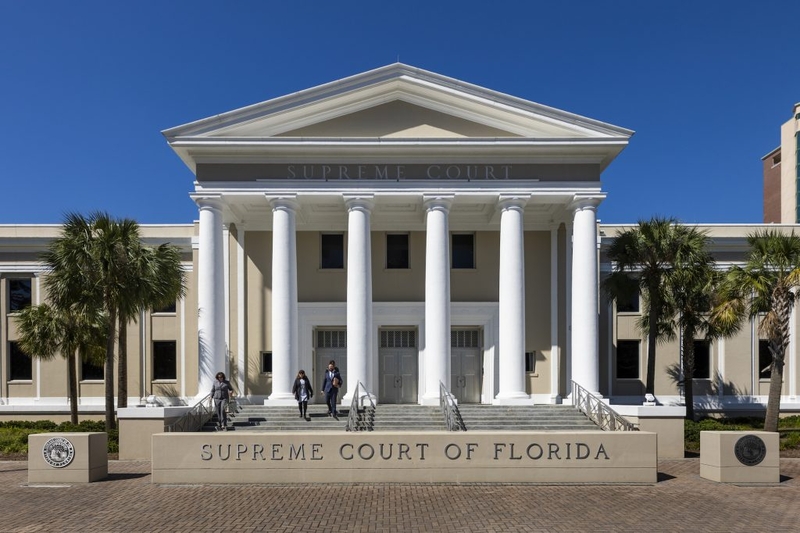
The Florida Supreme Court building. (Photo by Colin Hackley)
A former appellate judge has asked the Florida Supreme Court to order Gov. Ron DeSantis to fill the vacancy opened by his own resignation, which has lingered beyond the 60 days mandated by the Florida Constitution, pointing to a “pattern of inexplicable delays in filling judicial vacancies.”
“Disturbingly, this is the second time in less than a year that the governor has flouted his clear legal duty to appoint a judge by the 60-day deadline,” reads a petition filed by the American Civil Liberties Union on behalf of Kevin Emas, who resigned from the Third District Court of Appeal effective March 31. The intermediate appellate court sits in Miami and holds jurisdiction over Miami-Dade and Monroe counties.
DeSantis’ press office has not responded to a request for comment.
The court’s Judicial Nominating Commission sent six possible replacements to DeSantis on March 17, the petition reads.
“The 60th day after March 17 was May 16, 2026. As May 16 fell on a Saturday, the next business day was May 18. The governor failed to make an appointment by that date. To the best of petitioner’s knowledge, the governor’s failure is ongoing,” the document continues.
The Florida Constitution says, “The governor shall make the appointment within 60 days after the nominations have been certified to the governor.”
The brief says, “That last sentence could not be clearer: once the JNC certifies its nominees to the governor, the governor shall make the appointment within 60 days. This duty is ministerial and nondiscretionary.
The document cites a similar case when Charlie Crist was governor in 2009. Crist had rejected a list of potential judges compiled by the JNC for the Fifth District Court of Appeal and demanded the panel include Black candidates. The panel resubmitted its original list. Crist sat on the appointment.
Robert J. Pleus Jr., the judge whose resignation opened that vacancy, turned to the Supreme Court, which ruled that Crist was constitutionally obliged to fill the vacancy.
Of the justices who ruled in that case, only Jorge Labarga remains; DeSantis has appointed every other member of the court, and they’ve proved willing to reverse established precedents.
On Emas’ behalf, ACLU lawyers are seeking a writ of mandamus — essentially, an order that DeSantis fulfill his constitutional duty.
“This Court’s authority to issue writs mandamus is discretionary and concurrent with other state courts. However, this case warrants an expedited decision by this court since Judge Emas and district residents and litigants are being prejudiced by the illegal delay in filling the seat. The governor’s repeated, recent failure to abide by the Constitution’s clear mandate also counsels in favor of this court’s review,” the brief says.
“This court cannot serve the people of Florida without a full bench,” said Bacardi Jackson, executive director of the ACLU of Florida, in a written statement. “The governor’s refusal to act isn’t just an administrative failure — it’s a constitutional violation that leaves Floridians without the justice system they deserve. It’s unacceptable that we must sue him yet again to make him do the job he was elected to do.”
Tallahassee, FL