The doctor will not see you now: 1,900 seniors, disabled residents to lose Brown Health providers
Jun 30, 2026 | 4:26 pm ET
Description
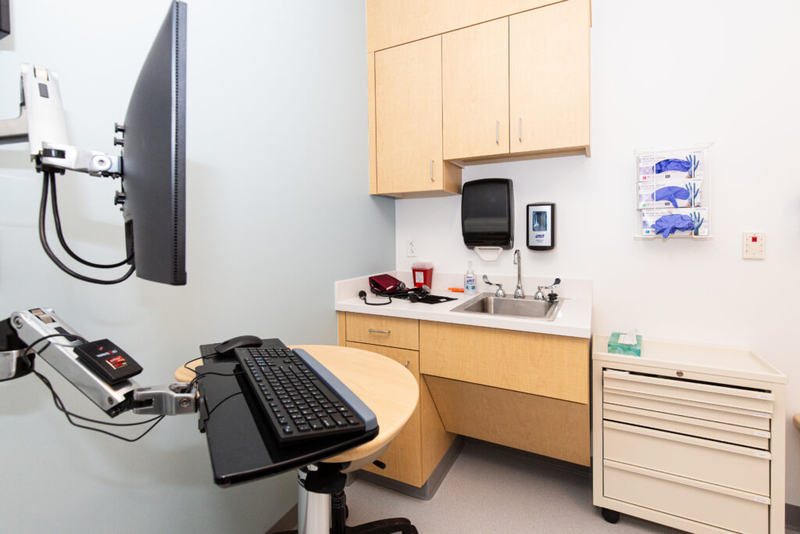
An exam room at Brown University Health Middletown Primary Care. (Courtesy of Brown University Health)
Dr. Avishek Chatterjee is trained on how to give bad news to patients.
But he’s having difficulty delivering the diagnosis, with no course of treatment, for the senior and disabled patients whose health insurance won’t cover their visits to him anymore.
“Most of it is surprise, and shock, and disappointment,” said Chatterjee, a primary care doctor for Brown University Health’s North Main Street offices in Providence. “It’s hard. Right now, I am focused on trying to make sure my patients can find access.”
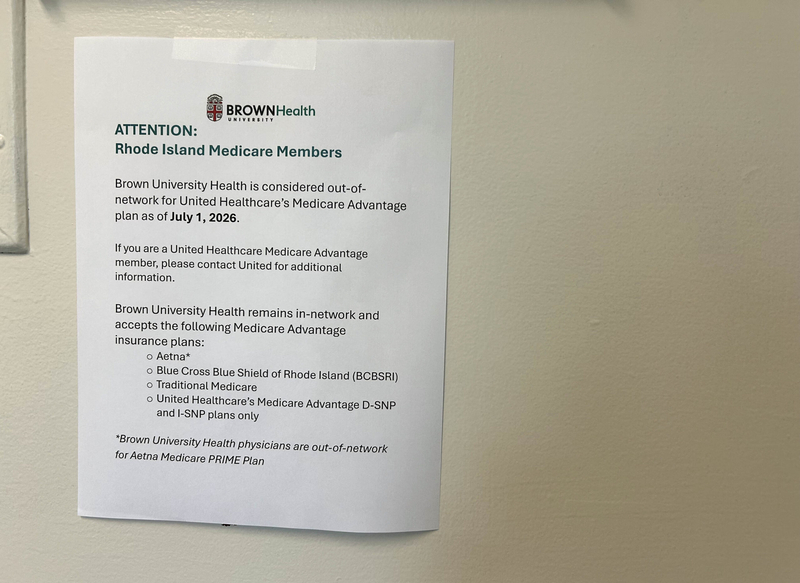
Unable to reach agreement on reimbursement rates and other contract details, Brown University Health and United Healthcare are ending their contract for Medicare Advantage patients as of Tuesday. The decision, first announced in May, means 1,900 seniors and residents with disabilities will have to pay out of pocket to keep seeing their primary care and specialty providers, or else find new doctors.
A two-month special enrollment period granted by the Centers for Medicare and Medicaid Services (CMS) at the request of Rhode Island’s congressional delegation offers a third option: to change insurance plans or providers, though this may also mean paying more, or finding a new provider anyway.
“These people are really kind of screwed,” Chatterjee said, noting that Blue Cross Blue Shield of Rhode Island — the other major state insurer that offers Medicare Advantage plans — has higher premiums overall.
Rhode Island’s federal delegation agreed.
“In a small state like Rhode Island with health care workforce shortages, this task may prove all but impossible,” they wrote in the June 5 letter to Dr. Mehmet Oz, CMS administrator.
Similar breakdowns between Brown Health and United last year cut off coverage for Medicare Advantage patients for non-emergency visits at Brown Health’s five hospitals, effective July 1, 2025.
But, those who stuck with United’s commercial alternative to government-run Medicare — available to people 65 and older or with disabilities or chronic conditions like kidney failure or Lou Gehrig’s disease — were still able to see their Brown Health primary care doctors, along with other specialists in dermatology, urology, radiosurgery, neurology, and more.
All those providers are no longer in-network as of July 1.
While the contract ends Tuesday, the CMS special enrollment period gives affected plan participants until Aug. 31 to switch insurance plans. Patients in the middle of treatment for cancer or other serious illnesses may qualify for a continuity of care determination from United Healthcare to keep seeing their Brown Health doctors even after formal coverage ends, according to information provided by both companies.
FAQs and finger pointing
In addition to mailed letters, email notices and doctor’s office waiting room signs, Brown Health and United each have a dedicated informational page on its website with frequently asked questions.
In June, Rhode Island Attorney General Peter Neronha’s office put up its own informational page, with links to each company’s website and information about the special enrollment period.
Neronha blamed both the companies, and the healthcare system, for not prioritizing patient care.
“Once again, patients are caught in the middle of a contract dispute they had no role in creating,” Neronha said in a statement. “When negotiations like this break down, the cost, literally and figuratively, is borne by older adults and people with complex medical needs who suddenly have to worry about whether they can keep seeing their doctors or afford their care.”
The contract dispute reflects rising costs for insurers and healthcare providers, which are only expected to worsen as federal Medicaid restrictions take effect and more people lose insurance coverage. United Healthcare executives told investors in January that they expect to lose up to 1.4 million Medicare Advantage members nationwide in 2026, citing competition with other providers and what they viewed as inadequate federal payments for Medicare Advantage.
Brown Health countered that the insurer was unwilling to agree to “fair reimbursement,” a long-held complaint among state health care providers across commercial and government insurance plans.
“Brown Health was unable to reach an agreement with UnitedHealthcare for its Medicare Advantage plan because the reimbursement rates offered for physician services in Rhode Island did not adequately support the cost of providing high-quality care,” Jessica Wharton, a Brown Health spokesperson, said in an emailed response. “In addition, the plan’s authorization requirements were excessively burdensome, increased administrative costs, and created barriers to timely patient access.”
Trasee Carr, a spokesperson for United Healthcare, declined to answer questions about Brown Health’s account of the contract negotiations.
“Our focus at this time is providing the people we serve with continued access to the care they need through either continuity of care or helping them transition to another provider, as appropriate,” Carr said in an email Tuesday.
United Healthcare under scrutiny
Chatterjee also accused United Healthcare of trying to return money to shareholders, offsetting continued drops in stock prices and credit ratings amid a series of state and federal lawsuits. In May, the Massachusetts attorney general’s office sued United in a complaint that alleged $100 million in state Medicaid fraud. The U.S. Department of Justice is also investigating United Healthcare for Medicare fraud, the company confirmed last year. And, a Senate Judiciary Committee report published in January found the insurer was “gaming” the Medicare Advantage system by artificially inflating testing and diagnostics to receive higher federal reimbursements.
United Healthcare has denied the allegations in the Senate report and the Massachusetts AG’s lawsuit, while pledging compliance with ongoing federal probes.
“I’m skeptical this product will be around for much longer,” Chatterjee said of United Healthcare’s Medicare Advantage plan. “I’d love to be proven wrong about that.”
While not the only private provider under scrutiny for manipulating the Medicare Advantage system to increase its bottom line, United Healthcare has been targeted as a top offender, found to have spent an extra $11.6 million on inflated risk assessments across its 6.9 million plan participants nationwide in 2025, according to research by the Center for Advancing Health Policy Through Research at the Brown University School of Public Health.
In Rhode Island, the insurer was projected to receive an extra $47 million in federal reimbursements due to higher risk assessments of its 37,000 plan participants in 2025, or $105 more per patient, on average. Blue Cross & Blue Shield of Rhode Island, which covers nearly twice the number of Medicare Advantage patients in the state as United, was projected to receive an extra $1 more per patient compared with traditional Medicare plan spending.
Both private insurers’ Medicare Advantage plans stayed within the state’s 5.1% spending growth cap in 2024, with United Healthcare increasing annual spending 4.4%, while Blue Cross spent 3.3% more, according to a recent report by the Rhode Island Office of the Health Insurance Commissioner. But the pair of Medicare Advantage insurers exceeded the spending growth target the year before, with United increasing total spending from 2022 to 2023 by 14.8%.
The end of the contract between Brown Health and United does not affect dual Medicare and Medicaid recipients. United Medicare Advantage plan participants whose insurance is covered through a former employer under a group plan may also continue to receive care with Brown Health physicians.
Brown Health urgent care centers are also not affected, nor are physicians and hospitals in Massachusetts.
Affected Brown Health physician practices
- Brown Dermatology
- Brown Emergency Room
- Brown Health Medical Group (Lifespan Physician Group)
- Brown Health Medical Group Primary Care (Coastal Medical)
- Brown Medicine
- Brown Neurology
- Brown Surgical (University Surgical)
- Brown Urology
- Miriam Hospital
- Newport Hospital
- Radiosurgery Center of Rhode Island
- Rhode Island Hospital

Providence, RI