Bill to address reassessment school tax rate increases passes out of committee
May 21, 2026 | 6:00 am ET
Description
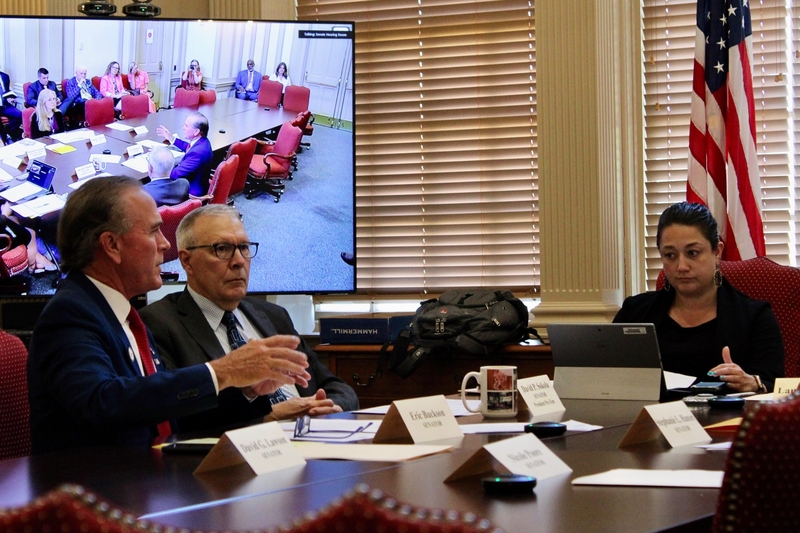
Photo courtesy of Spotlight Delaware
Why Should Delaware Care?
Last year, the state conducted its first property reassessment in decades. As a result, school districts were able to implement an up to 10% school tax increase without voter approval, sparking outrage throughout the state. But lawmakers say a new bill could provide flexibility to districts while eliminating the sticker shock of large tax hikes.
A third bill attempting to address Delawareans’ concerns about school district tax increases following last year’s first-in-a-generation property reassessment advanced out of the Senate Education committee on Wednesday.
Sponsored by Senate President Pro Tempore David Sokola (D-Newark), Senate Bill 322 is the latest legislation spurred by school districts across the state choosing last summer to increase their property tax revenues by 10% following Delaware’s first statewide property reassessment in nearly 40 years.
But those tax increases, allowed under a little-known state law, only worsened the resident outcry that had been building following reassessment. Sokola’s bill follows two failed attempts by Republican lawmakers earlier this year to scale back districts’ ability to take those automatic tax increases in the future.
While SB 322 would rescind school districts’ current ability to automatically implement a 10% tax increase after property reassessments, it also would allow them to seek additional funding without holding a referendum vote.
Instead of taking an automatic 10% hike, districts – should they meet certain criteria – would be able to implement an up to 2% tax increase each year without seeking approval from voters.
If signed into law, the bill would not take effect until 2031, after the next property reassessment.
In his remarks during Wednesday’s committee meeting, Sokola said the bill provides flexibility for school districts while also protecting taxpayers from the “stickershock” of seeing a 10% tax increase after a reassessment.
“Our schools and communities deserve a holistic and carefully measured approach that balances financial interests for our taxpayers with the overwhelming need to maintain and improve academic performance for all students,” Sokola said.
Committee debates bill details
Some Republicans on the committee questioned the merits of Sokola’s bill, especially as it compared to similar legislation filed earlier this year by Rep. Bryan Shupe (R-Milford).
Last month, Shupe opted to table his bill, House Bill 246, which also would have removed school districts’ ability to automatically implement a 10% tax revenue increase following reassessment, and instead allow districts to take a smaller percentage, if needed.
Sen. Eric Buckson (R-South Dover), who was the co-prime sponsor of HB 246, said Sokola’s bill did not have the same “hurdles” in place as Shupe’s to prevent a district from unnecessarily taking a 2% tax increase. Under HB 246, districts would have had to demonstrate that they would have lost revenue following a reassessment in order to implement an automatic tax rate increase.
But Sokola’s bill does include language that would prohibit certain districts from automatically raising taxes, albeit different language than Shupe’s.
According to SB 322, a school district would not be able to implement a tax increase if its reserve fund balance – essentially the amount of money in its savings – is more than 10% of the district’s annual revenue.
If a district wanted to implement a tax increase greater than 2%, it would still need voter approval.
Currently, Delaware is one of the few states left that require school districts to get approval from voters to increase funding for both operational and capital projects.
During the committee hearing, Red Clay Consolidated School District Superintendent Dorell Green, who also is the president of Delaware’s Chief School Officers Association, spoke in favor of the bill. Green said the legislation is not a “complete solution,” but he noted it is beneficial to both districts and taxpayers.
He said the legislation would grant districts and school boards the ability to “address local funding” while also delaying implementation until after the next reassessment to protect taxpayers.
One professor who studies education funding in Delaware, however, said SB 322 would not address the state’s underlying educational funding inequities.
Kenneth Shores, a professor at the University of Delaware who specializes in education policy, said that districts with higher property wealth, such as Cape Henlopen, will be able to bring in more money with a 2% annual increase than a district in western Sussex County, which may have lower property values.
Shores said the bill would not provide “any kind of state obligation to compensate districts for their property wealth.”
He also pointed toward states like Minnesota, where districts with lower tax-bases can receive state aid to help districts pay for the same level of services as wealthier school districts.
What led to this?
Last summer, multiple school districts, including the Appoquinimink, Christina, Capital, and Indian River school districts, chose to implement the full 10% tax increase during July board of education meetings. At the time, some leaders said taking advantage of the increase would prevent their district from needing to hold, and pass, a referendum.
Others, like the Brandywine School District, announced in July 2025 that it would implement a 1.7% tax rate increase, citing concerns over the future of federal education dollars. The following month, the Brandywine school board changed course, opting to reduce rates for residential properties and increase them for business properties.
Still, post-assessment property tax bills prompted outrage from many New Castle residents over the sticker shock of the increases in their bill. For some residents, tax bills doubled after the reassessment.
By August of 2025, state lawmakers held a one-day special legislative session in response to residents’ outrage. They allowed the public school districts in New Castle County to split their property tax rates to provide additional relief to homeowners.
The school boards for the Appoquinimink, Brandywine, Christina, Colonial, and Red Clay Consolidated school districts then approved new rates that lowered tax burdens for homeowners and raised them for commercial property owners.
Christina, Appoquinimink, and Colonial also chose to retain the extra revenue they raised through the automatic tax increases.
By December, four school district leaders testified before the General Assembly’s committee investigating the impacts of the reassessment.
Three months later, two Republican bills seeking to limit Delaware school districts’ ability to implement automatic tax increases following property reassessments were both tabled in committee, or not advanced to a full House vote, after nearly two hours of debate.
Now, Sokola’s SB 322 awaits consideration by the full Senate. If passed, it would then be considered in the House of Representatives.
Dover