In Alabama primary, voters cite different priorities as they choose nominees
May 19, 2026 | 5:45 pm ET
Description
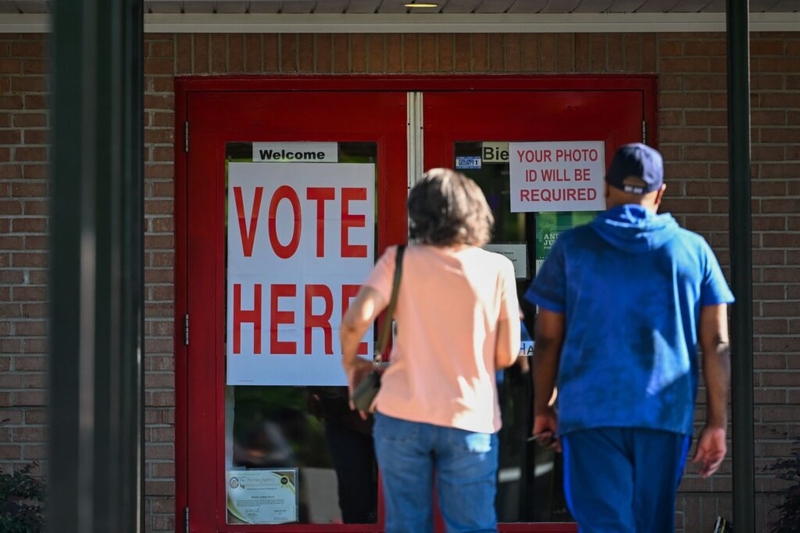
Two people enter a polling place at Messiah Lutheran Church in Montgomery, Alabama on May 19, 2026. (Anna Barrett/Alabama Reflector)
Alabamians went to the polls Tuesday with dozens of options on their ballots and many different issues on their minds.
The Democratic and Republican primary elections took place amid uncertainty about the state’s upcoming congressional elections and how that might affect turnout. Alabama Secretary of State Wes Allen said in a statement early Tuesday afternoon that there was “no way to gauge voter turnout” statewide at that point in the day.
The Jefferson County Board of Registrars said Tuesday afternoon that it expects a turnout of 22 to 25% when polls close in the Democratic-leaning county Tuesday evening. Montgomery County, which also tends to lean Democratic, reported turnout of 21.3% as of 4:25 p.m., according to the Montgomery County Probate Judge’s Office. Attempts to get turnout numbers from Cullman and Houston counties, which lean Republican, and Macon County, which leans Democratic, were unsuccessful Tuesday.
Midterm primaries tend to see relatively small numbers of voters. In 2022, turnout for the primaries was only 23%. The last time more than 40% of Alabama voters cast ballots in a midterm primary was 1994.
More than a dozen voters interviewed in Auburn, Tuskegee and Pike Road Tuesday cited several different issues and reasons for their choices, ranging from interest in particular issues to support or opposition of individual candidates.
Paul Bartgis, a retired finance worker who voted for U.S. Sen. Tommy Tuberville for governor; Alabama Attorney General Steve Marshall for U.S. Senate and Allen for lieutenant governor said he believed the candidates he voted for were consistent.
“I felt like those positions they took, they would carry forward as the nominees,” he said. “If they were elected, they would carry those same ideals with them, which are the same ideals and beliefs that we have.
Several Republican candidates, including Tuberville and Allen, engaged in anti-immigrant and anti-Muslim rhetoric during the campaign. Dara Hosey, a retired fundraiser from Auburn, said she voted for Republican gubernatorial candidate Ken McFeeters in part because the rhetoric of other candidates turned her off, saying that any candidate who spoke of people he or she hated “automatically did not have my vote.”
“I went to everybody’s website, and I read their platform statements. It was surprising to me how many candidates didn’t have a platform other than ‘God, family and country’ and ‘here, I have a picture with Trump,’” she said. “I was like, ‘You’re not telling me anything.’ What are you going to do for the state?”
Her husband James, who works in residential construction and also voted for McFeeters, said he had national issues on his mind.
“I don’t like all the policies that are coming down from Donald Trump,” he said. “I don’t like his decision on the Iran war. I don’t think he’s helped our economy, I think he’s turned it the other way.”
Scott Lewis, an Auburn University professor who voted in the Republican primary, said he wanted to see leaders “rally other conservatives to continue to push forward a conservative agenda.”
“Maybe swing the pendulum back just a little bit to be a little bit more conservative,” he said.
Those who voted in the Democratic primary also had a diversity of reasons for their decisions. Ayesha Moultry, a small business owner from Auburn, voted for former U.S. Sen. Doug Jones as the party’s gubernatorial nominee, citing his experience.
“He has a voice, he has the experience,” she said. “He knows how politics works. He has experience in those areas because he’s been there before.”
Matthew Fisher, a lab technician who lives in Auburn, who also voted for Jones, saying he felt the former senator had the best chance of defeating Tuberville, referring to questions over whether Tuberville has been a resident of Alabama long enough to qualify to run for governor. \
“I believe he’s unqualified for government, and he doesn’t even live in Alabama,” he said.
Others were focused on local concerns. Desheila Buchanan, a therapeutic mentor who lives in Tuskegee and voted in the Democratic primary, said her area needed healthcare and recreational facilities.
“The main issue is that we don’t have a hospital,” she said. “We don’t have recreation for the kids. We don’t have a jail currently; we have to send the inmates out. Our jail, the water pressure is torn up, and we don’t have anything for the kids to do.”
The impact of the battle over new congressional lines was not immediately clear on Tuesday. Gov. Kay Ivey last week set special primary elections for August in Alabama’s 1st, 2nd, 6th and 7th congressional districts after the U.S. Supreme Court allowed the state to use a 2023 congressional map it previously ruled racially discriminatory.
That move is being challenged by plaintiffs in the Allen v. Milligan case, who successfully blocked implementation of the map in 2023. However, congressional primaries under the old map took place on Tuesday amid concerns that confusion might dampen turnout. Speaking in Auburn on Tuesday morning, Tuberville said, incorrectly, that “there will not be congressional votes today on those seats.”
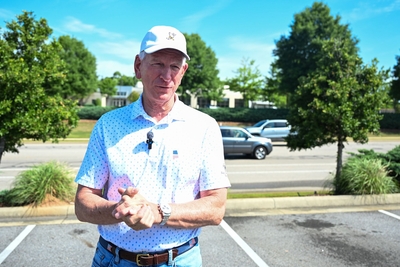
“They’re going to be pushed back, obviously, until August,” he said. “Gov. Ivey decided they’d do that. Now it might not change, they might come back and say that map’s out, and they might just vote the same map as we saw before this happened, so you know there’s so many if ands and buts, but I am for making sure everybody is represented in this state.”
Voters in Tuskegee in the 2nd Congressional District, most likely to be affected by the changes, criticized the decision on Tuesday.
“It is unfair,” said Walter Pack, a retired administrator. “It is not one man, one vote.”
Jolai Jenkins, an administrator for the city of Tuskegee, said Tuesday she was “upset like a lot of other people” about the moves by the U.S. Supreme Court and the state.
“There are a lot of people who want to change it around. It took so long to get voting for minorities, and now they want to change it,” she said. “We saw people, like John Lewis, work really hard to get voting and now they want to take it away.”
Polls will be open until 7 p.m. Tuesday.
This story was reported by staff writers Anna Barrett in Auburn; Ralph Chapoco in Tuskegee and Andrea Tinker in Pike Road. It was written by editor Brian Lyman. Updated at 4:58 p.m. with a turnout estimate from the Jefferson County Board of Registrars.
Montgomery