Homeless New Orleanians swelter amid scorching heat wave
Jul 30, 2026 | 7:11 am ET
Description
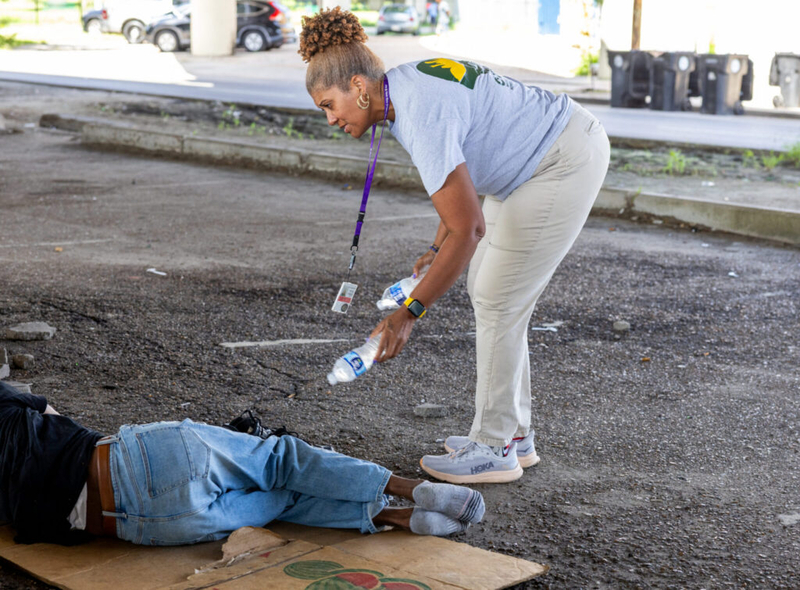
Elainna Williams of the New Orleans Office of Homeless Services and Strategy distributes water to an unhoused individual on Claiborne Avenue during a heat advisory July 20, 2026. (Photo by Christiana Botic/Verite News and Catchlight Local/Report for America)
For people experiencing unsheltered homelessness like Victor Tate, shade is sometimes the only available relief from summer heat.
Living in a makeshift shelter under the Pontchartrain Expressway, Tate told Verite News that he lost his shelter during 2025 Super Bowl sweeps, had his phone stolen and felt disrespected often by people passing by during the last 10 years that he’s been unsheltered on and off. With the heat index expected to reach as high as 115 degrees Fahrenheit this week, full shelters and worsening climate conditions, Tate is bracing for the additional stress brought on by rising temperatures.
“If it gets hot, you’ve got to stay up under here or go to the shelter at night,” he said. ”The cars going back and forth — that’s what makes it cool. Then when it rains, the wind blows.”
About 1,563 people experience homelessness across Orleans and Jefferson parishes, according to recent data from the U.S. Department of Housing and Urban Development. While the point-in-time counts estimate just over a quarter of unhoused people are unsheltered, people can often fall in and out of the gaps of New Orleans’ safety net.

Like the rest of the nation, Orleans Parish has seen warmer maximum morning temperatures — meaning those who remain outside have less recovery time from the heat, according to research from the Southern Climate Impacts Planning Program, a partnership between Louisiana State University and University of Oklahoma. Barry Keim, an environmental health professor at LSU who is a former state climatologist, called humidity a “killer” as it interrupts people’s natural ability to cool off.
“When you perspire, you’re still not getting a whole lot of evaporation off of your skin because the air is so humid to begin with,” Keim said. “It limits the amount of evaporation that can take place. And as a result, your body just continues to get hotter and hotter.”
According to research from the Louisiana Department of Health, parishes in southeast Louisiana experienced 98 heat-related deaths since 2023, which is just over half of the statewide total. This year, people from those same parishes made up over a third of all statewide hospitalizations for heat-related injury.
Seniors and people with disabilities are particularly vulnerable to heat, according to Joe Heeren-Mueller, a coordinator for the Louisiana Advocacy Coalition on Homelessness. Over the past six years, seniors — aged 65 and older — are the fastest growing unhoused population with a 78% uptick in homelessness, according to a recent study from Unity of Greater New Orleans.

According to the National Weather Service’s Baton Rouge/New Orleans office in Slidell, this year is currently the 16th hottest summer season since 1946. NWS meteorologist Danielle Manning recommends people outdoors stay in shaded areas, avoid physical activity and hydrate with water instead of coffee, soda or alcohol.
While unhoused New Orleanians are supported by shelters and heat relief initiatives in Orleans and Jefferson parishes, shelters are just one step in eliminating homelessness, according to Heeren-Mueller. He added that because demand for shelters is higher than their capacity, specialized solutions are needed to help people find relief.
“That doesn’t simply mean that we need to just build more shelters because…what works is creating flow,” Heeren-Mueller said. “You need sufficient shelters, and those who go into shelters need somewhere to go afterwards where they can maintain stable housing.”
At the start of next year, public sleeping will be illegal statewide because of a new law, Act 788. The law doesn’t explicitly mention the termination of services and programs that help people who are unhoused, but housing advocates are concerned at its potential to weaken trust with unhoused people and push them away from lifesaving services.
“Over 350 cities have passed anti-camping bills in the past two years,” said Jesse Rabinowitz, the communications director for the National Homelessness Law Center. “None of them have solved homelessness because laws that make it a crime to be homeless will never actually solve homelessness. They’ll only make homelessness worse.”

During extreme hot and cold weather, New Orleans activates cooling and warming centers in its libraries and recreation facilities. When overnight shelters for unsheltered people are at capacity, cooling centers can house about 100 people at each center.
City outreach teams from the Office of Homeless Services and Strategy and the Public Health Emergencies & Environmental Health Unit also coordinate bottled water distribution near the Claiborne Corridor and French Quarter. During colder weather, the same outreach teams will attempt to get unsheltered people into warming centers and shelters.
Elainna Williams, an Office of Homeless Services’ team member, said she learned how important rapport was the first time she did winter street outreach.
“They would not come off the street, and it was mind blowing. But then I went to the warming center the next day, and [saw] some of the same people that told me ‘no’ the night before,” Williams said. “Sometimes it takes time, and sometimes it could be a level of trust.”
To reduce the citywide heat index, the Office of Sustainability is planning to plant 40,000 trees by 2030 as part of the New Orleans forestation plan. After Katrina, New Orleans lost 200,000 trees, decreasing available shade and its tree canopy coverage to half of the shade of other southern cities. The Heat Action Plan is currently being drafted and is expected to be adopted by the city later this year, outlining different cooling strategies.
As the public sleeping ban goes into effect before winter’s coldest days, some advocates worry criminalization could perpetuate homelessness. A city spokesperson said warming and cooling efforts would not be affected by the public sleeping ban.
Outside of municipal operations, local grassroots efforts aid those living outside of shelters. During summer months, Below Sea Level Aid dispatches street teams to hand out cold drinks, ice packs, battery-powered fans and other cooling supplies. The weekly trips are part of the nonprofit’s harm reduction and public health mission.
“New Orleans is not built to handle extreme heat. Our infrastructure actually makes it even worse,” said Below Sea Level Aid founder Jack Waguespack-Slooijer. “I really try and focus on our people who are under the overpasses and directly on concrete or the street, [as] opposed to being in a park or somewhere green.”
Christiana Botic contributed to this report.
This article first appeared on Verite News New Orleans and is republished here under a Creative Commons Attribution-NoDerivatives 4.0 International License.

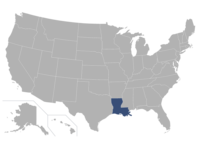
Baton Rouge, LA