Smart phones render Nevada privacy law vague and outdated, says attorney
Jul 30, 2026 | 8:00 am ET

Description
“The burden has now become placed on us as humans. If we want to have a private conversation, we really need to take extra steps to have that private conversation,” an attorney said while arguing a case involving Nevada's nearly 40-year-old privacy statute. (Getty Images)
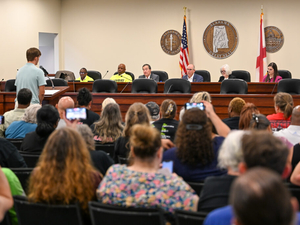
A law invoked by Clark County District Attorney Steve Wolfson in separate cases – one against a former Mesquite police chief and the other, against a current Henderson city councilwoman – for allegedly secretly recording conversations in their respective city halls, is antiquated in an age of smart phone ubiquity, defense attorney Tony Sgro argued Wednesday in Mesquite Justice Court.
The statute, passed in 1989, has never been amended, and is constitutionally vague, given modern standards, Sgro, who represents former Mesquite Police Chief Joseph MaQuade Chesley, told Pro Tem Justice of the Peace Christopher Laurent.
“When you are out in the world and anyone in your proximity, which is everyone, has a smartphone, they can record your table, and you didn’t know about it, because that’s where technology is,” Sgro said during a hearing on his motion to dismiss the charge against Chesley. “The burden has now become placed on us as humans. If we want to have a private conversation, we really need to take extra steps to have that private conversation.”
Chesley faces one felony count for allegedly secretly recording a 2024 conversation among two city council members and another person during business hours in Mesquite City Hall. Chesley contends there was nothing surreptitious about his uniformed presence on the stairs of the public building.
Henderson City Councilwoman Carrie Cox, who is up for re-election, faces trial in October just as early voting begins, for allegedly hiding behind a curtain at city hall last year and recording her council colleague Monica Larson, who was speaking with constituents.
Cox’s campaign contends the charges are part of an orchestrated effort by the council to get her out of office.
Sgro told the judge that Mesquite officials, who initially sought to avoid a conflict by asking Las Vegas Metropolitan Police to investigate the allegation against Chesley, backpedaled and conducted their own investigation when Metro declined to refer the case to the D.A.
The city pursued the investigation regarding Chesley’s recording, Sgro told the judge, in November 2025, after Chesley’s lawsuit against the city for wrongful termination “gained traction,” leaving the city “in an untenable situation where they see that the writing is on the wall. They’re going to lose this case.”
City officials who provided affidavits against Chesley recanted their allegations when pressed during depositions, Sgro said, adding the prosecution of the former chief “reeks of nefarious, corrupt activity.”
Chesley contends the Mesquite officer who investigated the allegations against him, Sgt. Jamie Stout, is biased as a result of being disciplined by Chesley on several occassions. Sgro argues Stout’s alleged bias against Chesley and Mesquite’s potential liability in Chesley’s federal court case led Stout to taint evidence to support Mesquite in federal court.
In 2025, Stout sent a text message to a council member the day before a council meeting regarding Chesley, whose job was on the line after the police union took a vote of no confidence.
“I just wanted to reiterate: it is in all of our best interest for him to be gone,” Stout wrote in the text, according to court filings. “Our union is prepared for a long fight, but we would much prefer him to go away quietly. We very much appreciate your support and for listening to our concerns.”
Sgro maintains the charge against his client amounts to selective prosecution orchestrated by the city to derail Chesley’s federal lawsuit alleging wrongful termination.
The charges, according to Chesley’s motion to dismiss, “are clearly retaliatory in nature because Mr. Chesley elected to pursue litigation against the City alleging that he was improperly terminated. Should Mr. Chesley be convicted, the City of Mesquite is excused from the due process requirements that are owed to Mr. Chesley.”
The city is already on the hook for a $1.425 million settlement with Chesley approved by the council in April to resolve wrongful termination cases he filed with the state Equal Employment Opportunity Commission and in District Court.
Last year, Clark County District Judge Nadia Krall stated in a related civil case that Chesley’s recording was not criminal.
Krall wrote the accusation against Chesley amounted to “bad faith and harassment” on the city’s part, and “an ongoing pattern of bad faith defenses.”
She found the accusations “are contrary to the facts” and that Mesquite “fabricated false charges… to relieve themselves of the due process obligations under the law.”
Deputy D.A. Austin Beaumont argued that Krall’s rulings in a prior case are inadmissible.
Laurent, the Mesquite justice of the peace pro tem, asked the attorneys to submit briefs on what role, if any, Krall’s findings on the same facts in the civil case have in the present criminal case. He took the motion to dismiss under advisement and is expected to rule in September.
The criminal cases against Cox and Chesley, though similar, could take different paths.
Though Krall found Chesley did nothing criminal by recording the conversation, in February, she refused Cox’s motion to dismiss the felony count against her.
Cox’s attorney, Josh Tomsheck, has not responded to the Current’s requests for comment.
Las Vegas, NV