Swim advisories have been posted at 20 Iowa state beaches since Memorial Day
Jul 03, 2026 | 8:00 am ET
Description
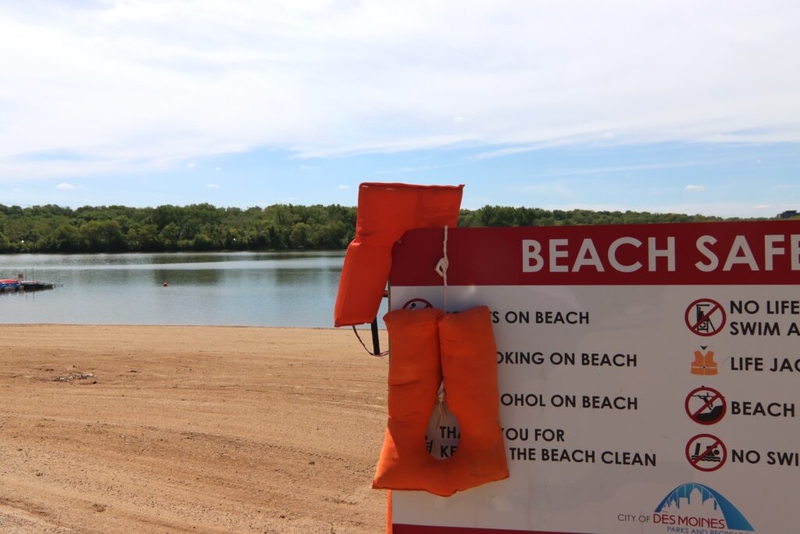
Lifejackets on a sign at Gray's Lake on May 23, 2025. (Photo by Cami Koons/Iowa Capital Dispatch)
Twenty state park beaches in Iowa have had swimming not recommended notices posted at least once since the Iowa Department of Natural Resources began monitoring the beaches for bacteria and harmful algal blooms at the end of May.
That’s about half of the 41 state beaches monitored by DNR throughout the summer.
Heading in to the July 4th holiday weekend, 11 state park beaches have swim advisories.
DNR measures the lake water at state park beaches for E. coli and cyanobacteria toxins from green-blue algae, which the U.S. Environmental Protection Agency classifies as a possible human carcinogen and a “potent liver toxin.”
While most E. coli are harmless, some can cause illnesses like diarrhea, urinary tract infections, pneumonia or sepsis when swallowed. High numbers of E. coli bacteria usually indicate there are high numbers of other, potentially harmful bacteria, according to the U.S. Geological Survey.
DNR issues a “swimming not recommended” warning at beaches where water samples show single time E. coli levels above 235 colony forming units per 100 milliliters, or a geometric mean – gathered from five samples over a 30-day period – of E. coli that exceeds 126 CFU/100 mL.
Swimming at beaches with these advisories poses an increased risk for waterborne diseases. Children, elderly adults and people with weakened immune systems have the highest risk of developing an illness by swimming at beaches with high indicator bacteria or toxins.
DNR monitors cyanotoxins at beaches by measuring microcystin, a common cyanotoxin. DNR issues a “swimming is not recommended” advisory when microcystin levels exceed 8 micrograms per liter.
The majority of Iowa beach swim warnings are issued because of excessive E. coli levels. Of the 20 beaches flagged as of Thursday, 16 had E. coli levels above the DNR threshold at least once since Memorial Day. Water at two beaches had microcystin levels above the threshold and two beaches were impaired by both E. coli and microcystin at least once during the period.
Per the DNR beach monitoring website, rain events are “one of the most important factors in generating high levels of bacteria” in water bodies. Rain can transport fecal bacteria, from improperly constructed septic tanks, livestock, wildlife, sewage treatment facilities and manure spills, to beaches and water bodies.
According to EPA, the presence of microcystin indicates that a water body is likely “stressed” by high levels of nitrogen and phosphorus. Many of DNR’s lake restoration programs involve installing sediment basins and buffers upstream to help keep nutrients in the watershed from running into the lakes.
At the end of last summer, 28 beaches had swimming not recommended warnings at least once during the 15-week monitoring period from Memorial Day through Labor Day. Backbone State Park, Beeds Lake State Park and Pine Lake State Park had the most swimming advisories during summer 2025 – each beach had just three weeks throughout the summer without an advisory.
Seven weeks into the 2026 reporting season, Lake Darling State Park’s beach and Pine Lake State Park’s south beach have topped the list. Both beaches have had swim advisories for all but one week.
DNR also issues an annual categorization of beaches based on data from the past five years of monitoring. Beaches are categorized as “vulnerable” if they have had E. coli sampling averages above the standard for three of the past five monitoring years. “Less vulnerable” beaches have had E. coli sampling means above the water quality standard in two or fewer years of the past five years.
This summer, 28 beaches were classified as less vulnerable and 12 were labeled as vulnerable. Classification was not available for the beach at Bobwhite State Park.
DNR beach monitoring is updated weekly. The website also includes information on city and county maintained beaches.
Des Moines, IA