Primaries end with a draw in SC House’s ongoing intraparty GOP battle
Jul 03, 2026 | 10:00 am ET
Description
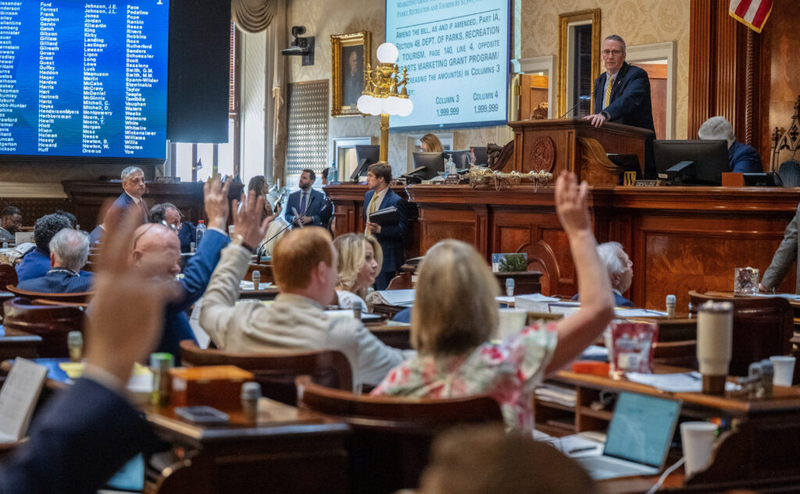
Members of the House Freedom Caucus raise their hands during the chamber's budget debate on Tuesday, March 10, 2026, to request a roll call vote on an amendment. In the middle are Reps. Josiah Magnuson of Campobello and Sarita Edgerton of Spartanburg. (Courtesy of the House photographers' office/photo by Kim Kim Foster)
COLUMBIA — Though overshadowed by statewide and federal contests, the intraparty battle in the GOP-dominated state House of Representatives continued between the mainline House Republican Caucus and the renegade House Freedom Caucus in last month’s primary and runoff.
It was a lower-key rerun of the pitched GOP-versus-GOP battles that raged across the state in the 2024 cycle.
The arguments and many of the matchups were the same. And both sides once again cried foul over a flood of out-of-state dark money. But the results were roughly the same as last cycle too: a stalemate.
In about nine contests, GOP voters reelected all the incumbent members of Speaker Murrell Smith’s House Republican Caucus who faced challenges from candidates aligned with, or sympathetic to, the Freedom Caucus.
But primary voters also returned all seven Freedom Caucus members who were primaried by more conventional Republican opponents to the Statehouse.
That didn’t stop both sides from claiming victory.
“The Freedom Caucus didn’t lose the primaries — they won them, and picked up seats,” Andy Roth, president of the State Freedom Caucus Network that supports state chapters, wrote about South Carolina June 26.
“It was a good night for the good guys,” said Walter Whetsell, a GOP operative who helped run many of the Republican Caucus incumbents’ campaigns.
The Freedom Caucus’s “math does not math,” he said. “But it’s not surprising that once again they just make things up.”
Republican Caucus leaders say they’ve picked up a seat with 25-year-old Hunter Hackett’s primary runoff victory in an open district in southern Lexington County.
Rep. Ryan McCabe, a Freedom Caucus member from Pelion, did not run for reelection, and, if Hackett wins the ruby red district in November, he will replace McCabe.
Hackett did not return phone calls and text messages this week from the SC Daily Gazette to confirm that he will join the Republican Caucus.
Mainline Republicans came within a hair of defeating Freedom Caucus Rep. Rob Harris, perhaps the House’s most right-wing member, but he held on with 34 votes after a recount, sending him toward a third term in the Spartanburg County seat.
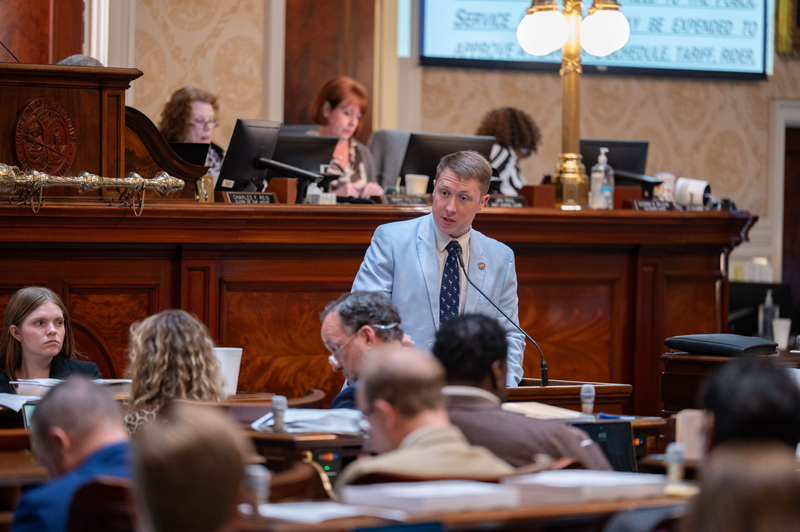
Freedom Caucus Chairman Rep. Jordan Pace, R-Goose Creek, did not make the broad claims Roth did, telling the Daily Gazette that the caucus did not endorse challengers or candidates in
open-seat races. The mainline caucus’ claims of victory were “an inaccurate framing,” he said.
“I’m encouraged by the results,” Pace said. “It would have been great to pick up more seats, sure, but I think we’re going to wind up gaining more seats in the end … if not members then at least friends and allies.”
Four years of feuding
The Freedom Caucus, launched in April 2022 by former state Reps. Adam Morgan and RJ May as chairman and vice chairman, has stopped publicizing its membership. But about 18 of 89 Republicans in the House are reliable votes on its measures and appear on its social media.
The caucus, which split from the majority GOP after the 2022 elections, regularly criticizes House leadership as too moderate and willing to compromise. Its members seek to push the House GOP agenda further to the right. During floor debates, they try to amend legislation supported by GOP leadership and cut spending from the state budget they consider nonessential.
The Republican Caucus argues that they’re focused on governing the state conservatively and responsibly rather than peacocking.
‘Tired of this crap’: GOP leader calls Freedom Caucus efforts to slash SC budget disingenuous
In the 2024 primaries, the House Republican leadership and its allies supported and helped fund primary challenges against almost every member of the Freedom Caucus, while the Freedom Caucus backed challenges to dozens of mainline Republicans.
Both sides had their sights set on statement victories.
But in the end, incumbents won almost every race. The Freedom Caucus did notch a notable win, ousting Assistant Majority Leader Jay West, R-Belton, from his Anderson County district.
The Freedom Caucus took a major hit when May, its co-founder, spokesman and chief strategist, was federally charged with exchanging videos of children being sexually abused with people around the globe using a messaging app. He eventually pleaded guilty in September 2025 and was sentenced in January to 17½ years in prison.
The case dominated headlines for months and sullied the caucus’ image.
Since May’s resignation from the House in August 2025, the relations between House leadership and the Freedom Caucus have warmed and the fiery confrontations on the floor have waned, if only slightly.
“RJ May leaving made things better,” said Rep. Brandon Newton, the House majority whip from Lancaster who easily turned back a primary challenger June 9. “RJ was a political consultant who was personally profiting from the fighting.”
Last month’s primaries
But on the campaign trail, the rhetoric, especially from out-of-state, dark money groups, was just as harsh as two years ago, if not more so, said state Rep. Don Chapman, an Anderson County Republican and member of the mainline caucus.
Chapman won a June 23 primary runoff with 54% of the vote against GOP activist Sherry Hodges, who won endorsements from many of the current Freedom Caucus members. Hodges had also unsuccessfully challenged Chapman in 2024.
“The mailers from Make Liberty Win were more vile than I’ve ever seen,” Chapman said of a Fairfax, Virginia-based dark money group that sent attack ads against many Republican Caucus
incumbents. “I think people are sick of the negative stuff, personally.”
On the other side of Anderson County, Freedom Caucus member Rep. Thomas Beach soundly defeated businessman Stewart Watson, who was highly critical of the Freedom Caucus. Beach garnered 68% of the primary vote.
The Freedom Caucus incumbents’ wins show GOP voters like their approach when they understand it, but the caucus’ limited resources have held back its growth, Beach said.
“We need to have someone to fundraise for us, a full-time fundraiser. We need to start reaching out to associations,” he said. “That’s why I’m talking about being professional. All we have, and all we’ve been doing is dependent on the grassroots.”
Though there were many similarities between the primary campaigns this year and in 2024, the statewide and federal races dominated attention, volunteer hours and campaign cash this cycle, leading to fewer primary challenges across the board, politicos on both sides said.
And both the Freedom Caucus and the Republican Caucus focused on defending incumbents rather than organizing a concerted effort to recruit challengers to unseat incumbents, which both sides did in 2024, though those efforts were broadly unsuccessful.
“Our priority was protecting our members, and, look, I think whittling it (the Freedom Caucus) down over time is likely the best strategy. You’re not going to just go in there and clean house,” Whetsell said.
A final unknown in the vote-counting math is Rick Shealy.
The 72-year-old timber farmer was the only challenger to oust a sitting Republican member of the House this primary cycle when he defeated Rep. Luke Rankin with 60% of the vote in a Laurens County district.
Though the same outside groups that supported other Freedom Caucus-aligned candidates ran ads against Rankin, Shealy told the Daily Gazette on July 2 that he does not plan to join either the Republican Caucus or the Freedom Caucus at the start of the next session if he wins the solidly Republican district in November.
He’ll “get the lay of the land” and then make a decision, he said.
“Just seems like there’s a lot of infighting going on,” Shealy said. “I don’t want to be a part of that fight. I want to serve the people of Laurens County.”
Indeed, of 28 Republican primaries, about 10 of them, like the one in Laurens County, did not feature a clear-cut contest between a Freedom Caucus-aligned candidate and a mainline Republican.
The governor’s race
After a second primary cycle without decisive wins, both sides argued the GOP gubernatorial primary showed they’re winning the ideological fight.
Lt. Gov. Pamela Evette named Pace, the current Freedom Caucus chairman, and Morgan, the founding chairman, to her shortlist of potential running mates.
And, during the campaign, Attorney General Alan Wilson sharply criticized the state government incentive package that brought Scout Motors to Richland County as a “boondoggle.”
“Hallelujah,” Pace said. “I would point to a lot of the talking points that were straight out of the Freedom Caucus’s policy box.”
But Newton, the House whip, said U.S. Rep. Ralph Norman’s gubernatorial campaign was a better barometer of the caucus’ support — and proof of its low ceiling. Before Morgan appeared on Evette’s list, he was Norman’s running mate.
“You could copy and paste their talking points to his talking points, and he finished a distant third statewide,” said Newton. “I think that has to be an example of the fact that their message compared to our caucus’s message is a lot narrower.”
Columbia