CRMC approves key SouthCoast Wind permit over objections from fishing industry
Jun 10, 2026 | 4:34 pm ET
Description
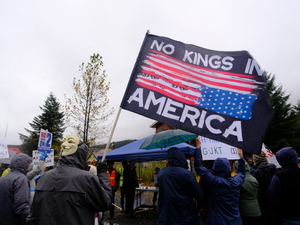
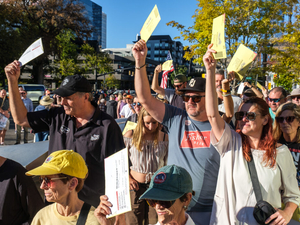
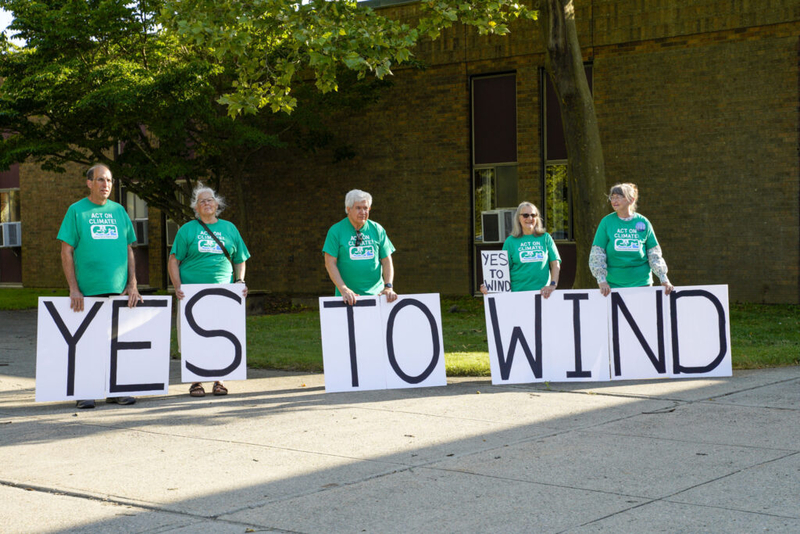
Members of Climate Action Rhode Island show their support for the SouthCoast Wind project outside Portsmouth Middle School on July 23, 2025. The Rhode Island Energy Facility Siting Board held a hearing on SouthCoast Wind’s cable burial plan that night. (Photo by Laura Paton/Rhode Island Current)
The murky future for SouthCoast Wind gained a small but significant sign of clarity Tuesday with a key permit approval from the Rhode Island Coastal Resources Management Council (CRMC).
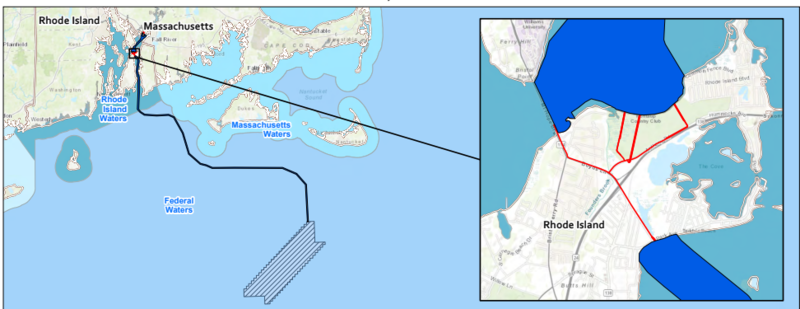
The panel’s unanimous vote — the first decision made by the newly retooled council —- followed a four-hour series of expert presentations and public comments on the impacts of the underwater cable lines in Rhode Island waters. The center of the project — 141 turbines generating more than 1,200 megawatts of wind-powered electricity at nameplate capacity — sits more than 60 miles south of Rhode Island’s coastline, closer to Martha’s Vineyard and Nantucket. But project developers needed permission from Ocean State regulators to run power lines from the turbines to the electric grid, snaking up the Sakonnet River, underneath Island Park in Portsmouth and out Mount Hope Bay to reach land at Brayton Point in Somerset, Massachusetts.
When and whether the high-voltage cables ever come through Rhode Island remains unclear; SouthCoast is one of many offshore wind projects facing unforeseen setbacks since President Donald Trump took office in January 2026. The developer hasn’t lined up a buyer for its product, though Massachusetts power providers are expected to announce a decision on a potential deal by the end of the month. Rhode Island Energy was initially interested in procuring a small piece of the project power, too, but broke off contract negotiations after multiple delays, citing federal policy uncertainty.
Federal regulators with the U.S. Bureau of Ocean Energy Management have also revoked a key federal permit tied to the project and are still reviewing whether to reissue the permit with new conditions — if at all.
Fishermen, municipalities and conservative-funded interest groups noted the federal uncertainty in 90 pages of opposition letters to coastal regulators. Far more pressing for critics, however, was the potential environmental harms to native species and habitats where the developer wants to drill and bury the power lines, and the commercial and recreational fishing community that depends on those habitats.
But the project also brings key economic and environmental benefits to Rhode Island, through jobs and clean alternatives to fossil fuels, according to environmental and labor groups who flooded the CRMC with 166 pages of support letters.
The council’s staff acknowledged both points of view in its analysis, which considers a laundry list of environmental topics, from bats and eelgrass to boulder relocation and electromagnetic frequencies. Many of the potential disruptions have been lessened by changes to the project construction, layout and timeline, the 135-page staff report states.
“Despite the effort to minimize impacts, in some cases impacts are unavoidable,” the report states. “These include permanent alteration to the benthic habitat from a soft bottom to hard bottom from secondary cable protection, along with impacts to fishing communities. SouthCoast has offered mitigation compensation to address these impacts on the fishing communities.”
Money talks
State coastal regulators’ power to include compensation in its permit review process can help affected anglers How to determine losses, and compensation, has proven a sticking point of past negotiations for other offshore wind projects, in part because of gaps in data about local catches of certain species and how the still-nascent wind industry will affect them.
“It’s very tricky when you’re talking about some of these individual species to know how they’ll come back or whether they’ll come back to the area,” Todd Guilfoos, a resource economist at the University of Rhode Island, told the CRMC Tuesday.
Guilfoos was retained by a volunteer fishing advisory panel to verify and build upon data provided by the project developer regarding total losses, and appropriate compensation. His expertise helped shape the final mitigation package, which calls for at least $932,000 in direct compensation and other support for commercial and recreational anglers, based on the project securing its financial agreements by 2027. Compensation rises to over $1 million if the project is delayed to account for inflation.
The bulk of the money goes to a third-party managed trust to which commercial and for-hire fishermen can submit claims for reimbursement. There is also a first-of-its-kind set aside for recreational anglers — whose losses have been difficult to put into numbers, said Kevin Sloan, a coastal policy analyst for the CRMC.
There is also $65,000 to study how the secondary cable support equipment will affect fishing gear once the project is operational.
Sloan touted the compensation package — the product of four years of negotiations, and nearly twice the $560,000 SouthCoast initially offered.
“We’ve brought it up quite a bit,” he said.
Fishing advisory panel not on board
The Fishermen’s Advisory Board rejected the compensation offer by a 2-4 vote, with four other members abstaining, Sloan said. The vote was taken over email, and a breakdown of members’ votes was not immediately available.
At 9 a.m. Tuesday, nine hours before the scheduled meeting, the panel wrote to the CRMC, asking for the decision to be postponed because its chosen attorney, Marisa Desautel, was not allowed to participate in mitigation negotiations. A copy of the email was shared with Rhode Island Current. Desautel said Wednesday she did not know why she was not allowed to participate.
Laura Dwyer, a spokesperson for the CRMC, did not immediately return requests for comment on Desautel’s exclusion.
The advisory board previously refused to pick an attorney from a pre-approved list from the developer. Desautel was not on the list, although she represented the same fishing advisory panel in other, unrelated project negotiations.
“I’m not surprised,” Michael Marchetti, a commercial fisherman on the panel, said of the CRMC’s decision in an interview Wednesday. “I think it was a foregone conclusion to be honest with you. I’m disappointed of course, but everything’s already been bought and sold.”
Desautel also represents the towns of Little Compton and Middletown, which opposed the project due to environmental concerns and noise and traffic impacts from construction.
Middletown declined to comment on the decision. Little Compton could not immediately be reached for comment.
Portsmouth, the most affected municipality, did not formally object to the permit, having already inked a host agreement with the developer in 2024 in which it will receive $23 million in exchange for granting access to town property.
The fishing compensation package is one of 33 conditions tied to the permit approval, along with regular reporting on environmental impacts and specific timing for seabed drilling to minimize neighborhood and species disruption.
A spokesperson for SouthCoast Wind did not immediately respond to requests for comment Wednesday.
The project also needs a general construction permit from the Rhode Island Department of Environmental Management and a submerged land lease from the Rhode Island General Assembly.
The project is expected to begin delivering power by the end of the decade, according to the project website.
Providence, RI