A political split in Oregon’s Columbia River Gorge
Jun 04, 2026 | 1:00 pm ET
Description
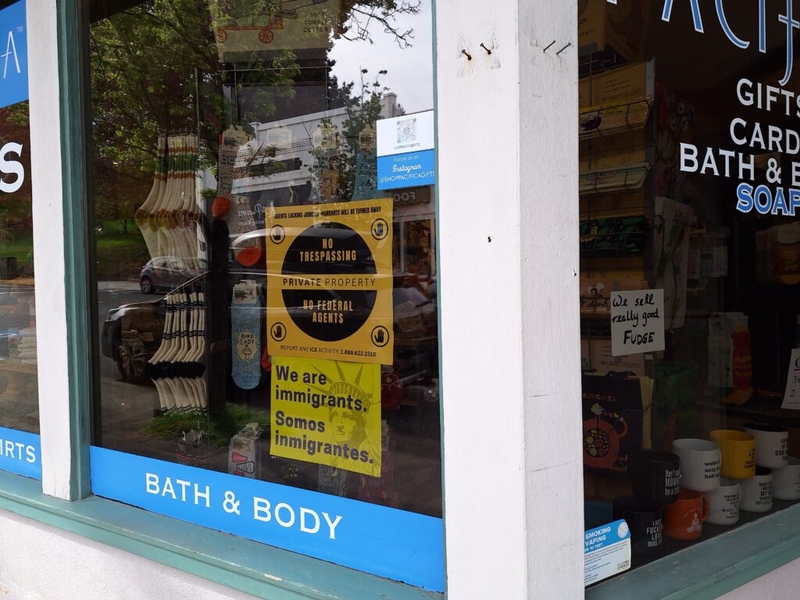
Storefront signs in downtown Hood River, Oregon, indicate support for immigrants and tell federal agents they're not welcome. (Photo by Randy Stapilus/Oregon Capital Chronicle)
Visit Hood River, as so many people do, and you’ll see on the front windows of many downtown businesses a sign saying: “We are immigrants,” and sometimes next to them signs saying, “No trespassing — no federal agents — agents lacking judicial warrants will be turned away.”
Many took care to advertise an April 23 community town hall about the “impacts of ICE actions in our communities.”
Politically and socially, Hood River closely resembles pieces of central Portland or Corvallis.
Travel about 20 miles down the highway to the other major Columbia Gorge community, The Dalles, and you’d have to search hard to find any such signs about immigration or other public policy. I couldn’t find one.
These two communities theoretically ought to be twins. The Dalles has a formal population about twice as large as Hood River, but the cities’ urbanized areas feel comparable in size. Both rely on their Columbia River location for strong tourism sectors, while each still depends considerably on agriculture. Both cities exude some prosperity (a little more obviously, maybe, in the case of Hood River). Even the cities’ road plans, and mix of commercial, industrial and residential areas are laid out similarly.
And yet to walk around these two cities is to get an entirely different feel. Hood River is packed solid on weekends — parking is hard to find — its popularity as a tourist destination spot (sporting activities, notably windsurfing, are a major draw). The Dalles draws tourists but seems more reliant on traditional resource businesses and its massive new data centers, a subject of some local controversy.
But the politics of the area is clear and reflects the overall feel of the communities. Hood River city, and the county around it, is strongly Democratic, while The Dalles area leans very slightly Republican and Wasco County around it mostly is strongly so.
The reasons for this, and the impact of recent economic developments, suggest a small but clear current movement toward Democrats, which may have an effect on one of the handful of closely contested Oregon legislative seats.
The Gorge, or at least the Oregon side of it, has been politically fluid over the decades. In the half-century up to 1988, you could argue that Wasco was more Democratic than Hood River; certainly it voted more often for Democrats for president. Since then — around the time Oregon became a consistent Democratic vote on the presidential level — Hood River has become clearly bluer, and Wasco more purplish.
Hood River County overall in 2024 voted 65.8% Democratic for president (well short of Multnomah but close to the margins in Washington and Benton), most strongly in Hood River city (four of those precincts went Democratic by more than 70%), but generally county-wide as well.
Wasco County barely voted Republican for president, 51.1%, and that close split reflected a wide range of views around the county’s 12 precincts. Four precincts in and just to the west of The Dalles voted Democratic, two more nearby were closely split, and the remaining rural precincts, with smaller populations, were strong Donald Trump bases.
The one rural precinct which went for Kamala Harris, Rowena-Mosier, lies on the old Highway 30 directly between The Dalles and Hood River. Many of the residences there are relatively new, suggesting that some of the same population moves and cultures that have influenced Hood River and to a lesser degree The Dalles had an effect in between them as well.
These geographic and voting pattern details matter when it comes to one of the region’s most closely-fought legislative seats.
In the decade before the 2022 election, all of Hood River County (along with mostly Republican slices of Multnomah and Clackamas) was located in the 52nd House District, and all of Wasco County (along with several other north-central Oregon counties, generally strongly Republican) in the 57th District.
The 2021 redistricting nudged the 57th District toward the southeast, expelling the precincts around The Dalles. Those are in the redistricted 52nd District, which was already closely split between the parties and lost some marginally Democratic territory in the Portland metro area.
This put the balance in this swing district in the new territory of The Dalles. In the 2022 election Republican Jeff Helfrich won three of the four counties in the 52nd District but lost Hood River overwhelmingly, for a narrow district-wide win of 52.5%. In 2024, he won again but by even less, 51.8%; the Wasco County precincts edged a little more Democratic that year.
This year, Helfrich is running instead for the Senate in the 26th District, where Republican margins are a little stronger. The two major candidates to replace him in the House are Republican Scott Hege and Democrat Hank Sanders, both winners of contested primaries.
Not much of a demographic change would be needed in this district to create an almost perfectly even playing field. This could turn out to be one of the last legislative seats in Oregon decided after election day in November.
Salem, OR