Eight incumbent Montana legislators lose primary elections
Jun 04, 2026 | 3:48 pm ET
Description
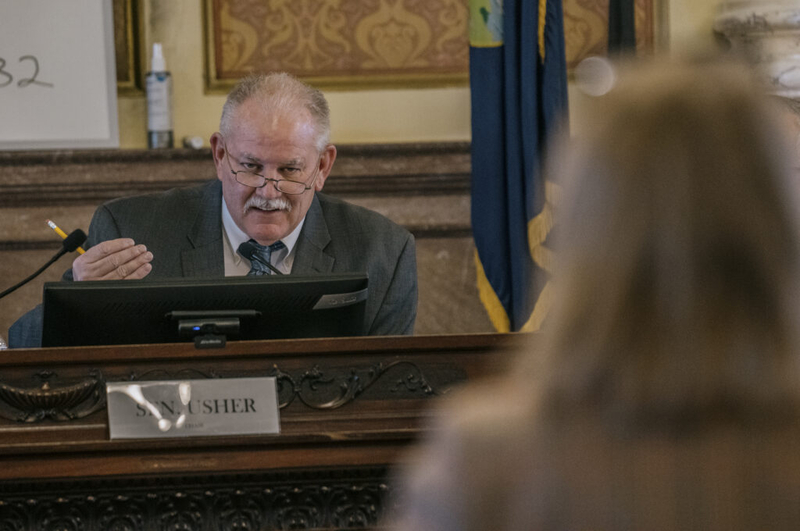
Senator Barry Usher, R-Billings, asks a question during a Montana Senate Judiciary Committee hearing on Wednesday, February 12, 2025. (Nathaniel Bailey for the Daily Montanan)
Eight incumbent lawmakers — all Republicans — lost in the June 2 primary election to challengers from within their party and will not appear on the November ballot – nor in Helena come January.
Six of the losses were among more moderate Republicans targeted by the more conservative state GOP party, and two were members of the state’s Freedom Caucus, including a longtime legislative leader.
Senate Majority Whip and chairman of the powerful Senate Judiciary Committee Barry Usher lost his primary to challenger Chris Rindal by around 8 points.
“Obviously, it’s not the outcome I wanted, but the people have spoken,” Usher told the Daily Montanan. “God’s got a plan, he just hasn’t told me what that plan is.”
Among the wins for the state Republican Party was the ousting of Sen. Shelley Vance, representing the Belgrade area.
Vance was one of “The Nine” senators who broke with the party in 2025 to work across the aisle and pass major bills including the state budget and property tax changes, and was summarily considered not to be Republican by the state GOP.
Vance, the only member of “The Nine” up for reelection in the Senate, lost to Rep. Caleb Hinkle by 48 points.
(Sen. Wendy McKamey of Great Falls withdrew from her race for health reasons, but her chosen replacement, Rep. George Nikkolokakos, won his primary; and Sen. Jason Ellsworth lost an campaign for a house seat across the state from where he lives.)
Hinkle has been a reliably conservative voice in the Legislature for the last three sessions.
In 2025, he ran bills allowing prosecution of individuals subject to federal immigration detention, and changing state laws around appointments to commissions and boards to remove a requirement to balance gender and racial makeup.
He also introduced bills including a resolution “recognizing history of racism and bigotry within Democratic party,” and a bill to allow legal action be taken against drag shows, neither of which passed.
Hinkle did not respond to requests for comment from the Daily Montanan by publication time.
House shifts
In the House, incumbent Reps. Lyn Bennett, Linda Reksten, Nelly Nicol, John Fitzpatrick, Ken Walsh and Curtis Cochran lost their primary races.
Nicol is a member of the Montana Freedom Caucus and was backed by the state GOP.
She lost to newcomer Troy Charbonneau in HD 53 by 13 points.
The other five legislators drew primary challenges from political newcomers on? the right.
Walsh has served as a lawmaker for six years representing House District 69 near Twin Bridges, and said it was clear that the targeting of more moderate candidates by the state GOP had an effect on his race.
“When you advertise that Ken Walsh is a radical liberal that supports sexually explicit material for kids and is woke and supports procedures for transgender minors, and you hear that 15 times on the radio, mailers or the internet, it can sink in; but I mean, really?” Walsh said in an interview. “They had a mission and went after it with a lot of ammo, and a lot of resources.”
He said he isn’t sure if he’ll try to return to the Legislature in the future, but he wants to keep his options open.
“There’s probably other things I could do to help my community, or this district, or southwestern Montana,” Walsh said. “Maybe it’s in public service again, maybe it’s something else. My motto’s always been kind of community service, give back more than you take.”
Newcomer Trevor Walter was holding a 6-point lead over Walsh as of Thursday morning, though the race remained uncalled. Walter did not respond to a phone call about his primary victory.
In the Flathead Valley, Bennett took a 40-point loss to Shaun Pandina, a perennial local candidate who has run for the legislature and local school boards, without success.
Pandina did not respond to specific questions about his primary win, but sent the Daily Montanan a 500-word statement thanking supporters and voters and promising to work to limit government spending and find tax relief for Montanans.
“Your ask is clear. A government that sees you, respects you, and works as hard as you do. I am honored and humbled that you have nominated me to work for you,” Pandina said.
He also recognized Bennett and the service and commitment she gave to the district.
“None of us own these spots,” Bennett, who served her first term in 2025, told the Daily Montanan. “It’s for ‘we the people’ The people elect you.”
Bennett, who has run for office several times, said the election cycle across the state was the “most sinister, mean-spirited” one she’s seen.
Bennett said the state party’s candidate vetting process, a priority for GOP chairman Art Wittich, were “very divisive,” not very fair and used very specific metrics were used to pick apart miniscule divisions and votes among candidates.
“What do we even disagree on, really?” Bennett said. “They can say I’m not a Republican, but they don’t own that. They don’t own who they get to call a conservative.
She added that she has a huge passion for the work she did as a lawmaker, and will continue to serve her community in any way possible.
Rep. John Fitzpatrick, an elder statesman in the Montana House and father of House Majority Leader Steve Fitzpatrick, lost his primary to Trish Shreiber, a vocal proponent of school choice, by 21 points.
Incumbent Reps. Curtis Cochran of St. Regis lost to Jeff Stanek by 24 points — Stanek has no general election candidate and will take office next year — and Rep. Linda Reksten of Polson lost to 20-year-old conservative firebrand Finley Warden.
Fitzpatrick, Cochran and Reksten were among a group of Republican candidates the state party admonished for working with a campaign consulting firm, Fireweed Campaigns, that is led by a former Democratic political strategist. The party rescinded its recognition of the candidates’ affiliation in April.
Warden, in an interview with the Daily Montanan, repeated the state GOP lines that Reksten was working closely with Democrats and funded by outsiders.
“People in the community I would say were incredibly disgusted with her behavior as our representative,” Warden said. “… I do appreciate her long record of service to our community, and I wish her luck in retirement.”
Heavyweight legislative leader loss
Usher, also a Freedom Caucus member, represents one of the biggest losses not just among State GOP-backed candidates, but for the Montana Senate due to his knowledge and experience in his field.
In his five sessions as a lawmaker, Usher focused on the criminal justice issues, drawing on his career experience in law enforcement.
The last two sessions he has been chairman of the Senate Judiciary Committee, overseeing legislation related to the state court systems, mental health and addiction, and the state Department of Corrections, which has gone through four directors while Usher has been a lawmaker.
He has also co-chaired the law and Public Safety committee at the National Conference of State Legislatures, where Usher will become president in July, and serve in that role until January when his term as a Montana lawmaker ends.
Usher said that voters don’t always do their homework and understand the complexity of the legislature and how some votes have to be taken in order to advance an overall agenda.
“My opponent hit on a vote I took, and I voted against it because it was a bad bill. But then we voted for the good bill on the topic, and we have to get the best one to go through,” Usher said. “That’s part of the process, but the public doesn’t know that.”
Across the state, Usher said he saw negative campaigning to a greater extent than in previous cycles, and doesn’t believe voters ultimately will benefit from that strategy. But that wasn’t top of mind this week.
“The first thing I need to figure out is how to pick up all of my signs. It’s a really big district,” Usher said.
Other lawmaker departures
As a part-time citizen legislature, Montana’s capital sees a routine changeover in lawmakers, who are termed out of each chamber after four sessions.
Several sitting lawmakers sought to jump to the opposing chamber, and also lost primaries.
In one of the closest primary races in the state, two Democratic representatives faced off in a competition to take over retiring Senate Minority Leader Pat Flowers’ seat in Bozeman.
Rep. Becky Edwards was down 79 votes — 2% — to Rep. Kelly Kortum, who will join the upper chamber in January.
Similarly, in the Bitterroot, Rep. Kathy Love, a staunch conservative and Freedom Caucus member, lost by 76 votes to Rep. David Bedey in the race for Senate District 43.
SD 43 was vacated by termed-out Sen. Jason Ellsworth, a member of “The Nine” who was effectively stripped of his legislative duties last session and is under investigation for misconduct.
Despite that, Ellsworth filed to run for a House seat on the opposite side of the state, challenging Freedom Caucus chair Rep. Jerry Schillinger, losing by 72 points.
Rep. Ed Buttrey, who last year was appointed President and chief executive officer for the Montana Hospital Association, sought to return to Helena in Senate District 11. He lost to a former Republican Rep. Steven Galloway by nearly 32 points.
And in one of the most closely watched races in the state, Republican Reps. Llew Jones, R-Conrad, and Zack Wirth, R-Wolf Creek, faced off in Senate District 9.
Jones was a removal target of the state’s conservative majority for his work leading a moderate Solutions Caucus in the legislature, and as the main architect of the state’s budget, but he prevailed by 6 points, preventing Wirth from retaining lawmaker status.
Helena, MT