Maybe NV’s primary should be first — but not for reasons NV Democratic leaders cite
Jun 04, 2026 | 7:00 am ET
Description
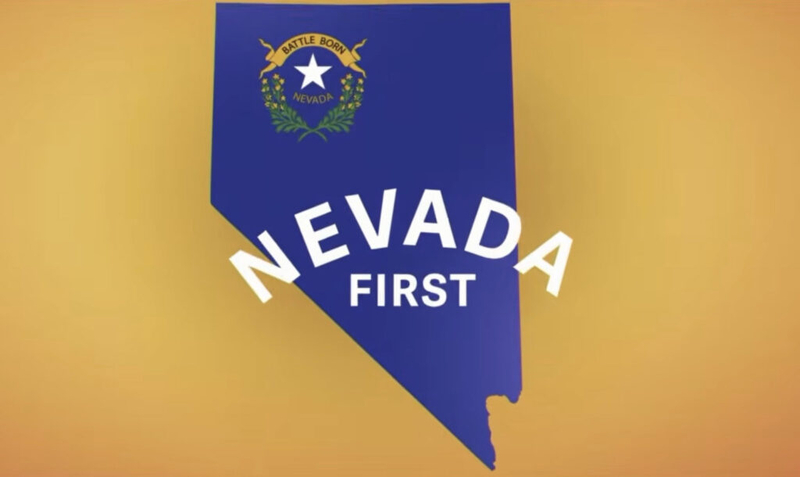
Could be something. Could be nothing. Could be something else altogether. (Image from Nevada Democrats presentation to the Democratic National Committee).
Nevada is in the running to hold the first Democratic presidential primary in the nation in 2028.
The idea, according to the state’s Democratic professional political leadership, is that Nevada Democratic voters are uniquely constituted to give unto a grateful nation a safe and not at all scary Democratic presidential nominee.
“The early calendar is first and foremost about selecting a nominee who can win the White House,” said former Harry Reid staffer, longtime Nevada Democratic strategist, and, according to the party press release her quote came from, the “architect of the Reid Machine,” Rebecca Lambe.
In the same release, Yvanna Cancela, current chief of staff for U.S. Rep. Steven Horsford and former state senator whose political career, like Horsford’s, was propelled by the Culinary Union, said “Nevada’s expansive rural counties include small mining towns, cattle ranchers, and farmers — voters we can win here and beyond our state’s borders with the right outreach and message.”
The “right” message Lambe, Horsford, Cancela and other state party leaders have in mind isn’t actually “right.”
Nor is it left.
It’s decidedly, calculatedly, blazingly centrist.
If Nevada goes first, according to the faith in stalwart incrementalism and bold caution that are among the founding principles of the Reid Machine, reliably moderate Nevada Democratic voters would support — and provide national momentum to — an inoffensive (if uninspiring) fellow moderate like, say, Kentucky Gov. Andy Beshear, instead of an energetic and inspirational change agent like, oh, Alexandria Ocasio Cortez.
There’s no denying Nevada Democratic voters, their choices often guided — and limited —by the machine Lambe built, have a track record of nominating dyed-in-the-wool moderates for high-profile elected offices.
The most prominent contemporary examples of course are Democratic U.S. Sens. Catherine Cortez Masto and Jacky Rosen. Democrats hold both U.S. Senate seats in 22 states. Nevada’s pair is the most centrist tandem of the bunch, and proud of it.
Cortez Masto and Rosen are also beneficiaries and products of the Nevada Democrats’ vaunted machine. In their initial Senate races, the field was cleared, the state party and its funders were aligned, and neither first-time Senate prospect was burdened with more than mere token opposition in their primaries.
A similar pattern is playing out now in the race for governor. Sure, Attorney General Aaron Ford is a viable Democratic gubernatorial candidate. But it’s not like he’s a charismatic thought leader whose political career has been marked by a knack for inspiring unbridled hope and optimism. There is nothing about his candidacy that obviously warranted immediate endorsements from every Democrat in the state’s congressional delegation and virtually every other Democratic leader in the state. Which is what Ford got.
Ford’s opponent in the primary, Washoe County Commissioner Alexis Hill, is critical of the state’s longtime economic policy by which Nevada gives publicly financed subsidies to corporations that don’t need them (and which would likely locate or expand in Nevada even if they didn’t get them). Hill has also called for a rethink of Nevada’s upside down tax structure in which the smaller your income, the larger the percentage of it you pay in taxes.
But while Hill has those and other notions, she does not have backing from the machine. So Ford is prohibitively favored to stroll into the general election with his agenda of modest reforms Nevada legislative Democratic leaders have campaigned on for years, while rebranding it as a consequential “affordability” agenda, because that’s fashionable.
At least the Democratic primary for attorney general is more competitive. But it also pits a state treasurer who is a cryptocurrency enthusiast against a state senator who tried (unsuccessfully, thankfully) to enact the largest public subsidy to private industry in Nevada history. Combined, their overly business-friendly candidacies stand in tragicomic testament to Nevada Democratic politicians’ dogged refusal to read the room.
Then again, maybe Ford’s glidepath and a sort of insulting AG primary just goes to show that Nevada Democratic voters really must be enamored with cautious incrementalism and the fully bipartisan (at least in Nevada) belief that the best way to help households is to help business.
So if Nevada’s Democratic presidential primary is first in 2028, a hide-bound moderate is bound to win it, right?
Maybe not.
For all the effort by Democrats and allied organizations’ to etch mild bipartisan-friendly centrism into the Nevada Democratic psyche, the last time there was a competitive Democratic presidential contest in Nevada, in 2020, damned if it wasn’t won by Bernie Sanders. By a lot. The Culinary Union, a stalwart and powerful component of the Reid Machine, had endorsed Joe Biden that year. He got 19% of the vote. Sanders got 40%.
Yes, the 2020 contest in Nevada was a presidential caucus — blessedly the last one the state would ever have — and not a primary.
And yes, the Nevada presidential caucus system was a) created by the Reid Machine during the 2008 cycle to register voters and build party infrastructure so Reid could beat Sharron Angle in 2010, and b) byzantine as hell. In 2008 and then in 2016 (2012 was Obama’s reelection year so the Democratic caucus was moot), people were required to go sit in gyms or classrooms and have their heads or hands or whatever counted, Iowa-style. Ugh. By the last Democratic presidential caucus in 2020, there was at least a ballot, and participation was better. But it still involved standing in long lines. There are few casual voters in caucuses.
But voters, especially casual ones (i.e. the ones who often decide elections) are far more familiar with presidential candidates than they are with their state’s governor or members of Congress. The Reid Machine can saddle voters with industry-approved candidates of moderation for governor or Congress, and a majority of Democratic voters will say — have said — yeah, whatever. Or words to that effect.
Voters say “yeah whatever” and hold their nose to vote for presidential candidates, too, especially when stuck with the not uncommon lesser-of-two-evils scenario.
An easy access presidential primary, however — especially if it’s the first one in the nation, and there are several candidates to choose from — is simply going to get voters’ attention in a way that Jacky Rosen vs. Sam Brown (to use a recent example) never could or would.
And there’s a chance that offered a choice between the centrist moderation the Reid Machine tries to force-feed Democratic voters and a more progressive agenda that our era and crises demand, the machine could be flummoxed in 2028 just like it was by Sanders in 2020.
So yeah, by all means, Nevada should go first.
It might not determine who the nominee will be (first in the nation ain’t what it used to be).
But it might reveal if Nevada Democratic voters believe, as the Reid Machine insists, that the answer to Trumpism is a polite return to policies crafted to appease the Democratic Party’s corporate wing, or if the machine has passed its sell-by date.
Las Vegas, NV