In Michigan, incumbents campaign on the public’s dime
Jun 04, 2026 | 2:01 pm ET
Description
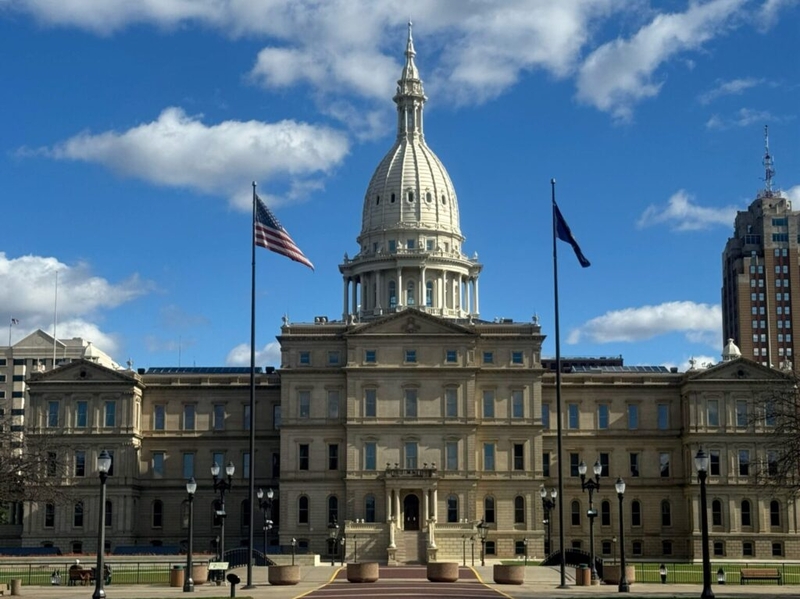
Michigan Capitol building. (Photo by Susan J. Demas
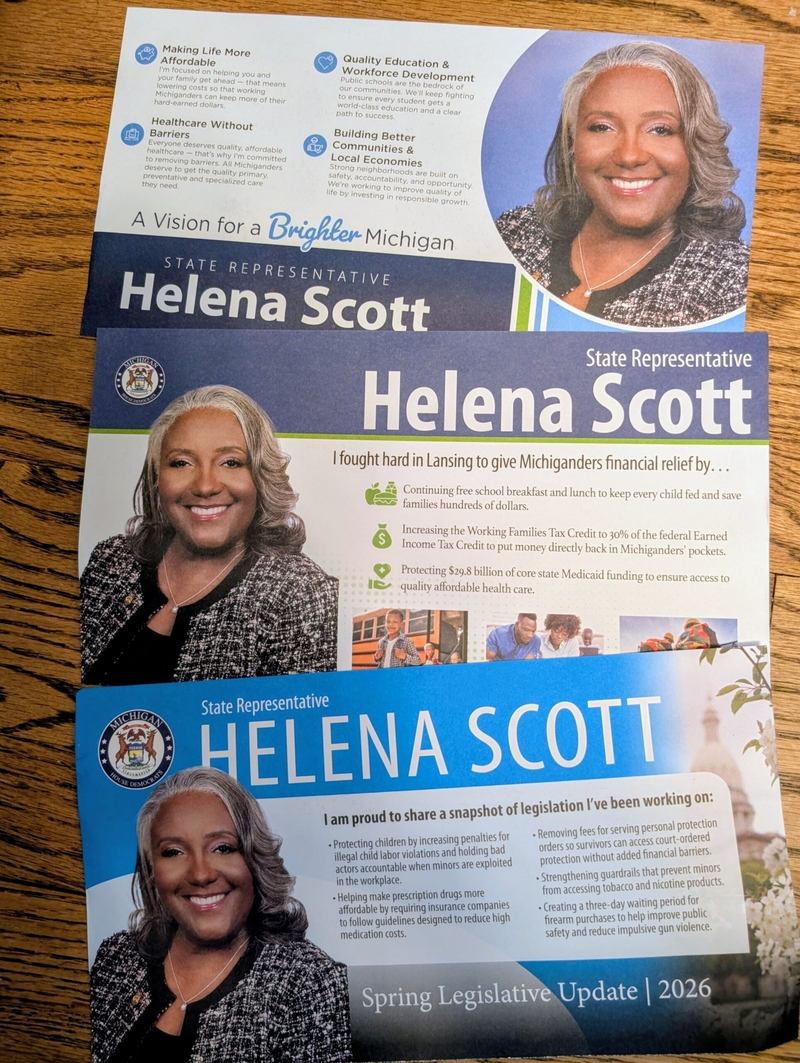
Over a period of around three weeks, I’ve pulled three mailers out of my mailbox from my state representative, Helena Scott. With Michigan’s Aug. 4 primary just nine weeks away, that is hardly surprising.
The mailer in my hand could have come from almost anyone currently holding a seat in Lansing. It happens every election cycle, in nearly every competitive district, to voters across the state.
Each mailing is an exercise in self-aggrandizement dressed as public service — her name in headline type, her face occupying half the card, every legislative outcome recast as a personal triumph delivered to a grateful district.
One mailer lists her platform priorities under four subheadings that read like a stump speech: “Making Life More Affordable,” “Healthcare Without Barriers,” “Quality Education & Workforce Development,” “Building Better Communities & Local Economies.” Another piece is a signed letter in which Scott writes that she has “been focused on doing everything I can to deliver financial relief to our community, lower utility costs and hold the government and corporations accountable to you.”
Another highlights a quote from Scott stating ”I’m working to make life more affordable for you.”
None of these mailers were paid for by her campaign. Each piece of mail carries the same small-print disclosure: “Prepared by the Michigan Legislature.”
You paid for these. So did I. And so did every taxpayer in Michigan, including those who don’t live in Helena Scott’s district and those who might prefer someone else to represent it.
Michigan House rules allow legislators to use taxpayer-funded office budgets for informational constituent mailings, subject to a blackout period that kicks in 30 days before a primary.
In this case, the cut-off date is July 5. Until then, incumbents can send as much mail as their budget allows, and the rules governing content draw a line that, in practice, is easy to straddle. Official mail cannot be explicitly electoral. But you absolutely can use your official portrait, your official seal, your campaign platform, and your claimed legislative accomplishments while having it paid for by the public.
Ask yourself a simple question: if these mailers are simply informational, why do I need three of them in three weeks? The same reason why legislators running for re-election in competitive districts spend nearly three times as much on taxpayer-funded mail as those in safe seats. The mailing behavior is driven by electoral anxiety, not civic duty.
Full disclosure: I am supporting one of Rep. Scott’s opponents in the August primary. But that is not the point. There is a difference between keeping constituents informed and using their money to run a shadow campaign, and it is hard to imagine taxpayers of any political persuasion sanctioning public funds being spent this way, regardless of which party holds the seat or which candidate benefits.
A challenger running against any incumbent legislator must raise every dollar they spend on outreach from donors, comply with contribution limits, disclose every expenditure, and explain to voters from scratch who they are. They get no budget for direct mail consisting of our tax dollars. Meanwhile, the incumbent can spend weeks blanketing the district with name ID-building, platform-advancing, brand-reinforcing mail that their campaign committee never has to report, because it doesn’t come from their campaign committee. It comes from us.
At the federal level, the mandatory disclosure language on such communications for House members was quietly watered down in 2020 from “prepared, published, and mailed at taxpayer expense” to the softer “paid for with official funds.” Michigan’s disclosure language of “Prepared by the Michigan Legislature” is softer still. Most recipients likely don’t register that the Michigan Legislature prepared a mailer touting one legislator’s personal brand.
The House Business Office, which administers these communications, has demonstrated it knows how to draw lines when it wants to, albeit in a revealing direction. Last year, state Rep. Dylan Wegela was blocked from sending a constituent newsletter that noted the influence of corporations like DTE Energy on the Legislature. The House Business Office told his staff the language was impermissibly critical of the government and needed to be rewritten.
Michigan’s official mailing system has decided that a lawmaker cannot use taxpayer funds to tell constituents that a utility company has political influence over the Legislature. But a lawmaker can use those same funds to blanket her district with mailers advancing her political brand. Then, when the blackout period arrives and the public money stops, the same utility sector Wegela attempted to criticize for their corporate capture of Legislature funds the closing sprint. Taxpayers prime the pump. DTE and Consumers finish the job.
The House Business Office that blocked a lawmaker from criticizing DTE in a constituent newsletter has been printing mailers for a legislator whose campaign DTE helped build. The financial relationships that benefit from this arrangement are not unique to one district. But the numbers in Michigan’s 8th illustrate the pattern clearly.
My own review of Helena Scott’s campaign finance filings spanning her legislative tenure shows $617,188 in total contributions over a decade of state legislative races. The single largest industry bloc is the regulated utility sector: Through four overlapping PAC name variants and more than 20 individual employee contributions DTE Energy alone accounts for roughly $27,000. Add Consumers Energy, Comcast, AT&T, ITC Holdings, NRG Energy, Constellation Energy, and a cluster of telecommunications and rural electric association PACs, and the regulated utility sector and its supply chain represent close to $92,000, or nearly 15 cents of every dollar she’s raised.
If legislators are proud of their constituent outreach, they should be comfortable telling the people paying for it exactly what it cost them. At minimum, every piece of mail produced with public funds should be required to say so in plain language: not “Prepared by the Michigan Legislature” in small print at the bottom of the address block, but a bold black box across the bottom of every piece reading “PRINTED AND MAILED AT MICHIGAN TAXPAYER EXPENSE” followed by the exact cost of the design, print, and mailing.
Michigan could impose a complete ban on taxpayer-funded mass mailings during any calendar year in which the legislator appears on a ballot. Short of that, it could impose a hard cap on the number of mailings an incumbent can send in an election year, rather than leaving the only constraint as a budget line that can be spent all at once.
It could require that any taxpayer-funded mailing trigger a matching public communication credit available to every declared candidate in that district. It could require the House Business Office to publish a real-time public ledger of every mailing produced with public funds, searchable by legislator and date, so voters can see what their money is buying. It could strip the House Business Office of sole authority to police its own content rules and vest that power in an independent body with referral authority to the Secretary of State.
Any one of these reforms would help. Taken together, they would transform a system currently designed to serve incumbents into one that at least pretends to serve the public.
Until then, every mailer carrying a state seal and a politician’s portrait is a reminder that in Michigan, one of the most valuable campaign finance advantages is an incumbent’s access to a taxpayer funded budget.
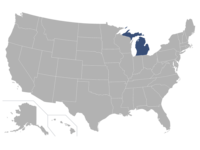
Lansing, MI