Sanctioning killing contests ‘pours fuel’ on controversy, says wildlife commissioner
Nov 12, 2025 | 7:55 am ET
Description
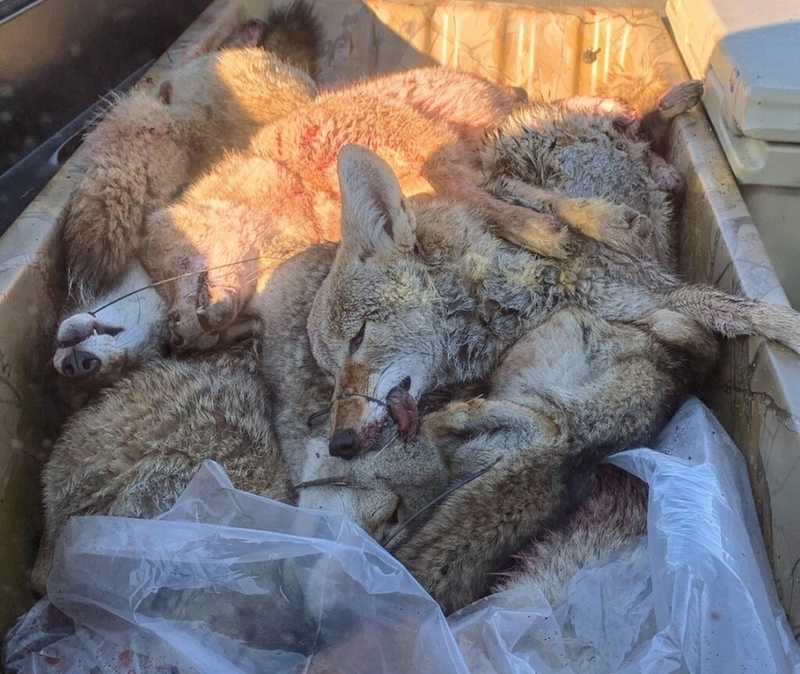
The coyote killing contests, in which bodies of dead coyotes are stacked like cord wood, award prizes for the most animals killed. (Nevada Department of Wildlife photo).
The Nevada Wildlife Commission voted Saturday to legitimize coyote killing contests, after a nearly decade-long effort to ban the events, which are opposed by a majority of Nevadans. The move, some say, illustrates the cultural divide between urban and rural residents of the state.
Commissioner Tommy Caviglia, who represents sportsmen on the nine-member Wildlife Commission, said at Saturday’s commission meeting in Washoe County that he opposed sanctioning the events, where the person who slaughters the most coyotes wins cash and prizes.
Until now, coyote killing contests in Nevada have been unregulated – neither prohibited nor sanctioned by the state. Ranching and hunting enthusiasts contend that the wanton killing reduces the population, lessening the volume of coyotes preying on cattle and mule deer.
But studies indicate populations are higher where coyotes are hunted because of a reproductive response triggered by decreased competition for food, resulting in larger litters born to younger mothers.
The regulation passed Saturday requires that participants have a Nevada hunting or trapping permit, and establishes the season from Sept. 1 to March 31.
“I do think it’s in poor taste. This is a polarizing subject. I don’t believe this language provides any benefit,” Cavigilia said, adding the controversy over killing contests is “U.S. wide. This issue is not going to go away. By defining it in a regulation, I believe we’re just pouring gasoline on the issue.”
Killing contests have been banned in most western states, including Arizona, California, Colorado, New Mexico, Oregon, and Washington. Nevada competitions are routinely organized and advertised in those states.
Efforts to regulate killing contests in Colorado and Washington failed, with both states banning the contests outright in 2020.
The rules “are theater,” wildlife advocate Stephanie Myers said during public comment. “They make it look like the Commission is doing something, while, in reality, they do nothing to stop these brutal contests with sordid prizes.”
Former Republican State Sen. Warren Hardy, now a lobbyist representing Humane World for Animals, called the vote “an offensive” response to Humane World’s campaign for a ban. The commission’s sanction of the contests on the heels of its rejection of a ban, he said, “sets an unprecedented precedent” and tells Nevadans “don’t bring your issues forward if we disagree with them, because if you do, there’s going to be a cost, and we’re going to do the opposite of what you asked.”
Hardy says he intends to “try to get the legislative commission to reject that insulting regulation and then back to the drawing board.” Legislative action, he says, “is likely our only recourse.”
One Nevada?
Two of Nevada’s most populous municipalities, Clark County and the City of Reno, have passed resolutions to stop the contests. The commission, however, has held firm, despite threats of legislative action, or in the alternative, an overhaul of the commission.
Activists argue hunting and ranching interests have a stranglehold on the commission, and by extension, on Nevada wildlife.
“It is telling that the prescribed solutions to managing wildlife regularly imposed by this commission invariably involve the death, destruction and permanent removal of wildlife species and vegetation such as pinion juniper,” commented Boulder City resident Fred Voltz. “The ‘killing is conservation’ concept so often invoked has not served our state, its wildlife, or the majority of Nevadans who do not have an irrational bloodlust and need for domination and submission of wildlife species.”
The Wildlife Commission is made up of nine members who are appointed by the governor. The commission must have five “sportsmen,” i.e. hunters, fishermen or trappers who have purchased a license in three of the past four years, one rancher, one farmer, one conservationist, and one member of the public.
It is the “the least democratic of all state boards or commissions which provide oversight to a public resource,” Don Molde, who battled the commission for decades until his death in July, said in 2021. “In fact, I’m not sure there is another that is so tilted.”
Hardy suggests the Legislature “should also take a look at whether the board is representative of the full state. We are certainly not stopping the fight.”
Despite the outcome of the commission’s vote, activists were encouraged that three commissioners voted against regulation – Caviglia and newest members Liz Munn, who represents conservation, and Wyatt Mesna, who represents ranching interests. In the past, only the conservation representative has consistently voted in line with activists’ interests.
Those interests extend beyond killing contests to include the state’s recreational bear hunt, the mountain lion hunt, leghold trapping, “and most of all, the undemocratic composition” of the Wildlife Commission, Myers wrote in an email to supporters following the meeting.
“Tommy Caviglia was right. We are not going away,” she said. “Our numbers will swell as more residents become aware of our issues.”
Las Vegas, NV