As Trump’s 2025 signature bill marks an anniversary, Dems use it as a cudgel
Jul 03, 2026 | 4:30 am ET
Description
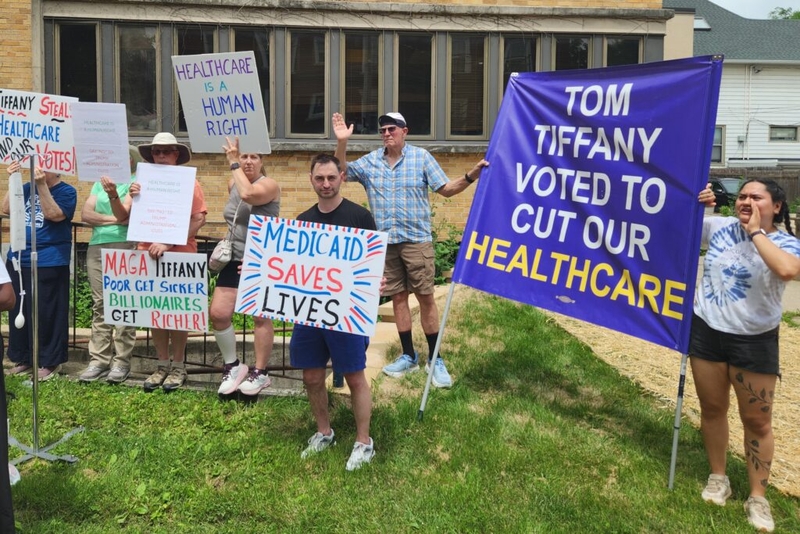
Protesters outside the Wisconsin Republican offices in Madison Tuesday, June 30, call attention to gubernatorial candidate Tom Tiffany's vote last year for HR 1. (Photo by Erik Gunn/Wisconsin Examiner)
One year ago, President Donald Trump signed the first piece of legislation Republicans in Congress had introduced at the start of his second term.
Passed using the complicated budget reconciliation process that enabled GOP lawmakers to enact the legislation without Democratic votes, HR 1 paired $4.5 trillion in tax cuts over 10 years with $1 trillion in cuts to federal healthcare programs as well as other initiatives to cut federal spending.
With the legislation’s first birthday on July 4, critics of the Trump administration and Democratic politicians have been using every opportunity to highlight the legislation’s role in driving unpopular results.
Healthcare cuts are among the most prominent of those outcomes. They include a series of changes to Medicaid — the state-federal health insurance program for people at or below the federal poverty guideline, with annual incomes of just under $16,000 per year for a single person or $33,000 for a family of four.
For medical and hospital care, Medicaid is called BadgerCare in Wisconsin. Medicaid also covers long-term care services for people who qualify, including home healthcare for the elderly and people with disabilities, and goes under a variety of names including Family Care and IRIS.
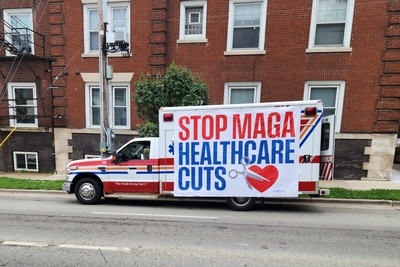
On Tuesday, the anti-Trump political activist group Indivisible and members of the healthcare union SEIU Wisconsin gathered in front of the Wisconsin Republican Party headquarters in Madison with an out-of-service ambulance to denounce cuts to healthcare attributed to HR 1.
“We are here to give voice to the millions of Americans who have lost access to healthcare and to the tens of thousands of Wisconsinites who have lost healthcare,” said Jean Grow, co-leader of Indivisible’s Milwaukee chapter.
The group aimed its barbs not just at Trump but at Republican U.S. Rep. Tom Tiffany, the party’s nominee for governor in the November 2026 election, who voted with the rest of his party in the U.S. House of Representatives for HR 1.
“Who in this state is primarily responsible for these cuts? Tom Tiffany,” Grow said, to hearty jeers from the crowd of about two dozen during the lunchtime protest.
HR 1 also cut the federal nutrition assistance program SNAP — known as FoodShare in Wisconsin — by 20% by 2034, about $187 billion.
The changes will pass on to most states a portion of the program’s costs, which the Center on Budget and Policy Priorities in Washington says could lead “the lowest-income people, including children, older adults, veterans, and people with disabilities” in every state to lose access to food assistance.
The so-called One Big Beautiful Bill Act “has been brutal for Wisconsin families,” said Secretary of State Sarah Godlewski, a Democrat who is running for lieutenant governor, at a press conference Wednesday at the Democratic Party’s Capitol Square offices that focused on Tiffany’s record.
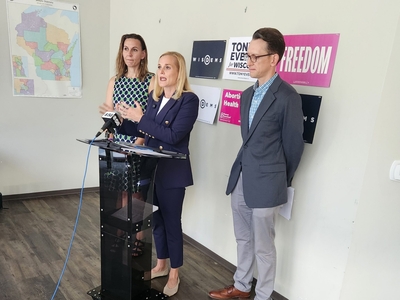
“We know that the impact it’s going to cause — things like potentially 270,000 Wisconsinites are going to lose healthcare,” said Godlewski. “We know tens of thousands of Wisconsinites are going to lose access to FoodShare.”
While Trump and GOP congressional leaders initially called HR 1 the “One Big Beautiful Bill Act,” critics quickly mocked it as “the Big Ugly Law” or variations on that theme. In September, the Republicans rebranded the bill as “The Working Families Tax Cut.”
The CBPP, however, found that the tax cuts are “tilted to the wealthiest households.”
The Congressional Budget Office “finds that the new law’s program cuts and tax cuts will make households with incomes in the bottom 20 percent of the income scale worse off: they will lose more from the cuts in health coverage, food assistance, and other programs than they will gain in tax cuts,” the CBPP reported in February.
For the bottom 10% by income, average annual incomes will fall by $1,200 — 3.1% — the CBPP reported, citing the CBO. Meanwhile, the top 10% will see their annual incomes rise $13,600 on average.
HR 1’s advocates said the healthcare spending reductions would only address waste, fraud and abuse.
Sen. Tammy Baldwin (D-Wisconsin) said during a virtual press conference in June that the changes — such as new work-reporting requirements for some Medicaid participants — would impose administrative burdens and red tape that will block people who are qualified to receive benefits.
“They’re trying to kick people who are fully eligible off the program,” Baldwin said. The press conference was organized by the advocacy groups Protect Our Care and Main Street Alliance.
Most of the Medicaid changes won’t take effect until 2027. Enrollment in the program has already been dropping, however. Federal data tracked by the Georgetown University Center for Children and Families show that in Wisconsin, more than 75,000 Medicaid recipients had left the program in the first five months of 2026.
Dr. Kristen Dall-Winther, a family physician in Birchwood, Wisconsin, also took part in the press conference with Baldwin.
“I see how access to affordable healthcare can make the difference between something that’s a manageable condition and a medical crisis. I also see the difficult choices patients are forced to make when healthcare becomes too expensive, which it generally, universally is now,” Dall-Winther said. “When funding is reduced, healthcare providers face greater financial strain, especially in rural areas where many of our facilities are already operating on razor-thin margins.”
Madison, WI