What happens to an empty college campus? Gaffney grapples with future following Limestone closure.
Aug 12, 2025 | 1:14 pm ET
Description
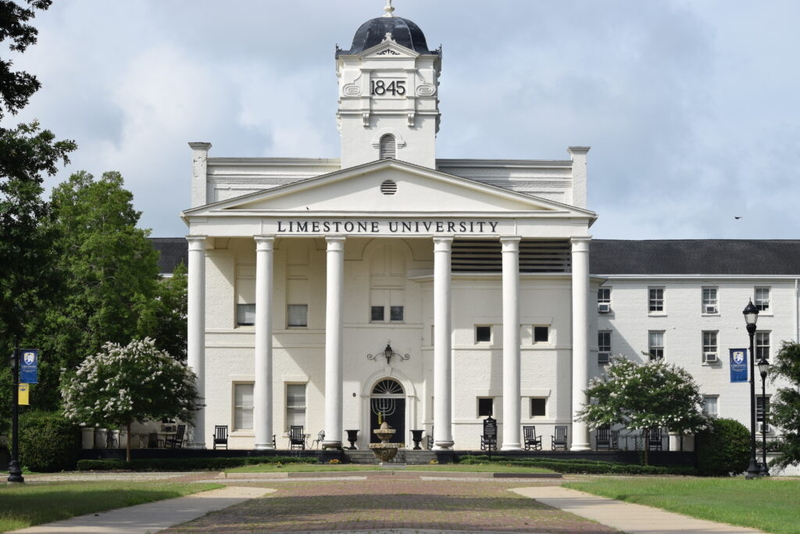
The Curtis Building pictured Tuesday, June 10,2025, on the Limestone University campus in Gaffney, South Carolina, served as the college's administration building until the school's closure at the end of April 2025. (Photo by Jessica Holdman/SC Daily Gazette)
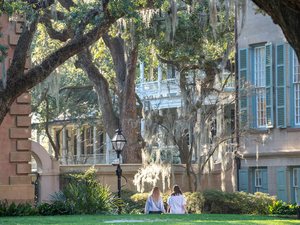
GAFFNEY — A month after the final class of Limestone University walked across the graduation stage, rocking chairs sit unmoving on the porch of the administrative building, overlooking the grassy quad where the royal blue-gowned graduates took family photos.
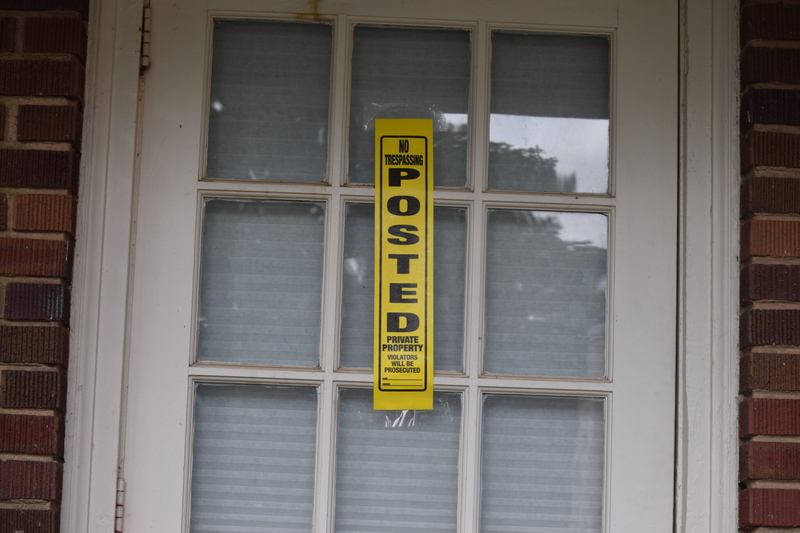
Narrow yellow signs of “POSTED, no trespassing” hang on the doors and windows of every building.
Half a dozen cars, held hostage with yellow parking boots, remain in a lot behind the student center.
And questions hang in the air: What’s next for the now-empty college that educated students in Gaffney for nearly two centuries? What can the town do to prevent the private university’s campus from falling into disrepair?
As more institutions of higher education close across the country each year, due to financial struggles and falling enrollment, small college towns are grappling with what to do with the sweeping quads, expansive athletic fields and mammoth historic buildings left in the wake.
At least 16 colleges closed in 2024, according to Inside Higher Ed. Fifteen closed the year before.
Now it’s Upstate South Carolina’s turn to face the challenge.
‘A neighborhood school’
Limestone employed nearly 480 people before its closure, all of whom lost their jobs in a city of less than 13,000.
“Obviously we’re devastated that the college closed,” James Taylor, Gaffney’s town administrator, told the SC Daily Gazette. “It’s been a significant contributor to both the economy and culture of Gaffney.”
The campus sits on the site of the former Limestone Springs community. A limestone quarry supported the town. Nearby springs were said to have healing qualities, and the town’s former hotel, which became the college administrative offices, once drew travelers fleeting stifling summers and malaria outbreaks in the Lowcountry.
Founded in 1845 by Thomas Curtis, a Baptist minister from England, the college began as Limestone Springs Female High School. At the time of its opening, it was the first women’s college in South Carolina and among the first in the country.
SC governor calls for study to consider consolidating colleges ahead of ‘enrollment cliff’
As the college grew, Gaffney’s historic residential district built up around it. Hundred-year-old homes stand on either side of the tree-lined boulevard that stretches between downtown Gaffney and the campus.
“These neighborhood folks definitely care about what happens to the college due to the fact that it truly is a ‘neighborhood school,'” said Cassidy Holman, a real estate agent who is helping sell several homes in the area. “People see it every day when they are driving home, riding bikes, walking their dogs or going for their early morning runs.”
Holman said the school often opened up its auditorium to community events, such as musicals, beauty pageants and the annual Peach Festival talent show. The same was true for the tennis courts when the school team wasn’t using them.
State Sen. Harvey Peeler, a Gaffney native and powerful chairman of the Senate Finance Committee, passes by the school nearly every day.
Both his wife and mother are Limestone alumnae and his grandfather’s farm backed up to college property.
“Students on one side of the road and cows on the other side,” Peeler said.
“It’s such a beautiful campus and has such a great history,” he added. “You just think of all the memories there, and it’s just hard to swallow. It’s a gut punch.”
Taylor said the school is using what’s left of its meager endowment to keep the power on and regularly patrol the campus to deter vandals.
‘We may be talking years’
City leaders have been in discussions with the U.S. Department of Agriculture, which holds the main lien on the property for a $30 million loan it granted in 2018.
Taylor said it’s the city’s hope the school will remain an educational facility, rather than subdivided into multiple uses.
But as much as residents would like for something to happen quickly, he’s realistic.
“We may be talking years instead of months,” he said.
Holman said her real estate firm has handled listings for university employees who have left town to find new jobs. There are also rental homes that previously catered to the students and sports teams.
“The silver lining is that our real estate market in the Upstate of South Carolina is strong, and potential buyers are definitely out there,” she said.
At least one potential developer has announced plans for repurposing the property.
A private equity firm wants to re-open the campus as a college focused on science, technology, engineering and math, according to the project’s leader and Clover native Dwayne McClure.
“Gaffney sits right on Interstate 85, between the nation’s second largest banking city after New York and one of the fastest-growing manufacturing and innovation hubs in the country,” McClure told the Daily Gazette. “There’s no reason why a university with its geographic proximity to both Charlotte and Greenville-Spartanburg shouldn’t be successful.”
McClure said his firm hopes to do what the administrators of Limestone could not by raising money from private investors to restart the school. He said they’ll work to secure government and industry contracts to keep it operating long term.
“A for-profit institution that derives most of its profit from intellectual property and contracting, that is going to be the economic engine behind the university that will finance further development,” McClure said.
McClure said his firm, Quantum Foundry Capital, has already begun raising $55 million needed to pay off all loans, cover sums still owed to former faculty and ensure all buildings are up to code. The federal government has yet to let bidders inside locked buildings on the 125-acre campus.
If chosen as the buyer, McClure’s group will have to get the school re-accredited. While it goes through that process, he said they hope to work with the state’s technical college system to operate workforce training programs that don’t require accreditation.
McClure said his firm also is working with a group of Limestone alumni, which calls itself Saving Limestone. The goal, after 10 years, would be to turn over management of the school’s endowment to those alumni who wish to invest and remain involved.
Online students lose thousands of dollars following closure of SC’s Limestone University
“If there’s one thing that we’ve noticed from this whole process, it’s that they’ve had no voice in this,” McClure said of the school’s alumni.
The college means a lot to its graduates, he said. It’s where they met their spouse, got married, made some of the biggest decisions in their life.
About a third of McClure’s own high school teachers in Clover were Limestone graduates.
“It was the local institution of higher learning,” he said.
Instead of Limestone becoming part of South Carolina’s history, McClure said his firm wants to see it continue to move the town of Gaffney into the future.
Not many success stories
When it comes to redeveloping empty college campuses across the country, McClure said the sad part is there are not many success stories.
“If you’re lucky, the university gets turned into some sort of (U.S. Department of Defense) outpost, like a training center, or a police academy. Or maybe it gets incorporated with the school district,” he said.
But those publicly-funded uses tend not to come with the same level of economic impact for the community.
The town of Gaffney estimates Limestone previously contributed $150 million annually to the local economy through staff salaries, visitors coming for sporting events and student spending in the town.
“It works, but at best it’s about half the level it was prior,” McClure said “That’s a hard pill to swallow, because every dollar that leaves the community is now a denial of the future of that place.”
Peeler compared it to how the city of Columbia would look if the University of South Carolina closed its doors.
“To add to the challenge, Limestone is a private institution,” said Peeler, the Senate’s chief budget writer. “The citizens are wanting the state to step up, but it’s a private college. It’s not state supported. It would be easier if it was.”
In Alabama, Birmingham-Southern University, a 168-year-old college affiliated with the United Methodist Church, remains closed after two potential sales fell through over the past year.
A trash disposal company purchased the former College of St. Joseph campus in Vermont, turning it into a commercial driver’s license training hub for employees.
A nonprofit has repurposed the former campus of a Catholic university in Ohio, Chatfield College. It offers high school students access to college financial aid and career coaching to jobless adults, especially those recovering from addiction.
And in Philippi, West Virginia, repurposing of Alderson Broaddus University is gradually proceeding since the Baptist-affiliated closed after more than 150 years in operation.
The story of Alderson Broaddus
“I didn’t want to see this place start to crumble,” said Craig Phillips, who bought the campus at auction for $5 million in January 2024. “I was just afraid it was going to go to shambles.”
Phillips, who has made his living developing grocery stores and small shopping centers, said he and his daughter have rented some office space to local businesses. They host weddings and class reunions in the campus chapel and event space. And area sports teams have used the athletics fields for summer camps.
“Everything we can do to keep it going until something bigger comes along,” Phillips told the Daily Gazette.
It hasn’t been easy. The 187-acre campus came with 625,000 square feet of building space.
Meanwhile, the town has a population of less than 3,000. The county — Barbour County — has less than 15,500 people, according to 2020 Census data, with an economy mostly reliant on coal mining.
Phillips has replaced water lines on the campus and a couple roofs. When the school closed, it was sudden and the entire staff left without making any preparations for winter. When he first walked through the buildings, coffee mugs were still sitting on desks, just as they had been left.
Last September, Phillips inked a deal with West Virginia Wesleyan College to open a satellite campus in one of the buildings.
Wesleyan, using a state grant aimed at helping meet West Virginia’s health care needs, has enrolled more than 18 working nurses in a program that will take them from licensed practical nurses, a two-year degree, to a bachelor’s degree, said Provost Lynn Linder.
Alderson Broaddus had been known for its physicians assistant program. Wesleyan used the grant funding to update Alderson Broaddus’ simulation lab so it could continue educating people for the health field.
Closure of the private college was hard on the community. Some 150 people lost their jobs. The town lost a major employer and part of its identity.
Linder saw how difficult it was firsthand while speaking with a former Alderson Broaddus student who was enrolling at Wesleyan to finish her degree. The student’s parents were with her. Both the wife and husband had been Alderson Broaddus employees.
Linder said she is confident Wesleyan’s program on the Alderson Broaddus campus will succeed because it’s focused on a major workforce need for the area and supports nearby Broaddus Hospital.
“Colleges cant just do business as usual and expect not only to survive but to thrive,” Linder said.

Columbia