That Blue Ribbon study to retool school funding formula? Lawmakers advance commission to study it.
Jun 10, 2026 | 5:20 pm ET
Description
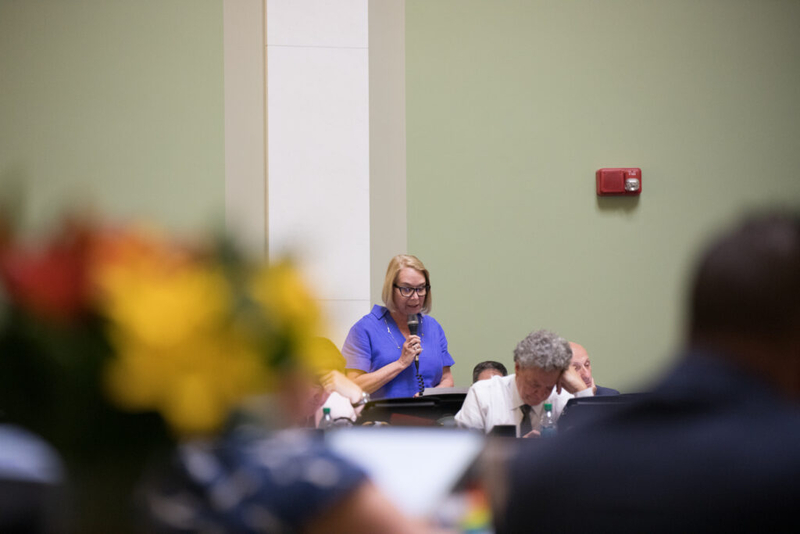
Sen. Hanna Gallo, a Cranston Democrat, speaks on the Senate floor in 2025. (Photo by Alexander Castro/Rhode Island Current)
Another legislative study commission may soon convene at the Rhode Island State House: one to study the findings of a Rhode Island Foundation-led panel’s proposal for radically altering how the state funds its public schools.
Finance committees in both the Rhode Island Senate and House on Tuesday night passed a resolution to create a fresh study group charged with studying Rhode Island’s K-12 education funding formula.
The companion resolutions — H8351 in the House, and S3368 in the Senate — are both scheduled for floor votes Thursday, which is expected to be the last day of this year’s legislative session. Joint resolutions do not require the governor’s signature to take effect.
The joint legislative effort would comprise a 15-member body to consider the feasibility of recommendations made by the Rhode Island Foundation’s Blue Ribbon Commission, which in its January report suggested overhauling the state’s approximately 16-year-old K-12 education spending system. The new model is designed to more equitably divide up costs between the state and municipalities — a proposal which would necessitate a much larger share of state spending.
Rhode Island Foundation panel urges R.I. to rewrite school funding formula, boost state share
Sen. Hanna Gallo, a Cranston Democrat, introduced both the study commission resolution and now-stalled legislation to institute the Blue Ribbon model outright. She also helped craft the state’s current formula back in 2010, but told the Senate committee that changing student needs, enrollment patterns and costs since then have made the formula’s attempt at equity outdated and unsustainable.
Still, the Blue Ribbon model could not be summoned quickly, she said.
“The reason why that Blue (Ribbon) study commission could not be implemented this year is because of money,” Gallo told her colleagues in Senate Finance Tuesday. “The financing is questionable, and we cannot just loosely say we’re going to implement it without having the financials studied and knowing where it’s coming from.”
Still, Gallo acknowledged her own annoyance with the process: “I think we’re all frustrated at this point,” she said.
Key to the Blue Ribbon recommendations is expanding state funding beyond what the panel saw as a somewhat myopic focus on direct instructional costs, which comprise the bulk of current state aid to schools. The Blue Ribboners concluded that the state should pursue what the report called “full funding” for municipal school districts — a model which would fold costs such as transportation and teacher pensions into the state’s obligations.
In the Blue Ribbon report’s estimate, raising the state share of K-12 education costs from about the present 38% to an ideal 58% would require roughly $600 million more in annual state spending on schools.
“I can’t imagine somebody doesn’t want it passed immediately, but we do need to look at how they came up with those numbers and how we’re going to implement that,” Gallo told the finance committee.
The Blue Ribbon report also suggested the state would need to revise the different weights applied to calculate the formula to better serve high-need students. Municipalities, on the other hand, would be required to have more uniform, transparent reporting of their own finances, as well as a better understanding of their own obligations.
Rhode Island Foundation President and CEO David Cicilline co-chaired the Blue Ribbon group, while Brown University’s Annenberg Institute served as the group’s research partner and facilitator and prepared the final report. The panel members consisted of superintendents, union leaders, advocates, charter and public school officials, as well as a Rhode Island youth working group.
The proposed legislative study commission, meanwhile, would consist of three senators and three state representatives, with at least one minority party member from each chamber. The remaining roster would be filled in by representatives or designees from the state’s two major teachers unions, the Rhode Island Department of Education, the Office of Management and Budget, the governor’s office, school committees, superintendents, school business officials and municipal finance officers.
‘Turtles all the way down’
At Tuesday’s finance hearing, Sen. Jonathon Acosta, a Central Falls Democrat, expressed his ire that another commission was needed to study the findings of a different commission. He noted the Blue Ribbon panel had itself spun off in part from a previous Senate commission which also studied the funding formula and wrapped up its final report in 2020.
“In so many ways, just turtles all the way down,” Acosta said.
Nevertheless, Acosta deemed Gallo’s new proposal “a significant step forward” and “a signal that the State House is willing to do something,” although any rollout of Blue Ribbon recommendations would likely would not begin until 2028.
Sen. Sam Zurier, a Providence Democrat, addressed Gallo and mused on another “very important line” in her résumé: Serving on an even earlier commission in 2007, the Foundation Aid Technical Advisory Group, which investigated and made its own recommendations for statewide school funding.
“The reason I’m so impressed with that,” Zurier said, “is that that group came up with recommendations that identified exactly the problems that the Blue Ribbon Commission is trying to fix, so rather than put on your 2010 hat, I encourage you to put your 2007 hat on.
“Sad, but true,” Gallo replied.
The Senate finance panel received one public comment on Gallo’s bill, from lobbyist Bob Marshall, who spoke on behalf of the Rhode Island Developmental Disabilities Council. Because of the centrality of high-cost special education in the school funding debate, Marshall argued for a seat on the new commission for someone from the Association for Special Education Directors to the commission.
“We have never heard a conversation about school funding that within the first few minutes the cost of special education didn’t come up,” Marshall said. “And we think that to go forward with this without them in the room probably is going to lead to something not working.”
The resolution’s specified timeline for the commission would require an initial meeting at the latest by Oct. 31, 2026, followed by the submission of an interim report by March 2, 2027. Final recommendations would be tentatively due by Sept. 1, 2027, and the commission would expire on Dec. 1, 2027.
Providence, RI