What are the odds? Dueling lawsuits filed on prediction markets in state and federal courts.
May 21, 2026 | 6:46 pm ET
Description
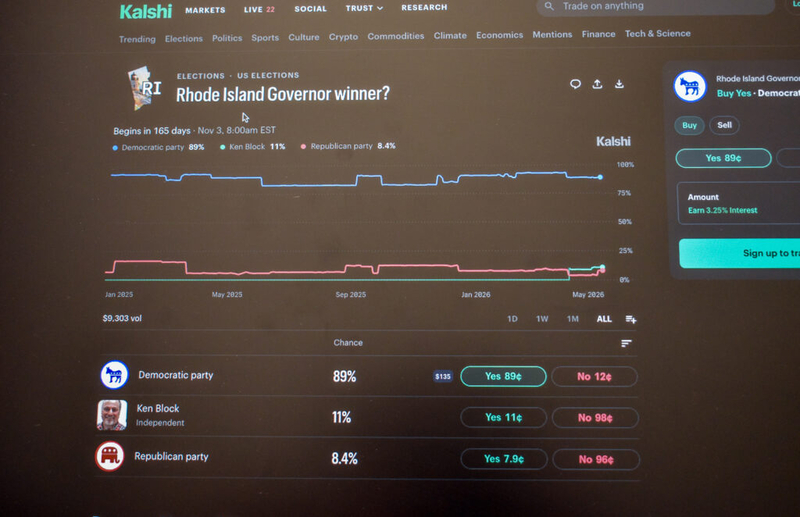
Kalshi's website displays odds of which political party will win the 2026 Rhode Island gubernatorial election. (Photo by Christopher Shea/Rhode Island Current)
Some examples of games of chance: Craps, blackjack, Texas hold’em, roulette, and more recently, prediction markets, wherein people bet on things like geopolitical strife or what President Donald Trump might say during a press conference.
To Rhode Island Attorney General Peter Neronha, there isn’t much difference between the classic means of losing money — dice and cards — and these prediction markets. That’s why Neronha is now suing the operators of two of them, Kalshi and Polymarket, in state court.
“Rhode Island State law heavily regulates gambling, for good reason, and we allege that Kalshi and Polymarket are evading our laws,” Neronha said in a statement Thursday. “While these private companies continue to profit exponentially off hard-working people, the state’s third largest revenue stream is detrimentally affected, which means less money to fund critical parts of programs that serve Rhode Islanders every day.”
Neronha’s complaint against the two prediction market giants was filed in Providence County Superior Court right around 4 p.m. But Kalshi beat him to it a few hours earlier. The New York-based company filed a federal lawsuit against the state at exactly 12:03 p.m. in U.S. District Court in Rhode Island seeking to maintain its ability to sell event-based contracts allowing users to place bets on anything from the World Cup to natural disasters to political contests and the war in Iran.
Kalshi predicted some form of enforcement was coming after its representatives met with Neronha and his staff Wednesday, according to its 32-page complaint. The federal lawsuit states its representatives sought assurances that it would not face enforcement action. But Neronah told them only that the company would not receive any advance notice if the state decided to proceed.
“In short, the Rhode Island Attorney General refused to provide any assurances that the state would refrain from enforcement,” the lawsuit states. “This information makes clear that Rhode Island views Kalshi’s event contracts as illegal under its state laws and intends to act imminently against Kalshi’s federally regulated business.”
Kalshi’s lawsuit notes it is under investigation along with other prediction markets by the Rhode Island Lottery. Lottery Director Mark Furcolo publicly informed the state’s Joint Lottery Commission in February that regulators were examining whether prediction market platforms are reducing sports betting revenue.
Now the state is asking the Superior Court to declare that Kalshi’s and Polymarket’s sports-related event contracts amount to sports betting — wagering subject to Rhode Island gambling laws in the state’s interpretation.
“We demand Kalshi and Polymarket stand down, abide by our state laws, and disgorge their profits, and this lawsuit is the first step towards that goal,” Neronha said.
Conversely, Kalshi’s lawsuit argues its activity does not fall under gambling laws because its event-based contracts are not truly wagers in the traditional sense, but rather assets traded between its users on a federally regulated exchange.
“The way they make their money is they take a cut of the amount that’s bet,” Patrick Kelly, a professor of accountancy at Providence College who studies gambling, said in an interview Thursday.
Kalshi’s lawsuit characterizes its actual business as a marketplace in which “event contracts,” whose value is “determined by market forces,” function like an exchange for other financial assets, specifically derivatives. Traders do not bet against the exchange — as gamblers do against the house in a casino — but instead rely on other traders, or “counterparties,” to help “assume risk in the hope of seeing a return.”
Kalshi notes in its suit that the U.S. Commodity Futures Trading Commission is charged with determining whether event contracts constitute gaming, and whether these derivatives “should be restricted as ‘contrary to the public interest’ — authority that is completely incompatible with parallel state regulation of the same putative subject matter.”
Still, Kelly notes that most activity on prediction market platforms revolve around sports wagers.
“They made significant strides last year and had some big success on Super Bowl Sunday,” he said.
And because prediction markets don’t fall under state gambling regulations, that means lost tax revenue.
“There are a number of states that are not happy with Kalshi because it operates in places that have approved sports betting,” he said.
Connecticut, Arizona and Illinois each filed cease-and-desist orders accusing major prediction market companies of engaging in illegal online gambling under state law. Arizona even went as far as filing criminal charges against Kalshi, but the move was blocked by a federal judge.
Minnesota on Wednesday became the first state in the nation to prohibit prediction markets.
Kalshi’s lawsuit against Rhode Island notes that a federal court in the Middle District of Tennessee granted the company a preliminary injunction barring officials in that state from taking action against its exchange.
A federal court in New Jersey granted similar relief, according to Kalshi’s filing.
“As other courts have recognized, Kalshi is a regulated, nationwide exchange for real-world events, and it’s subject to exclusive federal jurisdiction,” Elisabeth Diana, a spokesperson for Kalshi, said in an emailed statement to Rhode Island Current. “It’s fundamentally different from what state-regulated sportsbooks and casinos offer their customers. We are confident in our legal arguments.”
A spokesperson for Polymarket declined to comment on the lawsuit.
Reporter Alexander Castro contributed to this story.
Providence, RI