Gov. Polis defends Tina Peters commutation on free speech grounds following censure
May 21, 2026 | 6:51 pm ET
Description
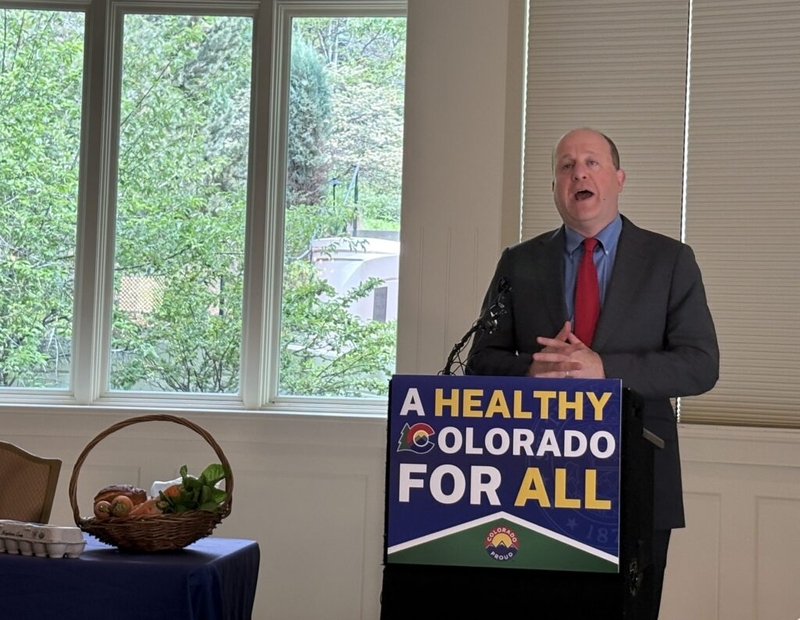
Colorado Gov. Jared Polis signed an executive order Thursday to encourage Coloradans to eat healthier. The event at the Governor's Mansion in Denver came a day after the Colorado Democratic Party overwhelmingly voted to censure Polis for his decision to commute the sentence of election denier Tina Peters. (Photo by Lindsey Toomer/Colorado Newsline)
Colorado Gov. Jared Polis on Thursday defended his decision to commute the prison sentence of former Mesa County Clerk Tina Peters, a day after the Colorado Democratic Party voted to censure him over the decision.
Peters, an election denier and prominent ally of President Donald Trump, was convicted in 2024 for her role in a breach of her office’s election system.
Just because the Democratic Party doesn’t want him speaking at their events doesn’t mean he won’t attend them, Polis said, but there are other events he’s invited to that he can opt to attend instead of official party events, such as those related to charity, hunger relief or education.
“I’m really proud to be a Democrat,” Polis said, adding that he’d rather be a Democrat than a member of a party that is “trying to abolish primaries, as the Republican Central Committee has been focused on doing here in the last few months.”
The Colorado Republican Party has been in court since 2023 seeking to block unaffiliated voters from participating in their primary elections.
Polis answered questions from reporters about Peters’ case Thursday at the Governor’s Mansion in Denver after he signed an executive order taking several actions intended to encourage Coloradans to eat healthier.
Polis said the Peters case “always bothered” him, because consideration of her speech by the judge in her case “is really very contrary to the First Amendment.” He cited a recent Colorado Court of Appeals decision, which said the trial court improperly took into consideration Peters’ protected expression of beliefs while determining her sentence, and it ordered a resentencing.
Arguments over her sentence detract from what should be “the broad-based condemnation of the illegal acts that Tina Peters committed, along with the reputation of any conspiracy theories that she believes in,” Polis said.
Defendants can believe in “a variety of conspiracy theories” that can be potentially relevant to their motive, Polis said, but those beliefs should not influence their sentence.
“I think the rightful conviction of the felonies she’s convicted for, which will stand, was not in question by the jury. It was very clear she committed these criminal acts, but the fact that she holds certain beliefs should not impact the sentencing.”
The governor’s decision, which came after a year-long campaign of legal pressure and coercion by Trump and other far-right election deniers seeking Peters’ release, was roundly condemned by Coloradans from across the political spectrum.
All six Democratic members of Colorado’s congressional delegation and numerous state lawmakers and local officials have blasted the commutation. Some Democrats have called for Polis to be impeached. The Republican district attorney who prosecuted Peters and the bipartisan Colorado County Clerks Association have also expressed deep disappointment.
Peters’ involvement in the breach of her office’s secure elections equipment was part of a failed attempt to find evidence of election fraud, and she has continued to espouse election conspiracy theories.
Question of free speech
Polis previously said he wouldn’t act until after the state appeals court released a decision on Peters’ sentence. Other legal processes are still playing out in the Peters case, but Polis said they could have taken years, and the clemency process is distinct from the courts.
“I think it’s very important to make this statement of support for our First Amendment rights and to make sure that going forward, we have a precedent ensuring that judges do not take into consideration the free speech of a convict when setting their sentence,” Polis said.
The commutation should not detract from the work he has done to take on the Trump administration, such as co-founding Governors Safeguarding Democracy, protecting state elections from federal interference, and defending immigrants and civil rights, Polis said.
“At the same time, we should not be sacrificing our ideals to do that,” Polis said. He cited the U.S. Supreme Court’s Skokie decision, in which the court ruled the town of Skokie, Illinois, could not prohibit a Nazi group from conducting a march in the town since it would violate the group’s free speech.
Polis said he has not spoken with Trump or members of the administration since he issued Peters’ commutation last week. He didn’t directly respond to a question about concerns that his decision could encourage future election interference, and he said he’d ask anyone with those concerns what they think an appropriate sentence for Peters would have been.
She was initially sentenced to nine years. Polis cut her sentence to four and a half years, ordering her release from state prison on June 1.

Denver, CO