As Brown Health operating losses deepen, pressure mounts to save Newport Hospital birthing center
May 21, 2026 | 6:34 pm ET

Description
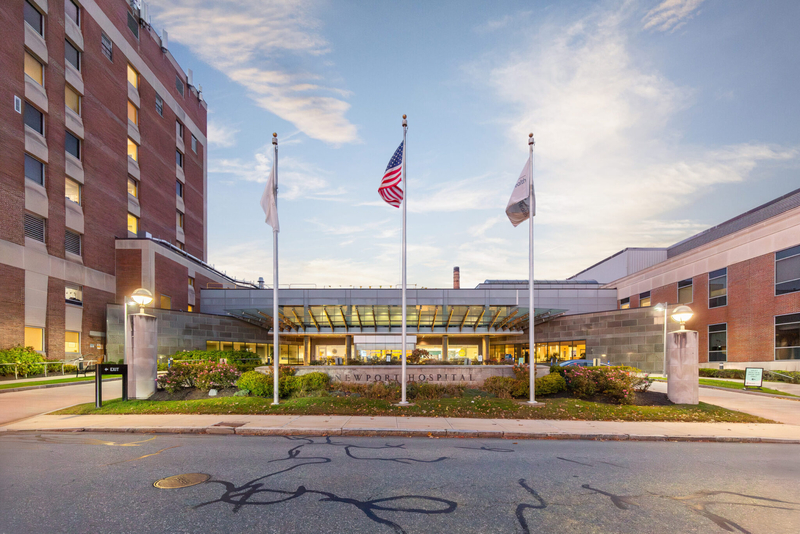
A sign supporting keeping the Newport Hospital Birthing Center open is on display on Broadway across the street from the hospital. (Photo by Janine L. Weisman/Rhode Island Current)
Staring down another quarter of operating losses, Brown University Health executives are unwilling to contribute a share of the $4.9 million needed to keep Newport Hospital’s birthing center open.
“We want to see the money come from outside Brown Health,” Peter Markell, executive vice president and chief financial officer, said during a virtual call with reporters Thursday. “We still need $4.9 million of support, whether from the state or philanthropy.”
In other words, Gov. Dan McKee’s earmark of $1.6 million from state settlement funds for the birthing center in his fiscal 2027 budget is not enough after the health system recorded an $18.9 million operating loss for the three months that ended March 31. It’s the second consecutive quarter that Brown Health ended in the red, down $36.5 million for the first six months of its fiscal year, which began Oct. 1.
The lopsided ledger looks far worse than it did when Brown Health initially warned that financial pressures could force the closure of the Newport Hospital birthing center last summer. The company, which also owns Rhode Island, Miriam and Bradley hospitals, quickly reversed course in the wake of community outrage over the loss of the only labor-and-delivery unit on Aquidneck Island.
Initially, it promised to maintain the 10-suite birthing unit through Sept. 30, 2026, and in March, committed to preserving services indefinitely. But the commitment comes with a $4.9 million price tag based on an undisclosed consultant’s report.
“The consultant report said it was a good program, but it could be better,” Markell said. “A lot of it has to do with physician coverage.”
He declined to share further details of the report or the financing, which is intended to include philanthropic contributions.
The pain point lies in Massachusetts, where a 2024 acquisition of two hospitals and associated physician groups from bankrupt Steward Health Care has dragged down the company balance sheet. In the six-month period that ended March 31, Brown Health’s Massachusetts arm lost $79.6 million, according to quarterly financial statements published Wednesday.
“Obviously we’re not very pleased with that,” Markell told investors during a 45-minute earnings call Thursday afternoon. “It’s been a very challenging six months, I am not going to sugarcoat it with you, particularly in Massachusetts.”
The company’s Rhode Island portfolio, including Rhode Island, Miriam, Bradley and Newport hospitals, ended the six-month period with a $43.1 million profit.
Lower-than-expected patient volume and staffing shortages have suppressed profits at St. Anne’s Hospital in Fall River and Morton Hospital in Taunton since their sale to Brown Health in September 2024. A new wrinkle emerged in the second quarter as the company tried to integrate its Massachusetts physician groups into its existing healthcare software program. Markell expected margins to improve in the second half of the company’s fiscal year now that all practices are up and running with payroll and patient software, and demand for services rises.
Downsized leadership
This week, the company appointed a new president from within its network to jointly lead St. Anne’s and Morton hospitals, shifting the existing Morton president to chief operating office and eliminating the president position from St. Anne’s, Markell told reporters Thursday.
“These changes are designed to strengthen operational alignment, enhance financial stewardship, and support long-term stability while advancing our integrated system-wide care model,” Sharon Torgerson, a Brown Health spokesperson, said in a statement. “We remain focused on ensuring continuity of care, supporting our employees and physicians, and continuing to provide high-quality care to the communities we serve.”
Markell warned that more cuts may come, but did not offer details.
Much of the company’s financial outlook hinges on what happens with federal funding and policy changes, including new work requirements for Medicaid recipients, and the fallout from expired federal discounts for state health insurance exchanges.
Brown Health already projected an extra $100 million to $200 million in net annual losses over the next eight years as more patients lose insurance and new caps are imposed in federal funding from states to hospitals.
“H.R. 1 is very much a wild card,” Markell said, referring to the name for the federal spending cuts signed into law last year.
Even more concerning than the impact of prospective insurance coverage losses for patients are the costs already rising from insurance claim denials, debt and charity care.
Service claims filed with insurers — commercial and government — are increasingly being rejected, forcing the hospital system and patients to bear the weight of costs they expected would be covered. Markell named cancer drugs and treatments and hospital readmissions — typically not covered if a patient is back again within 30 days— as common culprits for denials. And he was suspicious that at least some of the rejections were not legitimate.
“There’s policy and then there’s BS,” he said, adding that he believes use of artificial intelligence may be behind some of the unexpected and illegitimate claim denials.
A $70M ask in FY27 budget
The healthcare giant is now reaching its hands out to Rhode Island lawmakers to help offset the rising cost of uncompensated care.
The Hospital Association of Rhode Island and its members, which include Brown Health’s four hospitals, are calling for lawmakers to add an extra $70 million in state Medicaid funding to the fiscal 2027 budget. The funds, when matched with federal dollars, would provide a total of $170 million more for hospitals statewide.
“That would make a big difference in the ability of hospitals across the state,” Markell told reporters. “Given the match program that exists with the feds, it’s crazy for the state not to put it in its budget.”
McKee did not immediately respond to requests for comment Thursday on the additional hospital funding. Spokespeople for House Speaker Christopher Blazejewski and Senate President Valarie Lawson remained noncommittal, noting that all budget requests must go through the standard legislative review process in an emailed response.
McKee’s fiscal 2027 budget proposal already includes $441 million for hospitals, of which $147 million would come from state revenue. The breakdown of money to each hospital has not been determined, but is set by federal formulas based on the mix of Medicaid, Medicare and commercial patients.

Providence, RI