Kansas commission picks three district judges as finalists for opening on state Supreme Court
May 21, 2026 | 6:06 pm ET
Description
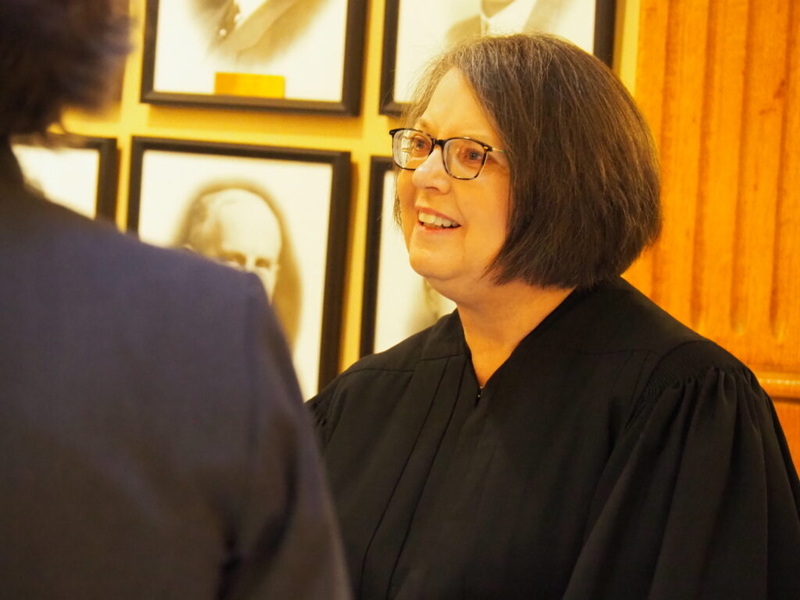
A Kansas nonpartisan, independent commission selects District Judges Robert Wonnell, Chris Jayaram and Carl Folsom as finalists to fill a vacancy on the Kansas Supreme Court. Gov. Laura Kelly is responsible for appointing a replacement for retired Supreme Court Chief Justice Marla Luckert, who was photographed in 2024 while at the Capitol for the annual State of the Judiciary speech to the Legislature. (Photo by Rachel Mipro/Kansas Reflector)
TOPEKA — The state’s nonpartisan nominating commission Thursday named three district court judges as finalists for a vacancy on the Kansas Supreme Court.
Commissioners interviewed seven applicants and voted during a public meeting to present Democratic Gov. Laura Kelly a list comprised of Johnson County District Judge Robert Wonnell of Olathe, a 2015 appointee of GOP Gov. Sam Brownback; Johnson County District Judge Chris Jayaram of Lenexa; and Douglas County District Judge Carl Folsom of Lawrence. Kelly appointed Jayaram to the bench in 2021 and selected Folsom for the district court in 2022.
Former Chief Justice Marla Luckert’s retirement in March created a vacancy on the seven-justice court. Luckert, who devoted 23 years of her legal career to the serving on the Supreme Court, stepped down after suffering a stroke in October that preceded a vehicle accident.
Under the state’s merit-selection process for filling slots on the Supreme Court, Kelly would have 60 days to choose from among the three finalists. In the unlikely event the governor didn’t meet that deadline, Supreme Court Chief Justice Eric Rosen would make the pick.
Kansas’ system of placing justices on the Supreme Court could be dramatically altered with passage in August of a proposed amendment to the Kansas Constitution requiring election of justices.
Wonnell, who earned a law degree at the University of Kanas in 2001, worked in private practice in the Kansas City area before chosen 11 years ago by Brownback to serve on the Johnson County District Court. He’s taken an active role in advancing the district’s special behavioral health court and treatment docket.
“I am excited about the opportunity to play a role in case law, in what guides our courts,” Wonnell said. “I’m excited for the secondary role of a Supreme Court justice to work in the administration of the justice system across the state.”
Folsom, who graduated in 2005 from KU’s law school, accumulated years of experience as a state and federal public defender before appointed to the Douglas County District Court. He was among three Lawrence applicants for this vacancy on the Supreme Court.
“This job is a perfect combination of my love of Kansas, my love of public service and my love of the law,” Folsom said.
Folsom was twice nominated to the Kansas Court of Appeals by Kelly, who said he was as “imminently qualified.” The GOP-led Kansas Senate voted to reject his nominations in 2020 and 2021.
“I think the best judges, and really all judges, should try to block out the outside noise,” Folsom said. “You make the decision on the facts and the law of the case.”
Jayaram took his place five years ago on the Johnson County District Court after two decades in private practice focused on business law. He earned his law degree in 1997 at Lewis and Clark College in Portland, Oregon. In 2025, he was a finalist for the Supreme Court position awarded to Leawood attorney Larkin Walsh.
“I’ve really worked hard throughout my career to try and master the areas of law which I practice,” he said.
He said much of his district court docket focused on family law and required difficult decisions about best interests of children in custody cases.
“I think that takes courage because whatever decision you’re going to make is either going to be … unpopular with at least 50% of the litigants and, often times, it’s 100% of the litigants that are unhappy with the decisions,” Jayaram said.
Other applicants for the Supreme Court opening were Lawrence attorney Meryl Carver-Allmond, Wichita attorney Molly Gordon, Douglas County District Judge Amy Hanley and Kansas Board of Tax Appeals Chair Kristen Wheeler of Wichita.
Topeka, KS