Alaska lawmakers approve one-time funding for K-12 schools, plus energy relief
May 21, 2026 | 5:54 pm ET
Description
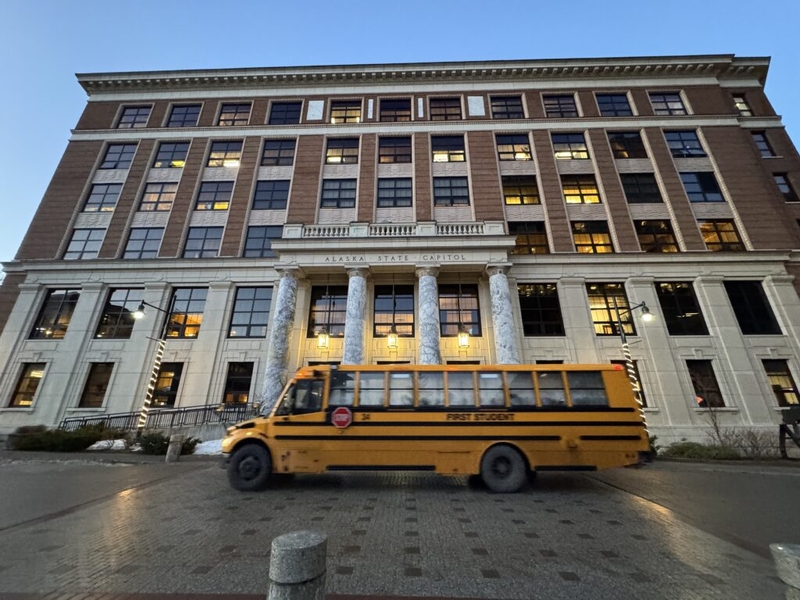
A school bus drives by the Alaska State Capitol on Jan. 21, 2026. (Photo by James Brooks/Alaska Beacon)
Alaska lawmakers approved an additional $144 million in one-time funding for K-12 schools next year, plus a batch of education policy changes that garnered bipartisan support particularly aimed at boosting teacher retention and offsetting districts’ energy costs.
The Alaska Legislature has been divided, and at odds with Gov. Mike Dunleavy, over the level of state funding for public education — even as districts across the state face significant budget deficits and declining enrollment, forcing steep cuts and school closures.
Rep. Andi Story, D-Juneau and co-chair of the House Education Committee, acknowledged the strife of school districts and said the policy changes and one-time funding are a step in the right direction.
“It doesn’t meet the need, but it moves the dial in the right way,” she said.
Last year, lawmakers passed a historic increase to state funding for K-12 schools and added millions in sustained per student funding, known as the base student allocation — but only after multiple vetoes by Dunleavy, and an equally historic veto override by the Legislature in a special session in August restoring the funding increase.

This year, in the second year of the 34th Legislature, lawmakers seemed to have less appetite for taking on another education funding battle with Dunleavy — particularly amid competing priorities in the Senate and House multipartisan majorities to pass elections reform and revive a state pension system. Both items were vetoed by Dunleavy. The governor has focused on pressing lawmakers to approve a property tax break for a proposed trans-Alaska gas line, and called a special session on that topic beginning on Thursday.
But Alaska schools will see some additional funding next year as the U.S. war on Iran and global oil shock has driven up state revenues from the rise in oil prices.
In addition to the $144 million in one-time funding in the operating budget for K-12 schools, including $29 million for offsetting rising energy costs next year, lawmakers also approved a pared-down education package. It establishes a student loan forgiveness program for teachers, an adjustment to state funding for districts in local municipalities and a plan for the state to fund school districts energy costs — beginning in 2028, and subject to future Legislatures funding it.
“I’m thrilled,” said Story on Wednesday after the vote. She authored the underlying bill establishing the loan forgiveness program for teachers, which is aimed at recruiting and keeping young teachers in Alaska.

“It’s an incentive to keep continuity, keep your teachers employed, and that’s great for kids — whenever they can have the same teacher in the building, that always makes a difference,” she said.
If approved by the governor, the bill would establish a new student loan forgiveness program for teachers of up to $15,000 over three years. It’s focused on teachers specializing in English as a second language, special education, science, technology, engineering and math. The program is expected to serve up to 120 teachers next year.
Senators also included a provision from another bill to cap local municipalities’ contributions to school districts. The provision says the contribution may increase by no more than 4% from the previous year. The cap is intended to provide relief to boroughs with rapidly rising property assessments, which informs how much they contribute to their local schools as part of the complex funding formula with state and federal dollars.
Sen. Jessie Bjorkman, R-Soldotna spoke in favor of the policy change, as much of the Kenai Peninsula region is seeing rising property values. “Our current law does shift significant cost from the state to local municipalities,” he said. “We accept as local municipalities that we have some skin in the game… we’re okay shifting some cost, but not so much.”
State plans to cover K-12 schools’ rising energy costs
In addition to the $29 million lawmakers allocated for K-12 schools’ fuel costs next year, they approved a provision in the education package that would initiate the state covering school districts’ fuel costs beginning in 2028 and subject to future lawmakers approving the funding.
Alaska districts have reported rising fuel costs in recent years to keep schools warm and facilities running, especially in rural and remote areas — estimated at $90 million statewide this year.
If approved by the governor, the state would annually reimburse districts based on the average of the past three-years of fuel costs. Districts are asked to make a reasonable effort to manage fuel use and costs, to not exceed the usage from the previous year and report how much they’re spending on fuel to the Alaska Department of Education and Early Development.
Fuel costs are expected to skyrocket this year with the onset of the U.S. war on Iran, and districts are facing bulk fuel orders in the millions. Officials with the Lower Kuskokwim School District report an 80% expected increase in fuel costs next year for its nearly two dozen village schools in Western Alaska.

On Wednesday, Sen. Rob Yundt, R-Wasilla, said he’s watching three schools close in his district in the Matanuska-Susitna Borough and expressed enthusiasm for the plan on the Senate floor: “I cannot tell you how excited I am. My district last year spent between $6.4 million on natural gas and electricity alone. Those have been rising every year for our community.”
“I do look forward to the day that the state pays for the energy related to all of our schools,” he said.
The bill also includes provisions for homeschooled students to keep textbooks, equipment and other supplies when they leave a school district, to allow regional resource centers to hire former teachers while keeping their defined benefit retirement benefits and to allow school board members to be hired as substitute teachers.
It also changes the statute so that schools that are closed during school consolidation can be reopened in four years instead of seven years.
‘Most anti-education governor in history’
This year, members of the House and Senate advanced various education bills that failed to garner bipartisan support.
They included more targeted and ambitious funding increases with millions for energy costs, transportation, reading instruction and career and technical education programs, as well as policy changes related to tribal compacting for public schools, homeschool programs and math instruction.
Story authored another bill to help stabilize school districts’ budgeting process by redefining the student counts that passed the House last week, but failed to advance in the Senate. “It costs $113 million and they had already put one time funding in there for districts,” she said, referring to funding in the current operating budget. “And I think there was a fear that the governor would veto that.”
Story said she plans to reintroduce the proposal if re-elected next year.

After adjournment Wednesday night, leaders with the Senate Majority caucus praised the 34th Legislature’s wins for education in a news conference, but acknowledged they were hard fought, and that districts are continuing to struggle amid budget cuts.
“This has been probably the most anti-education governor in the history of our state,” said Sen. Bill Wielechowski, D-Anchorage, and criticized Dunleavy for repeatedly vetoing funding increases for schools.
“It’s been an absolute battle,” he said. “So people wonder why schools are closing, because we haven’t kept pace with inflation. But part of its revenue, a huge part of its revenue, we’ve got to figure out (and) we’ve got to stabilize our revenue going forward. It’s going to be tough conversations going forward.”
Juneau