Governor declares drought emergency as Utah dips into reservoir ‘savings’
May 21, 2026 | 6:11 pm ET
Description
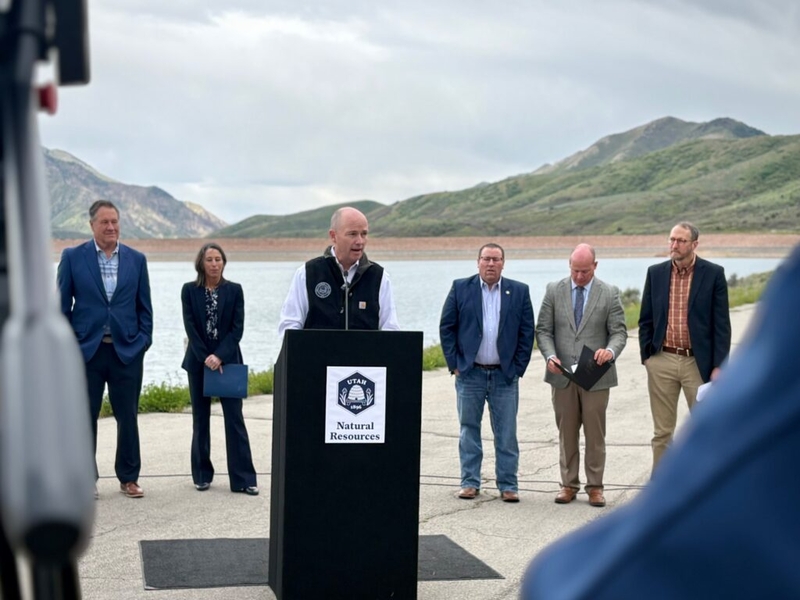
Utah Gov. Spencer Cox speaks to news reporters at Little Dell Reservoir about his drought declaration on Thursday, May 21, 2026. (Annie Knox, Utah News Dispatch)
Gov. Spencer Cox declared a state of emergency Thursday, noting every county is in a state of severe or extreme drought after a dry winter marked by record warmth robbed Utah of its snowpack and left rivers and streams running low.
The declaration opens the door for farmers and ranchers to tap into federal funding and loans managed by the state. It also gave state leaders another opportunity to urge homeowners to cut back on watering their lawns and replace some of their grass with less thirsty plants.
Speaking to reporters at Little Dell Reservoir east of Salt Lake City, Cox referred to mountain snowpack Thursday as “our checking account,” saying it supplies roughly 95% of Utah’s water.
“And right now, our checking account is running low. We are relying on our savings account in our reservoirs,” Cox said. He said there’s enough water in the reservoir system to get through the year on the condition that “we treat every gallon as a finite resource. We need aggressive conservation across all sectors.”
Statewide, reservoir levels are hovering just over 70%, according to state data, about 15% lower than the same time last year. When Flaming Gorge on the Wyoming border and dwindling Lake Powell on the Arizona border are considered, the median drops to about 60%.
Cox said about two-thirds of residential water is used outdoors and pleaded with Utahns to stay vigilant and avoid watering too much. But he said any restrictions are a decision for local leaders and water districts, not for state officials.
On the Wasatch Front, Midvale has already imposed a 25% surcharge for outdoor overuse. In northern Utah, the Weber Basin Water Conservancy District mandated a 20% cut, Cox said, and the central Utah town of Emery cut off secondary household water used for lawns and gardens.
Farmers and ranchers are the main users of water in the Great Salt Lake and Colorado River basins. Asked what his message is for Utahns who don’t want to conserve because they want agriculture to cut back, or because they believe a proposed Box Elder County data center will deplete big quantities of water, Cox shot back that “farmers conserve more than anybody in this state.”
The Great Salt Lake has already reached its max height for the year
“That’s where the biggest cutbacks will always be, always have been, and so I get pretty fired up about that one, because it’s a lie and it’s wrong,” said Cox. A farmer himself, he said his fields near Fairview have been cut back to half of normal production.
Farmers and other water rights holders have been forced to take cuts in dry years under a priority system overseen by the state Division of Water Rights. Several farmers have also volunteered to take part in programs reimbursing them to upgrade their irrigation systems or paying them to leave fields unwatered for a time. It wasn’t clear exactly what sort of cutbacks Cox was referring to Thursday.
He also reiterated his past statements and others from backers of the proposed Stratos data center that it would use less water than ranchers there do now.
In May, Utahns watered outside like they normally would in June, said Laura Briefer, director of Salt Lake City’s public utilities department.
“I don’t see us going into the next stage of our drought contingency plan, but a lot of that’s going to depend on how well people heed our conservation requests,” Briefer told Utah News Dispatch. Starting in March, the city required government institutions to cut water use by 10% and asked businesses and homeowners to help it meet a conservation goal of 10 million gallons per day.
During the news conference, icy rain fell on Cox, Briefer and other officials helping to manage rivers and reservoirs. But they said spring rainfall doesn’t provide the sort of help it would have in colder temperatures when it could have boosted the snowpack.
The forecast for the summer ahead indicates southern and eastern Utah might get more rain than normal, but the relief would be minimal at best, Cox said. And he gave a warning about what next year may hold, saying Mother Nature may not deliver come winter.
“We can’t control the weather,” Cox said. “But we can control the tap.”
Salt Lake City, UT