UPDATED: Arkansas public television commission pauses state plan to break off from PBS
Mar 12, 2026 | 3:25 pm ET
Description
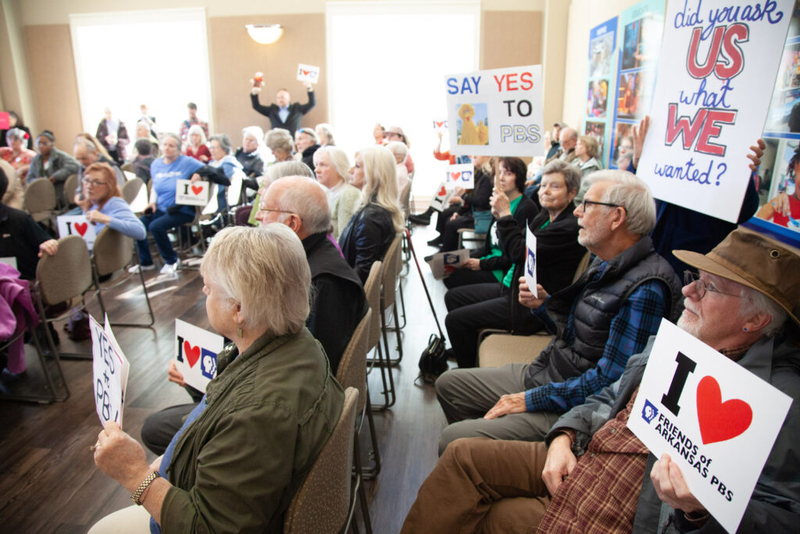
Supporters of PBS held up signs at the Arkansas TV commission meeting held on Thursday, March 12, 2026 in Conway, Arkansas. (Photo by Katie Adkins/Arkansas Advocate)
Arkansas’ public television commission voted Thursday to pause efforts to become the first state to cut ties with PBS after hearing almost two hours of frustrated public comments from opponents, including the head of the national network.
The 4-1 vote saw some PBS Commission members support the pause after voting in favor of forgoing PBS membership in December. The station had been preparing to disaffiliate from PBS on July 1.
Commissioner Anne Cowie was among the members who reversed their votes. She said her goal with both votes was to be financially responsible, and she pointed out that there were no public statements of support for disaffiliation at the meeting or in Arkansans’ calls and emails to commissioners.
“We saw the [fiscal] cliff and we responded,” Cowie said. “We see the people, we see that swell, and we are responding and I feel like it’s appropriate.”
Arkansas is the only state whose public television station responded to last year’s defunding and closure of the Corporation for Public Broadcasting by taking steps to end its PBS membership. The station rebranded from Arkansas PBS to Arkansas TV.
Arkansas public television viewers, parents disillusioned with network’s plan to cut ties with PBS
Several attendees at Thursday’s four-hour meeting said they would no longer financially support the station and denounced the split as an ideological move, echoing comments others have told Arkansas TV in emails.
Arkansas TV CEO Carlton Wing, who assumed the role in September, again said Thursday that the station could not afford to pay more than $2 million in PBS dues. Only PBS member stations can purchase PBS programs, and the station used about half of a $2.5 million community service grant for this purpose before CPB shuttered.
PBS CEO Paula Kerger told the commission it needed to consider all its options and hear from the public before making PBS programs unavailable over the air, especially to rural parts of Arkansas with poor broadband access. Opponents who spoke also included former Arkansas first ladies Gay White and Barbara Pryor, who co-chair a group formed to oppose the disaffiliation.
About 20 people spoke at the meeting, the first time commissioners could remember anyone signing up for the public comment portion of its meeting. People with signs supporting PBS filled an overflow space in the Allen Weatherly Atrium.
Allen Weatherly was executive director of Arkansas PBS, then called the Arkansas Educational Television Network, from 2001 until his death in 2016. His widow, Peggy Weatherly, was among Thursday’s speakers. She and several others criticized the commission for voting to separate from PBS with no advance warning and said a call for fundraising could have alleviated the network’s financial concerns.
“Don’t let those in the state who would like to keep us uneducated win the battle,” Weatherly said, receiving audience applause.
Allegations of partisanship
Dora Bradley of North Little Rock, who served on the board of the precursor to the Arkansas PBS Foundation, remembered making phone calls to ask viewers for money before the station had state government funding. Thursday, she implored the panel to keep PBS programs available to all Arkansans.
“You’re moving beyond a public [broadcasting] station to a government-controlled station, which is moving in the direction of political bias,” Bradley said to much applause from the audience.
Three state public television commissioners have Republican ties and Wing was a GOP state House member before he resigned to run the station.
Republican Gov. Sarah Huckabee Sanders is expected to soon appoint two new commissioners to replace Woody Freeman, whose term is expiring, and Annette Herrington, who resigned in December. Herrington was one of two members, along with Cynthia Nance, to vote against leaving PBS.
Nance made the motion Thursday to pause the disaffiliation effort for 180 days. She said she wanted the public to know the commission took their concerns seriously.
Commissioner Gary Newton, elected as the panel’s chairman Thursday, said allowing time for fundraising that might not be enough to fulfill the station’s financial need was “a terrible position to put the public in.”
Maria Sullivan, whose husband is GOP Sen. Dan Sullivan, was the sole vote against Nance’s motion. Newton said he was inclined to agree but did not ultimately vote on the pause.
Freeman said he wanted to see if Arkansans could raise enough money for dues in 180 days.
“I always like to give somebody a second chance,” he said.
Public frustrations
The PBS Commission voted last summer to retain the station’s membership through June 30, when the current fiscal year ends. At the time, the CPB defunding was on the horizon but had not been finalized.
The Arkansas PBS Foundation saw an uptick in contributions after the CPB defunding, foundation CEO Marge Betley said. This allowed the foundation to provide the network with a one-time emergency fund of $1.5 million between June and September, supporting both operating expenses and about half of the $2.3 million in national dues.
The network lost 3,738 donors between Nov. 30 and Feb. 28, Betley said, and likely would see a bigger drop if the network officially left PBS.
Betley told the commission last year that 80% of those who donate online cite PBS programming as their reason for giving. Several of Thursday’s speakers said PBS enriches their and their families’ lives.
Wing has said Arkansas TV’s goal is to produce in-house, Arkansas-focused programming, but Paula Johnson said the network shouldn’t produce exclusively local content because “Arkansas does not exist in isolation from the rest of the world.”
Some speakers were current or former educators. A few noted the cost of PBS dues pales in comparison to the $309 million Arkansas has budgeted in the coming year for its school voucher program.
Leon Kaplan of Little Rock reminded the commission that other states’ PBS stations have not moved to leave the network despite dire financial straits.
“[It] makes us look like an uneducated backwoods state, a look that we have been trying to overcome,” said Kaplan, receiving much applause from the audience.
PBS chief calls for Arkansas public TV commission to ‘take a pause’ on leaving national network
Financial debate
Arkansas’ PBS dues for the fiscal year that begins July 1 will be about $2.1 million, Kerger said, a discount from the $2.3 million the state paid for the fiscal year that ended last June 30.
PBS reduced the dues to $2 million for the current fiscal year in response to CPB closing.
Kerger disputed Wing’s claim that starting the fiscal year as a PBS member station would put the station on the hook for a full year of dues, saying the national network would prorate dues if Arkansas cut ties midyear.
The commission’s December vote came with the knowledge that PBS requires 180 days’ notice before a station revokes its membership.
Wing noted that the majority of Arkansas TV’s funding comes from state funds, and the network’s spending authority has repeatedly faced resistance in the predominantly Republican Arkansas House. Wing was among the lawmakers who urged their colleagues to pass the network’s appropriation bill in 2024, when the bill passed after three attempts. The appropriation took five attempts to pass the House in 2025.
Wing said state officials “want the station to represent our educational standards” set by the Arkansas Department of Education. Kerger reminded him that the public just told the commission they specifically want and value PBS shows.
“That is educational programming, that is what we were created to do, and that is what we’re doing, so [does the state believe] that doesn’t count?” Kerger asked.
“That is programming we cannot afford,” Wing said, and the audience booed in response.
Bradley said after the meeting that she appreciated the commission’s decision but was concerned that the station had lost too much public trust to raise enough money.
Peyton Bishop said she wanted to keep donating to the station but had misgivings.
“I’m going to double my annual [donation] and possibly more, but only if I’m assured that those monies will go toward staying with PBS, [not] if they absorb that into their local development stuff,” Bishop said.
- 5:21 pmThis story has been updated to include discussion from the commission meeting.
Little Rock