A pair of data centers proposed for Tucson would use more water than four golf courses when fully built out, and be energized with more power than any other TEP customer, according to city documents released Monday.
While City Manager Tim Thomure said he’s supportive of the proposal, elected members of the City Council have sounded notes of caution, with at least one declaring he’s a solid “no” so far.
While the Council has yet to discuss the project, the Pima County Board of Supervisors approved rezoning and selling a county-owned parcel to the developers last month. The initial project, on the Southeast Side, will require annexation into the city to procure the massive amounts of water required to cool the planned operation. Another associated data center is being planned for a different location somewhere within the city limits, officials said.
A third site is being studied for yet another data center in the region, but outside of the city limits, the city’s newly released documents said. The city posted the documents and a message from Thomure on a “Project Blue — Facts and Information” section of its website Monday afternoon.
Just the first two sites combined would require nearly 2,000 acre-feet of water per year, making them Tucson Water’s largest customer.
‘Cloak and dagger’
The ultimate operator of what local officials dubbed “Project Blue” has not been publicly identified. Thomure told the Sentinel on Monday that he doesn’t know who the company is. Negotiations by the city and county have been conducted with a developer, Humphrey’s Peak Properties LLC, which is set to build out the centers before handing over the keys to the operator.
Limited details about the project’s use of power and water were not provided until Monday, with government officials citing non-disclosure agreements they said were necessary to negotiate behind closed doors in the initial stages of the talks. A draft “development agreement” was made public Monday, along with a summary from the city manager, with Thomure saying he hoped the information would “hopefully replace the misinformation and speculation that has been prevalent to date.”
“I don’t like the whole secrecy thing attached to this project from the get-go,” Councilmember Paul Cunningham told the Sentinel on Monday after reviewing the new documents. “There’s still too much cloak-and-dagger stuff that I’m not comfortable with.”
“If the vote was today, I still wouldn’t vote for it,” the Ward 2 councilmember said. “I appreciate the effort of them releasing some info,” he said of the documents which were provided to members of the Council on Monday morning, prior to a public posting in the afternoon. “But that doesn’t get me to a ‘yes.’ My concerns and skepticism remain.”
Councilmember Nikki Lee, who represents the Southeast Side, likewise sounded a skeptical note Monday.
“After reviewing this draft, I now have more questions than answers,” she said.
“I’m especially concerned about how key water provisions would be enforced and whether they truly protect Tucson’s long-term water supply. Air quality hasn’t been addressed at all. Economic benefits remain vague. And there are still a lot of missing or unclear details,” said Lee, whose ward would include the area to be annexed under the deal.
“I’ve read every single word. Twice,” she wrote in a social media post. “Of the 21 questions I raised on June 26, only four can clearly and thoroughly be answered in writing based on what’s in this draft. City staff have said they’re working on a supplemental document to address the rest, but I haven’t received a timeline for when those responses will be available.”
“There are so few guarantees here,” the Ward 4 councilmember told the Sentinel on Monday, after reviewing the documents. “The up-side is not very high compared to the amount of resources we’re talking about. That’s what I’m trying to help surface. We’ve seen this play out in community after community.”
Of the 180 positions the project is forecast to result in, “there’s no mechanism to make sure that those jobs actually get created and for how long,” Lee said.
‘It’s not Dr. Evil’
Thomure — the city’s top administrative official, appointed by the mayor and Council — is leaning on his years as the head of Tucson Water in recommending the project move forward, he said.
“The net water use (of Project Blue) is zero,” he told the Sentinel on Monday, citing provisions in the proposed agreement with the developers that would allow the data center operator to offset water use by purchasing more Central Arizona Project water, supporting leak repairs throughout the city system, funding low flow toilets and leak detecting meters, and cleaning up PFAS-contaminated wells.
“Project Blue will fund local water projects within the region or bring new water supplies to the region to augment and supplement Tucson’s replenishment efforts,” one of the city documents said.
To serve the Southeast Side data center, the developers will construct a $100 million 18-mile pipeline that would deliver reclaimed water from a treatment facility on the Northwest Side. A second planned data center site, which does not yet have a publicly specified location, would have to be somewhere nearby that pipeline to also be served, Thomure said. That second site would include a 30-acre recharge facility where water used by the data center there would be returned to the aquifer, he said.
The city would piggyback on the new pipeline, paying for a somewhat larger pipe in order to be able to provide reclaimed water to more customers on the Southeast Side, he said.
The data centers wouldn’t impact reclaimed water that is sent flowing down the Santa Cruz River to recharge, Thomure said, noting that he wants to increase the amount flowing past Downtown. The amount sent to the riverbed on the Northwest Side would still flow past the Pinal County line but could vanish underground a shorter distance north than it now flows, he acknowledged.
The project would require potable drinking water for three years while the reclaimed water pipeline was under construction, city officials said.
“This actually isn’t draining our water supplies,” Thomure said. “We have more leakage than this amount.”
While he acknowledged that some of the possibilities for the developers to replenish water are somewhat “nebulous,” he told the Sentinel that “with almost any mechanism they choose” the data center operators could hit their water targets.
“We absolutely have sufficient capacity,” he said.
Further, critics have “over-estimated” the energy use, and the developers are “not asking for incentives” in return for employment pledges, he said.
“The jobs matter, but they don’t change my perspective of the longterm value of the project,” the city manager said, citing “thousands of construction jobs and longterm additions to the tax base.”
The city documents said “data centers generate substantial and reliable property tax revenue for local governments while requiring minimal local government services and have little impact on traffic congestion in surrounding neighborhoods. ”
“We’re not providing infrastructure; they are,” Thomure said, contrasting the project with ventures such as Pima County’s deal with World View, which never achieved its lofty employment forecasts and saw the company refuse to pay rent on a building that taxpayers funded for them.
While members of the Council and the public alike have blasted the deal for not disclosing the planned operator of the proposed data centers, Thomure said he backs it “regardless of who the ultimate end user is.”
While he himself doesn’t know the company for sure, “I can say it’s not Dr. Evil,” he told the Sentinel in response to a request to characterize the operator. “We’re here, we’re proud to be here,” he said the company would say.
Other councilmembers ask questions
Councilmember Karin Uhlich said she has concerns about the massive power the planned data centers would require, and how that would impact other Tucson Electric Power customers.
The Ward 6 Democrat also said “questions remain” about “specifics on issues such as water warming and evaporation, energy needs tied to moving water, and whether there are any sites in the valley that could host data centers without county and/or city approval(s) (for the land or water needed).”
“The net neutral/positive scenario also notes this project could utilize water credits (not clear to me whether paper water credits vs actual wet water have been factored into the equation),” Uhlich wrote. She also questioned how much the city would have to maintain the 18-mile pipeline once it is constructed.
Councilmember Kevin Dahl, who’s been critical of the project, told the Sentinel that he would not have the opportunity to review the new documents until Tuesday.
A pair of data centers proposed for Tucson would use more water than four golf courses when fully built out, and be energized with more power than any other TEP customer, according to city documents released Monday.
While City Manager Tim Thomure said he’s supportive of the proposal, elected members of the City Council have sounded notes of caution, with at least one declaring he’s a solid “no” so far.
While the Council has yet to discuss the project, the Pima County Board of Supervisors approved rezoning and selling a county-owned parcel to the developers last month. The initial project, on the Southeast Side, will require annexation into the city to procure the massive amounts of water required to cool the planned operation. Another associated data center is being planned for a different location somewhere within the city limits, officials said.
A third site is being studied for yet another data center in the region, but outside of the city limits, the city’s newly released documents said. The city posted the documents and a message from Thomure on a “Project Blue — Facts and Information” section of its website Monday afternoon.
Just the first two sites combined would require nearly 2,000 acre-feet of water per year, making them Tucson Water’s largest customer.
By the numbers
When fully built out, the Southeast Side site would have up to 10 data centers, using about 870 acre-feet of water per year. It could take up to 600 megawatts to power the entire facility, the city documents said.
The second site, despite its yet publicly unrevealed location, would be even larger than the initial Project Blue complex.
That part of the project would use up to 1,040 acre-feet of water per year, and consume up to 700 megawatts of electricity.
Project Blue, even before building the third site, would require about 6 percent of Tucson Water‘s total reclaimed water capacity — and be the city-owned utility’s largest customer. The data centers would also be the largest customer for the private company Tucson Electric Power.
While the draft development agreement includes caps on water use by Project Blue, exceeding them wouldn’t mean the city would turn off the taps. Surcharges would be imposed for using more water than scheduled, based on rolling monthly and annual amounts. Using too much water for more than a decade would mean “liquidated damages” under the deal, with charges of $500,000.
Under the deal with the county, the initial property will be acquired by the developers for nearly $20.8 million.
The $1.2 billion project is forecast to create 3,024 jobs through construction and another 2,050 through ripple effects, according to a report by Applied Economics. By 2035, it will take 180 workers to operate, which could generate a quarter-billion in tax revenues over 10 years through direct and indirect economic activity, the consultant claimed.
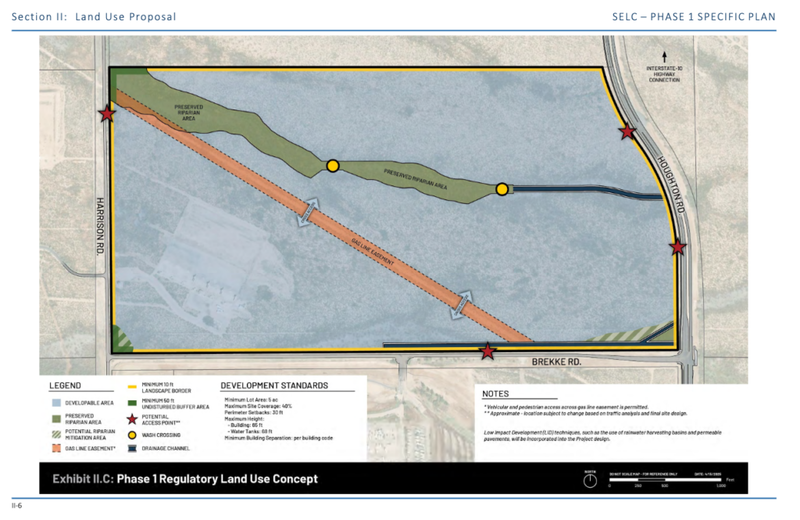
Construction would begin within 24 months of the closing on the property, which is just north of the Pima County Fairgrounds. The plan is to build 2.3 million square feet of data center space with $2.4 billion in equipment being installed. Phase 1 of the project would see the construction of four buildings, with up to 10 possible when the project is complete.
The data center must agree to employ 75 people within seven years of the purchase under the deal with the county. Those jobs must remain on the books for two years at an average base salary of $75,000. Twice a year, for those two years, the company must provide proof that the payroll promises are met.
Public discussion
The City Manager’s Office noted that the draft development agreement released Monday is “just one part of the puzzle — and more factual information is forthcoming.”
“We know that the information being released today will not answer every question or concern,” the “executive summary” provided along with the draft deal said.
While the Board of Supervisors voted to approve the sale of public land and rezoning for the first data center last month, the City Council has yet to discuss the plans. They’re set to do so at a study session on August 6, but no votes are planned for that public meeting.
A public hearing will take place at the August 19 meeting of the City Council, which could include an initial vote on annexation of the Southeast Side property.
If the mayor and six members of the Council vote to move forward, annexation could be finalized by October.
A public meeting about the project, organized by city officials, will be held Wednesday, July 23, at Mica Mountain High School, 10800 E. Valencia Rd. The 5-7 p.m. information session will also be streamed on the city’s Youtube channel. That meeting will include Councilmember Lee.
Another meeting will be held July 31, and include Mayor Regina Romero. The location has not yet been released.