Google data center plan raises tax, transparency questions in rural Missouri
May 22, 2026 | 7:00 am ET

Description
Gov. Mike Kehoe acknowledged some Montgomery County residents' concerns about electricity prices and environmental impacts at the announcement in High Hill of a Google data center this week but said the company had "done [the] work to ensure that their growth does not come at the expense of the community this center calls home" (Steph Quinn / Missouri Independent).
HIGH HILL — A $5 million federal pandemic recovery grant helped Montgomery County prepare a rural industrial site along Interstate 70 for major development. Two years later, Amazon and Google are building data centers on nearly 2,000 acres near New Florence — and local officials are preparing to offer Google a 70% personal property tax abatement.
Google announced Wednesday that it will invest $15 billion in a data center south of the highway, joining an Amazon Data Services project already underway north of I-70. Supporters say the projects will bring construction jobs, permanent positions and millions in annual tax revenue to a county where many residents commute east for work.
But as the projects move forward, some Montgomery County residents say they were excluded from discussions that should have happened in public. Key details about Google’s tax agreement — including how much revenue the county would collect and how much it would forgo — won’t be discussed until a June 8 hearing.
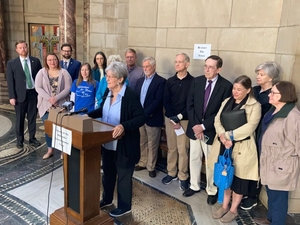
Google President Ruth Porat, Gov. Mike Kehoe and Montgomery County commissioners gathered Wednesday in High Hill to announce construction of the data center outside New Florence, a town of fewer than 700 people.
The Google data center is part of a 5,000-acre industrial megasite straddling I-70. After Missouri lawmakers appropriated $27.5 million in federal COVID-19 recovery funds in 2023 for industrial development, the Missouri Department of Economic Development awarded Montgomery County a $5 million grant to establish “shovel-ready industrial sites” to lure major investors.
Some Montgomery County residents, during a May 6 meeting hosted by Preserve Montgomery County LLC in New Florence, demanded to know why the county never brought the issue to a vote of the people.
“That’s not how this works,” said Presiding County Commissioner Ryan Poston.
Data centers have sparked public outrage elsewhere in the state. Voters in Festus ousted four incumbent city council members in April after the body approved a $6 million data center, citing transparency concerns. Camdenton’s Board of Aldermen passed a moratorium on data center development earlier this month after hundreds of residents packed a County Commission meeting to express health and environmental concerns.
An FAQ document on Montgomery County’s website indicates that “residents have a voice through elections and public comment, but not direct ballots on each project.”
“This process ensures every proposal is reviewed under the same consistent standards,” according to the document.
At Wednesday’s event, Poston told an audience of construction union members, local educators and developers that when he was growing up in the county, many of his classmates left after graduating high school, searching for better work opportunities.
Poston said that when he first met Trystine Payfer, Google’s regional head of data center public affairs, “she says, ‘We see your community. I want to be in your junior class right now, talking to your junior kids, whether they want to run a bulldozer, whether they want to work in a data center. We want to keep your kids and your families here, so they’re not leaving your community.’”

Porat said Google’s support of the Laborers and Contractors Training Center in High Hill, where the event took place, will enable the center to “train more than 2,300 construction laborers, including 1,500 apprentices, over the next two years.”
That’s close to the number of construction jobs required to build the data center. Kehoe said the project is expected to create more than 2,000 construction jobs lasting between two and three years and about 200 full-time positions once data center operations begin.
State Rep. Jeff Myers, a Warrenton Republican who represents Warren and Montgomery counties, told The Independent the project wouldn’t change the need for most of his constituents to travel east toward St. Louis or St. Charles for work.
The difference, Myers said, is tax revenue.
Tax revenues, abatements
County commissioners plan to grant Google a 70% personal property tax abatement, covering equipment like servers, according to Steve Etcher, a consultant hired by the Montgomery County Economic Development Council. Google would not receive any exemption under the plan from real property tax, which covers buildings and infrastructure.
In exchange, Google would pay $10 million annually for 20 years. High Hill, New Florence, Gasconade County School District, Wellsville and Middletown would receive $500,000 each year, Poston said. The remaining $8 million would be available for reinvestment across the county.
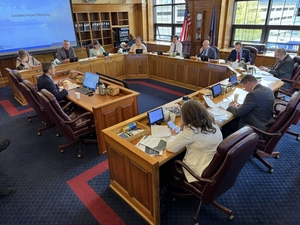
It’s not clear how much tax revenue the Google project would bring in or how much would be left on the table. County commissioners will hold a hearing June 8 to discuss their cost-benefit analysis of the incentive plan.
Amazon Data Services is set to receive personal property tax exemptions between 75% and 95% between 2028 and 2052, according to the county’s cost-benefit analysis for that project.
Those tax incentives could be worth between $244 million and $982 million depending on the number of buildings included in the project. And the county anticipates total tax revenues between $400 million and $1.8 billion. That’s including real property taxes.
In the minimum and maximum scenarios, Amazon would be paying less than half the taxes it would owe without any tax abatement.
Myers said data centers are still a good deal for constituents. He said that with the data centers bringing millions of dollars of extra revenue, schools and fire departments could roll back their personal property tax levies.
“If your budget doubles overnight, you don’t need my tax dollars anymore,” Myers said. “And when I hear from my constituents, one of the biggest things they talk about is property tax.”
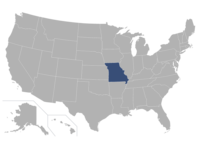
Jefferson City, MO