Trump’s firing of immigration judge delays Maine resident’s asylum decision by years
May 22, 2026 | 11:48 am ET
Description
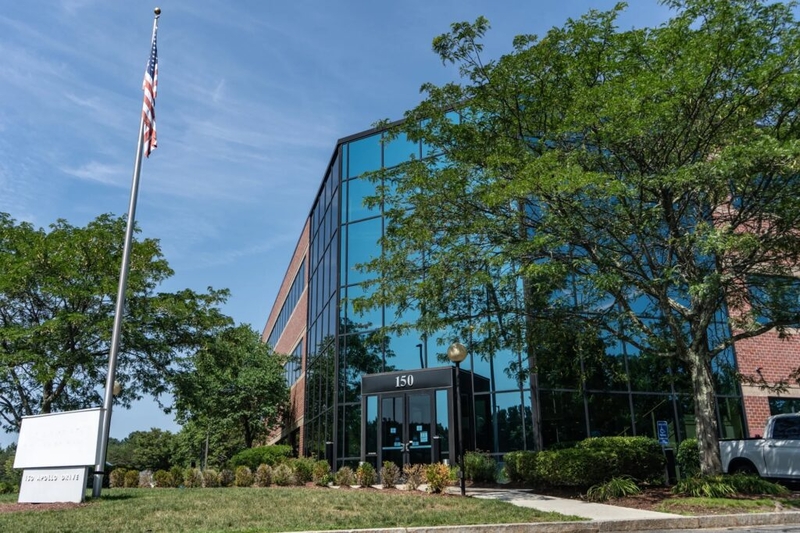
The entrance to the Chelmsford Immigration Court in Massachusetts . (Photo courtesy of Eleonora Bianchi / The New Bedford Light)
An asylum seeker in Maine was supposed to have his first hearing in court on Thursday. It’s now slated for 2028 because the Trump administration fired the immigration judge who had been set to hear his case.
“I was excited about it because I was ready to respond in my [hearing], to know the decision and how things are going to be,” said the man who spoke on the condition of anonymity out of fear of retaliation. “It’s stressful. You are ready and waiting for something, and they change and change.”
Since he was detained during the large-scale U.S. Immigration and Customs Enforcement operation in Maine in January, the man has spoken with Maine Morning Star numerous times about his ordeal in detention and securing asylum.
Though his attorney, Stephanie Marzouk, never received notice, she assumed the hearing was off when the U.S. Department of Justice in April terminated Nina Fróes, the judge who was supposed to preside over the man’s case in the Chelmsford Immigration Court in Massachusetts.
Fróes had seen her firing coming. It’s part of a pattern.
The Chelmsford court was supposed to help alleviate the backlog of cases on the overloaded Boston court, which previously covered Maine. Chelmsford had 19 judges when Fróes was appointed there in May 2024. The recent firings leave just five permanent and two temporary judges.
These are some of the more than 100 immigration judges the Trump administration has removed overall, in addition to dozens of others quitting due to discomfort with policy directives. All the while, case loads are growing for those who remain, as well as for the new “deportation judges” the administration has hired — so much so that the president himself has said it’d be impossible for everyone to get a trial.
“I don’t think that the agency at this time is interested in reducing the backlog in any way other than by ordering people removed,” Fróes said. She added, “At any cost.”
Starting in February, Fróes watched her fellow colleagues hired under former President Joe Biden receive email notices informing them they’d been terminated, without citing a reason. Immigration courts, which are civil courts run by the U.S. Department of Justice, are always at the whim of a given presidential administration.
These notices often came near the end of the two-year probationary periods immigration judges must serve before becoming permanent judges, an achievement that historically the vast majority secured. (One of the terminated Massachusetts judges is suing to get his job back, alleging the DOJ discriminated against him because of his prior legal work defending immigrants.)
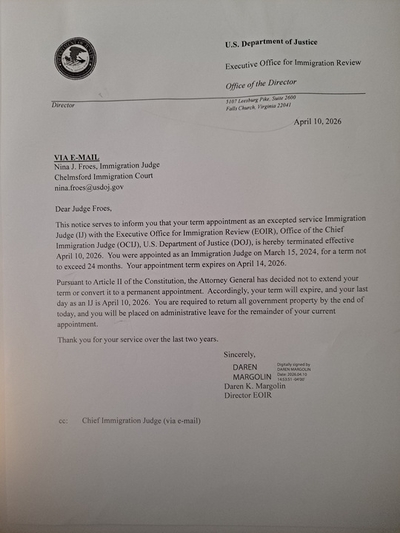
The dismissal email hit Fróes’ inbox on April 10. Her probationary period was set to end on April 14.
“My intention always was to be fair to both parties,” Fróes said. “That was always what I wanted to do. It’s always what I did, I think.”
Fróes wasn’t surprised by her dismissal, having seen the others, but she said any hope of keeping her job vanished when a decision she made that blocked the deportation of Mohsen Mahdawi, a Columbia University student who led pro-Palestinian protests, drew national attention.
“I literally treated the case like every other case,” she said, adding that she hadn’t heard of Mahdawi before his case reached her desk. She ruled that the administration failed to certify a document it wanted to use as evidence.
“The actual decision that I issued wasn’t substantive. It was procedural,” Fróes said. “They could have remedied it the next day, and we could have moved on.”
The Justice Department’s Executive Office for Immigration Review, which oversees the courts, declined to comment on the reason for Fróes’ firing, or why the Maine asylum seeker’s hearing was pushed out two years.
That master hearing — which is the first hearing in immigration court — was rescheduled for July 2028. As for finding out about that delay, Marzouk told Maine Morning Star, “Literally, as I was texting you, that’s when I realized it was rescheduled because I looked it up in the portal.”
She’s checking that case information system more now than ever as court dates, and policy, are changing rapidly under the second Trump administration. However, long wait times are not new.
When federal agents arrested the Maine asylum seeker in January, he’d already been waiting for eight years for the federal government to schedule a hearing for his case. His wife and first born child are still waiting.
They’d entered the U.S. on a visa and soon after applied for asylum, which made them “affirmative” asylum seekers able to present their cases before an immigration officer who determines eligibility without a prosecutor opposing the claim.
Instead, federal agents detained the father, despite him having no criminal record or history of being a flight risk. That detention shifted only him into a “defensive” posture, meaning he will go right to court where a denial from a judge could mean deportation with more limited opportunities to appeal under Trump.
“In the past, we would generally just be waiting for the hearing and preparing the case,” Marzouk said. “Now I do expect that there will be additional case law and policy changes and judge changes and I’m not entirely sure exactly what is coming down the pike.”
The Trump administration has already made substantial changes, both with public facing policy and through internal directives. Fróes described the pressure for judges to deny cases.
“Nothing was telling them, ‘These are the circumstances in which you should be granting relief,’” Fróes said. “Everything was framed in the negative. Every policy was framed in the negative, every email, every off the record statement from management.”
After fleeing danger, asylum seekers are getting caught in Trump’s dragnet
Some of that came in a barrage of public policy memoranda from Sirce Owen, then-acting director of the Executive Office for Immigration Review, such as one permitting judges to determine someone isn’t eligible for asylum without a hearing and criticizing judges for not efficiently managing their dockets.
“It really just set this tone of the agency seeing its own employees as the enemies almost,” Fróes said. “They really wanted to push efficiency over fairness in every case.”
The implications of these compounded policy changes on the outcome of the Maine asylum seeker’s case won’t be known for years now, but the firings extend the state of limbo he and his family have been in ever since fleeing to the U.S.
“A lot of people feel like their life is somewhat on hold,” Marzouk said of asylum seekers waiting for decisions. “This just extends that for longer. That unsettled feeling, especially in this political environment, is not something that people want to continue.”
It’s not something the Maine resident who she’s representing wants to continue.
“Still in this country, I’m worried for me and my family,” he said. “I have to wait. There’s nothing I can do.”
Augusta, ME