South Dakota senators endorse resolution asking voters to rein in lieutenant governor’s authority
Feb 24, 2026 | 8:54 pm ET
Description
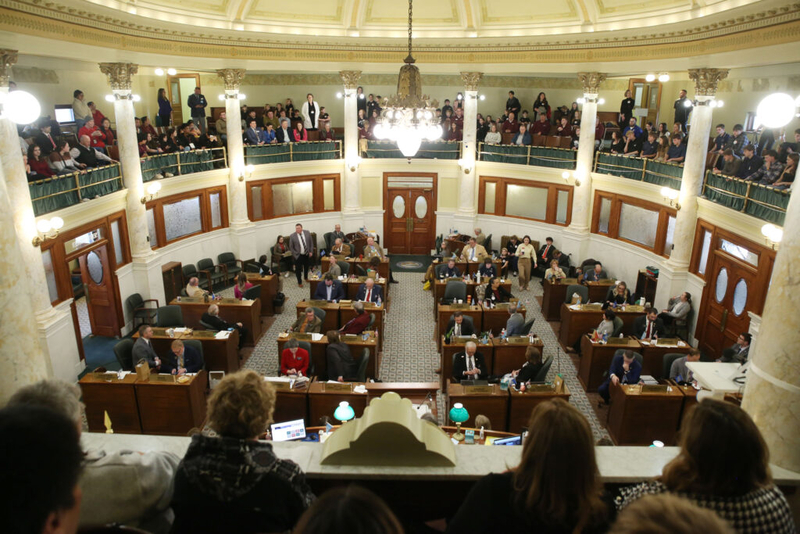
The South Dakota Senate meets on Feb. 11, 2026, at the Capitol in Pierre. (Photo by Makenzie Huber/South Dakota Searchlight)
Voters would get to decide if South Dakota’s lieutenant governor retains the right to preside over the state Senate under the terms of a resolution passed Tuesday at the Capitol in Pierre.
The state Senate voted 19-14 to pass Senate Joint Resolution 508. The resolution now moves to a House of Representatives committee for consideration.
The resolution is an outgrowth of an issue that’s emerged during the 2026 legislative session in the long-term, health-related absence of Sen. Arch Beal, R-Sioux Falls.
In order for a bill to pass the Senate, the state constitution requires a yes vote from the majority of elected senators – 18 of the 35 – not a majority of the senators in the chamber when a vote takes place.
The constitution also says the lieutenant governor, as presiding officer of the Senate, only gets a vote when members are equally divided.
When 35 members are present and vote, however, no tie is possible.
Lieutenant governor can break tie in Senate, state Supreme Court says
Earlier this year, when Lt. Gov. Tony Venhuizen resolved a 17-17 tie with a vote to pass a bill about energy transmission line permitting, Sioux Falls Republican Sen. Chris Karr challenged Venhuizen’s authority to break ties.
Karr is the Senate president pro tempore, who presides if the lieutenant governor is absent. The position of president pro tempore would be elevated to Senate president if voters take that responsibility away from the lieutenant governor.
The constitution requires a bill to have the support of a majority of senators, Karr said, and the lieutenant governor isn’t one. The Senate supported Karr.
Gov. Larry Rhoden asked the state Supreme Court to decide if the lieutenant governor can indeed break a tie. The answer, issued in an opinion released last week, was yes.
On Tuesday, Karr argued that the decision stripped the constitution’s requirement for a majority vote from all senators of any meaning.
The majority vote provision, Karr said, is meant to ensure no bill becomes law without the support of enough lawmakers to collectively represent a majority of South Dakota citizens.
“When a member is absent, the lieutenant governor’s not merely breaking a tie, they’re essentially exercising a proxy vote for that absent member’s constituents,” Karr said.
Unlike senators, Karr said, the lieutenant governor isn’t obligated to vote on bills. In the event of a tie, they can choose which ties to break, and Karr said any lieutenant governor will “likely” vote in line with the position of the governor.
“Should an executive officer, potentially at political odds with a specific district, be the one to decide a district’s will on the Senate floor?” Karr said. “That is the current reality of the Senate.”
Asking voters to change the constitution is too rash a response to the oddity of 2026’s functionally 34-member Senate, though, Mitchell Republican Sen. Paul Miskimins said.
He praised Venhuizen’s work as the chamber’s presiding officer and questioned the wisdom of putting questions on Senate operations in the hands of the electorate.
Governor asks South Dakota Supreme Court to settle state Senate tiebreaker debate
“Just reading my emails over the last few days, I really question the judgment of our public at this moment,” Miskimins said. “I think our founders and our constitution put a lot of thought into this process.”
But Sen. Kevin Jensen, R-Canton, returned to the issue of representation. Until a change that passed the Legislature in 2023, the lieutenant governor was chosen by parties at the state convention. Now, candidates for governor choose their running mate.
“Yes, they will have to be on the ballot with the governor,” Jensen said. “But in most cases, people don’t vote for the lieutenant governor. They vote for the governor. So in essence, the lieutenant governor is appointed or hand picked, and the people really have no say.”
Neither of South Dakota’s current chief executives were elected to their respective posts.
Rhoden was lieutenant governor to former Gov. Kristi Noem, who left her post in 2025 to serve in the Cabinet of President Donald Trump. Venhuizen was serving in the state House of Representatives when Rhoden selected him for the lieutenant’s post.
Rhoden is one of four men seeking the Republican nomination for governor in 2026.
Sen. Steve Kolbeck, R-Brandon, was the lead sponsor of the resolution. The resolution is not an indictment of Venhuizen, he said, but rather a matter of addressing the constitutional issue.
With at least four candidates, he said, it’s unclear who might preside over the Senate during the next legislative session in the absence of a constitutional change.
Kolbeck also pointed out that he is not running for reelection. If voters opt to change the constitution through his resolution, he said, “a new Senate, one I will not be a part of, will get to choose who they want the president to be.”

Pierre, SD